

First Impressions: A Minimalist Pre-Launch Landing Page
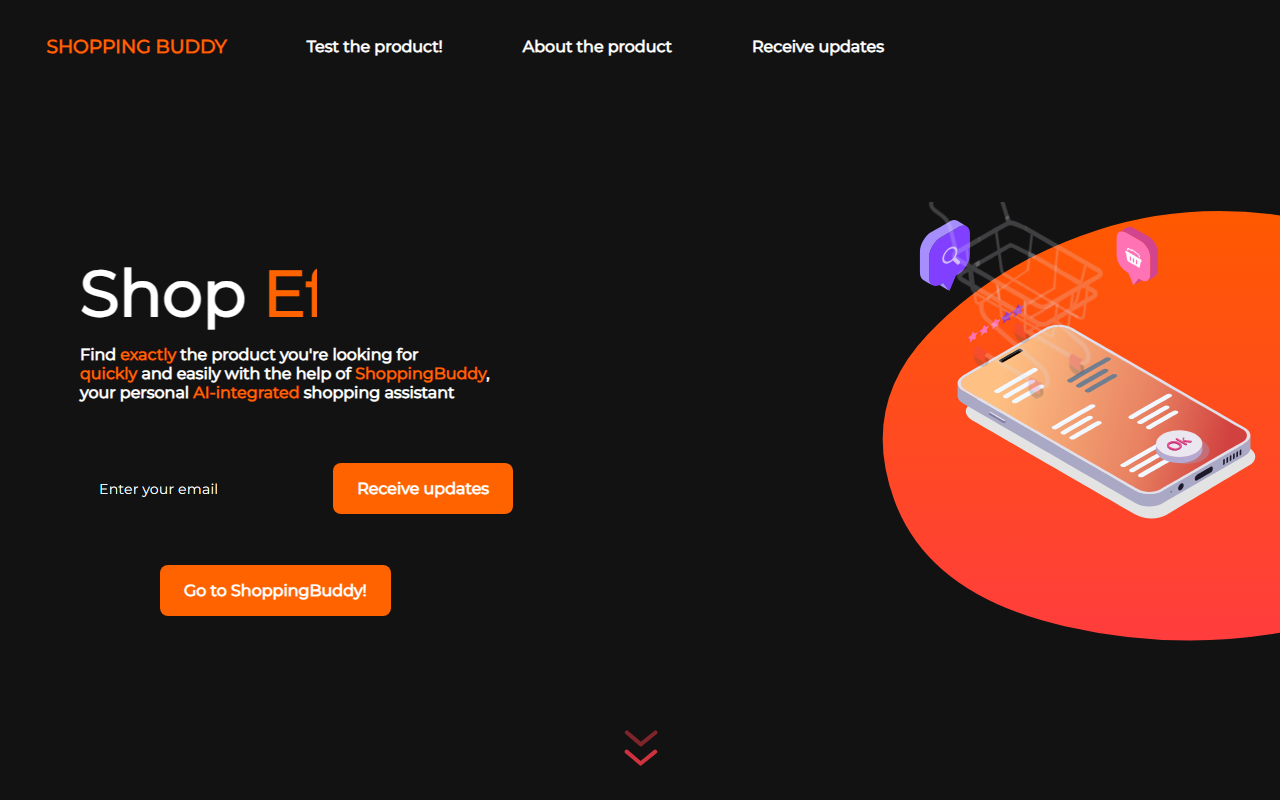
Upon visiting ShoppingBuddy’s site hosted on Netlify, I was greeted by a clean, single-page landing page that feels more like a tease than a tool. The hero section states, “Find exactly the product you’re looking for quickly and easily with the help of ShoppingBuddy, your personal AI-integrated shopping assistant.” Below that, a simple email input field invites visitors to “Receive updates” alongside a prominent “Go to ShoppingBuddy!” button—which currently leads nowhere functional. During my test, clicking that button simply reloaded the same page. The interface is minimalist, with no dashboard, no chatbot, and no actual AI interaction. The only evidence of the product’s intended features comes from four icon-and-text panels: “Stores” (works with famous online stores), “Filter” (filters best matches), “The power of AI” (integrated with largest AI models), and “Friendly chat” (shopping as easy as talking to a friend). There is no pricing, no FAQ, and no demo video. For a pre-launch site, it sparks curiosity but offers little substance for immediate evaluation.
What ShoppingBuddy Aims to Solve
ShoppingBuddy targets a familiar pain point: the overwhelming number of choices when shopping online. Instead of manually browsing through countless product listings, the assistant promises to understand natural language requests and then search across stores to present the best matches. The “power of AI” claim suggests it will leverage large language models (likely integration with GPT, Claude, or similar APIs) to interpret user intent, while the “friendly chat” aspect indicates a conversational interface similar to how you might ask a knowledgeable friend for recommendations. In theory, this could compete with tools like Perplexity’s shopping feature or Bing Copilot’s product search, but ShoppingBuddy differentiates itself by focusing exclusively on shopping and promising seamless integration with major online retailers. Unlike general-purpose AI chatbots, ShoppingBuddy aims to narrow the scope to product discovery, price comparison, and personalized filtering. The filters mentioned would ideally allow users to specify attributes like brand, price range, size, or color, making the results highly targeted. This is a compelling vision, especially for cross-border shoppers who face language barriers and confusing store interfaces.
The Technology and Integration Gap
As of now, ShoppingBuddy is purely conceptual. The website lists no technical details—no mention of specific AI models (e.g., OpenAI, Anthropic, or open-source alternatives), no API availability for developers, and no list of partner stores. Are we talking Amazon and eBay, or niche e-commerce platforms? The phrase “largest AI models” is vague; it could mean multiple AI providers or simply a generic claim. Without a working prototype, I cannot assess response quality, latency, or accuracy. Furthermore, the site offers no indication of whether it will be a browser extension, a standalone mobile app, or a web-based chatbot. For context, competitors like Komo AI (a shopping-focused search engine) or even ChatGPT’s browsing mode already allow users to ask for product recommendations, albeit with variable reliability. However, ShoppingBuddy’s focus on a “friendly chat” experience could be its edge if implemented well. The absence of pricing information is understandable for a pre-launch product, but it also implies the business model remains unknown—subscription, freemium, or ad-supported? These gaps make it impossible for me to recommend the tool today for anyone needing a working solution.
Who Is This For? And Should You Wait?
ShoppingBuddy is best suited for early adopters and tech enthusiasts eager to follow a promising AI shopping assistant from its inception. If you enjoy being on the bleeding edge and don’t mind a product that hasn’t launched yet, signing up for updates is a low-risk move. Conversely, anyone seeking a practical tool to simplify online shopping right now should look elsewhere—try Perplexity Shopping or the “Buy” feature in Google Bard’s sidebar for immediate, though imperfect, results. The strengths of ShoppingBuddy lie in its focused, user-friendly concept: a dedicated AI chat for shopping that might eventually integrate deeply with major retailers. Its limitations are clear: no product, no demo, no pricing, and an unknown timeline. Additionally, the lack of transparency about data privacy or how AI models are trained could be concerns for cautious users. In summary, ShoppingBuddy shows promise in a crowded space, but until the team releases a beta or functional prototype, it remains a placeholder. I recommend keeping an eye on the project, but hold off on any excitement—the true test will come when you can actually ask ShoppingBuddy to find you a winter coat and see if it delivers.
Visit ShoppingBuddy at https://shopping-buddy.netlify.app/ to explore it yourself.













Comments