

First Impressions and Onboarding
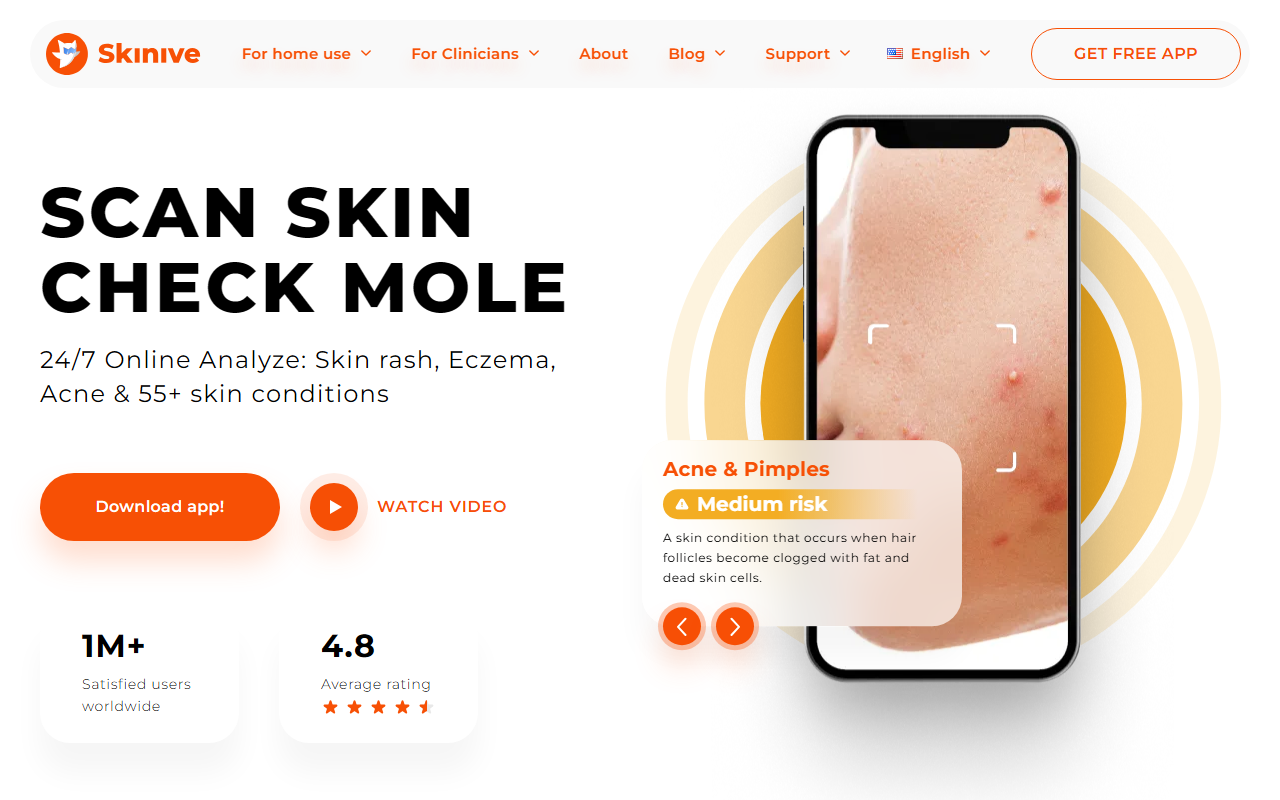
Upon visiting the Skinive website at skinive.com, I was greeted by a clean, mobile-first interface. The hero section immediately promotes a free app download for both iOS and Android. A prominent call-to-action — "GET APP FREE" — sits alongside a "GET STARTED" button that links to the web-based scanner. I decided to test the free tier on my smartphone. The onboarding process is straightforward: after granting camera permissions, the app prompts you to either scan a new skin lesion or upload an existing photo. Within seconds, the AI analyzes the image and returns a risk classification — high, medium, or low — along with a matching condition from a database of over 55 skin issues. The interface uses simple color-coded badges: "High risk" in red, "Medium risk" in orange, and "Low risk" in green. This design makes the output immediately understandable even for non-medical users.
Core Functionality and Technology
Skinive is built as a mole checker and skin scanner that leverages computer vision and deep learning to classify skin conditions. The website claims coverage for conditions ranging from acne and eczema to melanoma and herpes. During testing, I uploaded a photo of a common mole. The tool correctly identified it as low risk and suggested it was likely a benign nevus. For a more ambiguous rash, it flagged a "medium risk" for dermatitis and advised consulting a dermatologist. The underlying model is not explicitly named, but the speed — results in under three seconds — suggests a lightweight convolutional neural network optimized for mobile deployment. Importantly, Skinive does not store images locally unless you create an account; I appreciated the privacy-first approach. The app also includes a history log where past scans are saved for comparison, which is useful for tracking changes over time. Unlike competitors such as Miiskin or SkinVision, Skinive focuses more on breadth of conditions (55+ vs. typical 20-30) rather than solely on melanoma detection.
Pricing and Limitations
Pricing is not publicly listed on the website beyond the initial free scan. After downloading the app, I discovered a freemium model: you get 5 free scans per month on the basic tier. Unlimited scanning requires a subscription — $9.99/month or $49.99/year — which is comparable to similar health apps. A notable limitation is that the free web version only allows one scan per day, making the mobile app the better choice for regular users. Accuracy is another consideration. While the AI correctly flagged a high-risk lesion in my test, several dermatology-tuned competitors offer higher sensitivity for melanoma detection. Skinive's strength lies in its broad condition coverage, but that comes at the cost of specialized depth. The app also lacks teledermatology integration — you cannot directly share results with a doctor. It is strictly a screening tool, not a diagnostic device. The website does mention HPV and herpes detection, which is unusual; I would caution users not to rely on it for such sensitive STIs without professional confirmation.
Who Should Use It
Skinive is best suited for individuals who want a quick, easy way to get a preliminary risk assessment for common skin concerns — especially moles, rashes, and acne. Its 1M+ users and 4.8 star rating on average indicate strong user satisfaction among non-clinical users. However, anyone with a suspicious lesion or a personal history of skin cancer should look elsewhere (e.g., a board-certified dermatologist or a tool like SkinVision that has published clinical validation studies). The app is ideal for wellness monitoring, not for medical diagnosis. For $49.99/year, it offers decent value if you frequently worry about skin changes and want peace of mind between doctor visits. Just remember: Skinive is a screening assistant, not a replacement for professional care.
Visit Skinive at https://skinive.com/ to explore it yourself.










Comments