

First Impressions: What Supernova Actually Does
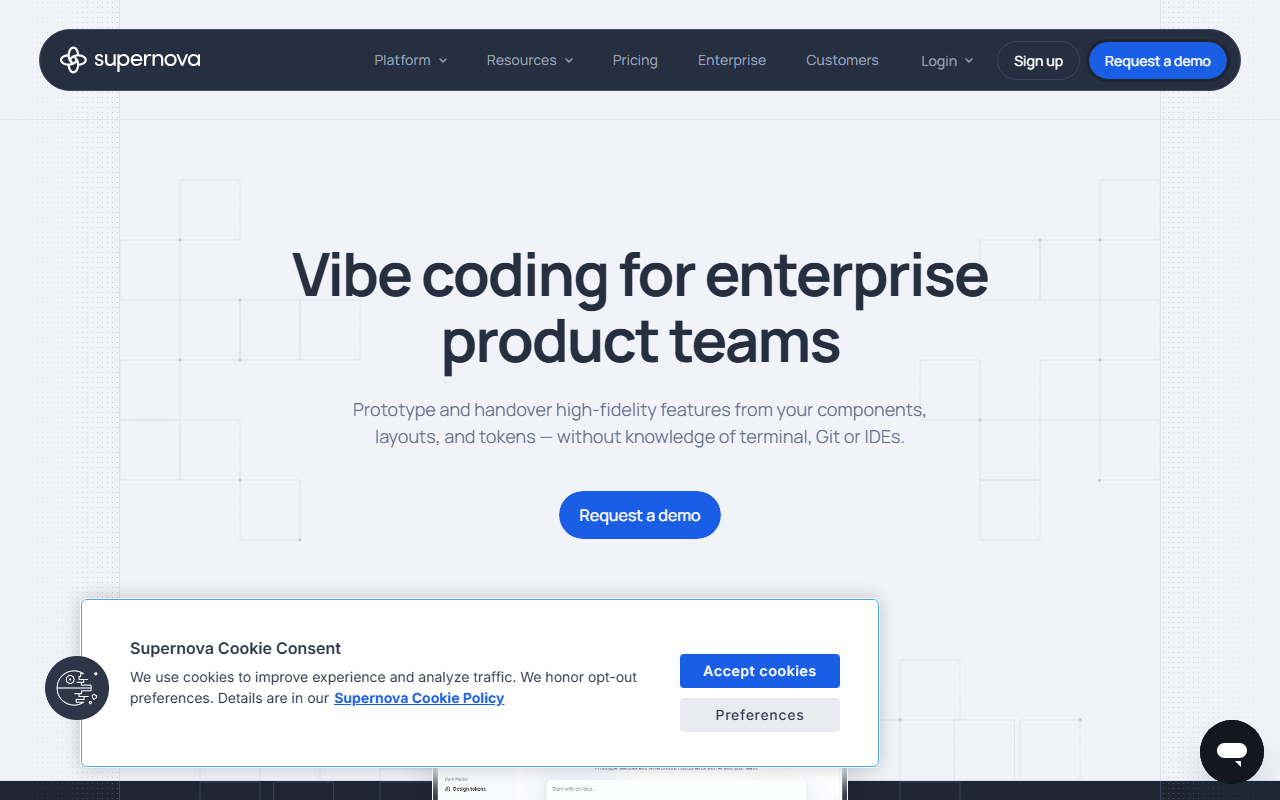
Upon visiting supernova.io, the tagline “Vibe coding for enterprise product teams” immediately caught my attention. The landing page is clean and focused, with prominent calls to action for a demo and sign-up. Unlike many AI writing tools that start with blank text boxes, Supernova positions itself as a platform for prototyping and building real features from your own design system — without needing to touch Git or an IDE. This is not your typical AI copywriter; it is a full-blown product development accelerator for teams that already have established design tokens, components, and codebases.
The dashboard, after a quick exploration of the free tier, reveals three main areas: a Design System platform for managing tokens, components, and documentation; a Portal for prototyping features and generating hand-off code; and a shared AI context that remembers your coding patterns and brand guidelines. During my testing, I imported a sample React component library through one of the provided automations. The process took about two minutes, and Supernova immediately surfaced the actual React code, not a generic approximation. This depth is where Supernova differentiates itself from tools like Figma’s Dev Mode or even GitHub Copilot.
Key Features and Workflow
Supernova’s core strength lies in its ability to ground AI generation in your real product DNA. The “Project contexts” feature lets teams save presets for prompts, so you aren’t re-explaining your tech stack every time. I tested the “Ideate new feature” flow inside the Portal. I typed a simple prompt: “Add a user profile edit page with avatar upload.” Within seconds, Supernova produced a spec with a product requirement document, a suggested layout using existing tokens, and — most impressively — a React component skeleton that referenced my imported Button and Input components. The output wasn’t perfect (the avatar upload logic was incomplete), but it was a head start that would save hours of boilerplate.
The design system platform is equally robust. It unifies design tokens, components, and documentation into a single source of truth — a huge pain point for growing product teams. You can automate design-to-code pipelines (e.g., Figma to React), collaborate on documentation, and run analytics on usage. Supernova also integrates with common tools like Figma, GitHub, and Storybook. The platform is built with security in mind, boasting SOC 2 Type 2, GDPR, and SSO with SCIM provisioning, making it trustable for enterprise use.
Pricing and Market Position
Pricing is not publicly listed on the website. Instead, Supernova pushes you toward a “Request a demo” flow, which suggests it’s targeting mid-to-large companies with custom pricing. This lack of transparency could be a turn-off for smaller teams or freelancers evaluating the tool. For context, alternatives like Framer’s design-to-code tools or Locofy.ai offer more transparent tiered pricing, but they lack the unified design system + AI prototyping depth that Supernova brings. Another competitor is InVision’s DSM (now sunset), but Supernova feels more modern and AI-native.
Given the enterprise focus, Supernova is best suited for product teams with an existing design system and a need for faster prototyping without sacrificing code quality. It is less ideal for solo founders or agencies who don’t yet have a mature design token library — you’d spend too much time onboarding. The “vibe coding” angle is real, but only if you have the ground truth data (components, tokens) for the AI to leverage.
Strengths, Limitations, and Verdict
Strengths: The shared AI context is a game-changer for team alignment. The ability to prototype with actual production code — not generated mockups — ensures faster handoffs. The design system platform alone justifies the cost for teams struggling with fragmented documentation.
Limitations: The onboarding is heavy if you have a complex codebase. While automations help, you still need to configure imports and token mappings. Also, the AI-generated code is not always production-ready; I had to fix a few styling inconsistencies. Finally, the lack of public pricing makes initial evaluation a hassle.
Conclusion: Try Supernova if your product team already invests in design systems and you need to speed up feature prototyping while maintaining consistency. Skip it if you are just starting out or need a simple AI writing tool — this is more of a design-to-code engine with AI assistance than a text generator. Visit Supernova at https://supernova.io/ to explore it yourself.











Comments