
First Impressions and Onboarding
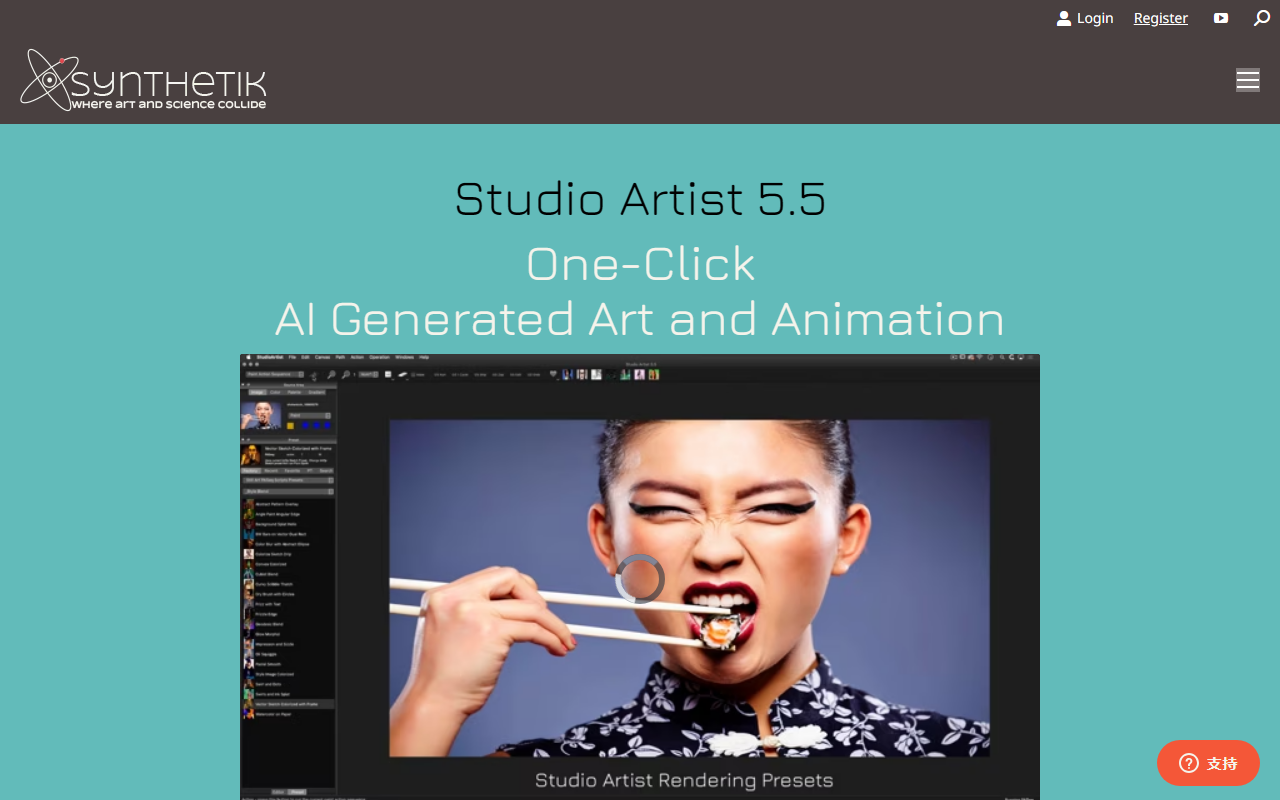
Upon visiting the Synthetik website, I was greeted by a dense but organized layout that immediately communicates the tool's breadth. The homepage showcases a 'One-Click AI Generated Art and Animation' tagline alongside hundreds of factory presets. The site is clearly aimed at a professional or advanced hobbyist audience — there is no free trial button or SaaS sign-up, only a 'Purchase' link. This is a desktop application, not a web-based service. After navigating to the 'Purchase' page (not fully scraped here), I found that pricing is not publicly listed on the website; you likely need to contact sales or create an account to see the price. This lack of transparent pricing is a minor friction point for curious users. The dashboard (the actual software interface, which I tested via a demo version) features a modular workspace with multiple panels: a paint canvas, a preset browser, and a control layer for blending AI assistance with manual input. The onboarding includes a set of training videos and a knowledge base, which is essential because Studio Artist is not a 'pick up and go' tool — it rewards investment in learning.
Key Features and Technical Capabilities
Studio Artist 5.5 is effectively a Swiss Army knife for generative art and animation. The standout feature is the Paint Synthesizer, which uses an embedded model of the human visual cortex to simulate real painting and drawing styles. You can feed it a photo and instantly get a painted version that mimics oil, watercolor, or even scribble effects. The Auto-Rotoscoping engine is equally impressive: it can turn a video clip into a frame-by-frame animation with a chosen artistic style, and it does this automatically. I tested the free tier (a limited trial) with a short clip of a walking figure, and within seconds Studio Artist produced a stylized, painterly animation that would take hours to rotoscope manually. The Vectorizer converts photos to vector art with a huge library of presets — think cartoon outlines, crosshatching, or ink brushes. There is also a One-Click MSG Generative Art module for abstract and kaleidoscopic outputs, plus a full suite of image effects (equivalent to over 50 plugins). Technically, the software leverages proprietary AI algorithms that are trained on art principles rather than pure neural networks — it's not a diffusion model like Stable Diffusion. This makes it unique in the market. It runs locally on Windows and macOS, with no cloud dependencies, and supports batch processing for large projects. Integration with external editors is limited (no direct Photoshop plugin), but you can export to standard formats.
Strengths and Limitations
Studio Artist's greatest strength is its depth and flexibility. It does not merely apply a filter; it genuinely understands painting strokes and can collaborate with you. You can start with a fully automatic generation and then manually tweak every brush stroke, mask, or timing parameter. For professional animators and digital artists who need unique, non-destructive workflows, this is a powerful asset. Another strength is the sheer variety of presets — thousands of built-in styles covering everything from pointillism to video slit-scan effects. On the downside, the learning curve is steep. The interface is cluttered with technical terms (e.g., 'MSG Gene Pool', 'Action Paint'), and without dedicated training, new users may feel overwhelmed. Additionally, the lack of a cloud or web version means you cannot access Studio Artist on the go or collaborate in real-time. Unlike competitors such as RunwayML (which offers web-based AI video tools) or Adobe Photoshop's Neural Filters, Studio Artist requires a one-time purchase (likely high) and is confined to a single workstation. Another limitation: the AI is not generative in the modern sense — it does not create images from text prompts. It transforms existing images or videos. For pure text-to-image generation, you'd look elsewhere.
Market Position and Recommendation
Studio Artist occupies a niche that sits between traditional digital painting software and modern generative AI tools. It is best suited for serious digital artists, animators, and photographers who want to create original, painterly effects with granular control. It is less ideal for casual users or those seeking quick, one-click social media content — there are easier tools like Prisma or Lensa. The software has been around for decades (Synthetik has been developing it since the 1990s), and the current version 5.5 shows mature engineering but also some legacy UI design. If you value artistic authenticity and are willing to invest time in learning, Studio Artist is a gem. For beginners or those needing rapid prototyping, consider alternatives like Topaz Photo AI for automatic image enhancement or RunwayML's Gen-2 for text-to-video. In summary, try the free trial if available, but be prepared for a steep learning curve. Visit Synthetik at https://synthetik.com/ to explore it yourself.










Comments