

First Impressions: A Gentle Onramp to NLP
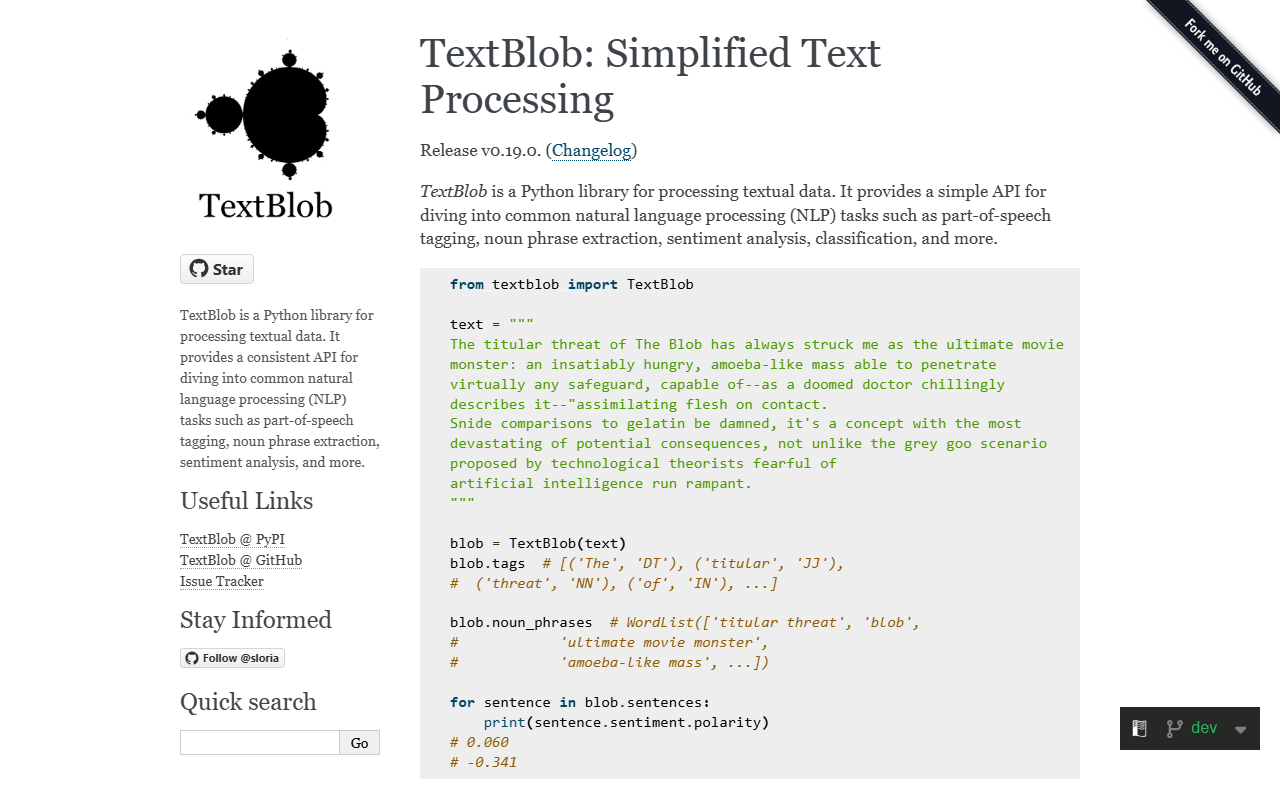
Upon visiting the TextBlob documentation site, I was struck by how straightforward the onboarding feels. The landing page drops you directly into a code example — a snippet showing sentiment analysis on a movie review — which immediately communicates the tool’s purpose. There is no flashy dashboard or sign-up wall; instead, you get a clean, documentation-driven experience that reflects TextBlob’s identity as a developer tool. The library is installed via a simple pip install -U textblob command, followed by downloading corpora with a single Python module call. Within minutes, I was running sentiment analysis on sample text, and the output was clear: polarity scores for each sentence. The API feels intuitive, especially if you’re already comfortable with Python. The use of a TextBlob object that behaves like a string but adds NLP methods is a smart design choice.
Technical Deep Dive: What TextBlob Actually Does
TextBlob is a Python library for common NLP tasks. It is not a cloud API or a full-fledged platform; it is a local, open-source package built atop NLTK and Pattern. Under the hood, it leverages these heavyweight libraries but wraps them in a consistent, high-level API. Key features include part-of-speech (POS) tagging, noun phrase extraction, sentiment analysis (polarity and subjectivity), classification (Naive Bayes, Decision Tree), tokenization, n-grams, word inflection (pluralization/singularization), lemmatization, spelling correction, and WordNet integration. I tested the sentiment analyzer on a few custom sentences, and the default model returned reasonable polarity scores, though it lacks fine-grained emotion detection. The library also supports extensions for custom models and languages, but those require extra work. One concrete interaction: I used blob.sentences to iterate over sentences and extracted their sentiment scores, which worked flawlessly. The documentation includes a full API reference, a Quickstart tutorial, and guides for building text classifiers. For developers who prefer working offline or want to avoid API costs, TextBlob is a solid choice.
Pricing and Ecosystem
TextBlob is completely free and open-source under a MIT license. There are no paid tiers, no hidden costs, and no usage limits. You can download it from PyPI or GitHub. The library is stable (current version 0.19.0) and maintained by Steven Loria and contributors. Because it runs locally, you don’t need an internet connection after the initial corpus download. This makes it ideal for prototyping, education, and small-to-medium projects. However, compared to cloud services like Google Cloud Natural Language or AWS Comprehend, TextBlob lacks scalability — it runs on your machine, so large datasets require significant memory and processing time. Also, the sentiment model is relatively basic and may not perform well on domain-specific or nuanced texts. There is no built-in support for deep learning models; if you need state-of-the-art transformer models, you’d look to libraries like Hugging Face Transformers or spaCy (which is also local but more modern). TextBlob’s strength is simplicity, not performance.
Who Should Use TextBlob — and Who Shouldn’t
Strengths: Ease of use, excellent documentation, zero cost, and tight integration with Python’s ecosystem. It’s perfect for beginners learning NLP, for quick prototypes, or for small-scale projects where accuracy is not mission-critical. Academics and hobbyists will appreciate the straightforward API.
Limitations: The default models are outdated compared to modern deep learning approaches. Sentiment analysis is limited to polarity and subjectivity — no emotion detection or aspect-based sentiment. The documentation, while clear, is not as rich as spaCy’s or NLTK’s. No active community forum (only GitHub issues). No real-time inference support or deployment tools.
Alternatives: For more advanced NLP, consider spaCy (faster, supports transformers) or Hugging Face Transformers (cutting-edge models). For a cloud-based alternative, Google Natural Language API offers high accuracy but costs money.
Final Verdict: TextBlob is best suited for Python developers who want to add simple NLP capabilities to their projects without learning complex libraries or paying for APIs. It excels in educational settings and for quick experiments. If you need production-grade accuracy or handle large volumes, look elsewhere. I recommend trying TextBlob if you are new to NLP or need a lightweight solution — you’ll have it running in five minutes.
Visit TextBlob at https://textblob.readthedocs.io/ to explore it yourself.











Comments