

First Impressions and Onboarding
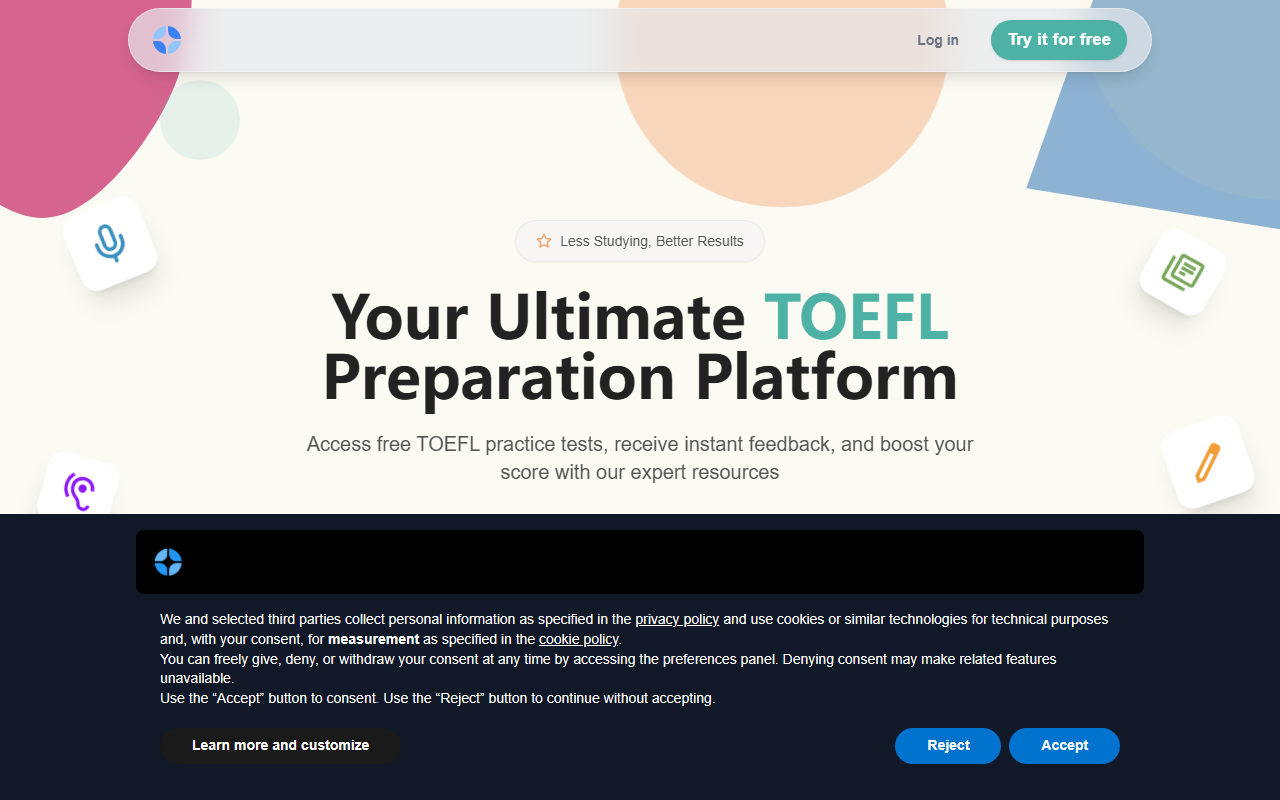
Upon visiting TOEFLPractice.io, I was greeted by a clean, modern landing page that immediately communicates the platform’s core value proposition: free TOEFL practice tests with instant AI feedback. The hero section displays a counter showing 67k+ active users, 200+ universities, and 50+ practice tests—impressive numbers that lend credibility. I clicked the “Start Practicing Free” button without signing up, and the site prompted me to create an account before accessing the test. The registration process was straightforward, requiring only an email and password. Once logged in, the dashboard presented a simple four-tab layout for Writing, Speaking, Listening, and Reading practice. The interface is uncluttered, with clear navigation and a timer for each section. I decided to test the Writing section first.
AI-Powered Grading and Feedback Quality
The Writing practice opens with a prompt and a 20-minute countdown. I wrote a short essay response—about 200 words—and clicked “Submit Answer.” Within seconds, the AI returned a score (99 in my case) and a breakdown across Reading, Listening, Speaking, and Writing. The feedback was surprisingly detailed: it highlighted grammar issues, suggested vocabulary improvements, and evaluated essay structure. This instant grading is the platform’s standout feature. According to the site, the system “uses AI-powered grading to evaluate responses in Speaking and Writing sections, closely mimicking the official TOEFL scoring system.” Compared to official ETS prep materials, which require manual scoring or paid evaluation, this is a significant time-saver. However, I noticed that the feedback, while accurate, felt slightly generic—it didn’t pick up on nuanced argument flaws the way a human tutor might. Still, for self-study, it’s remarkably effective.
Test Format and Preparation Tools
The platform explicitly states its tests are “updated for the new 2026 TOEFL iBT format.” I verified this by looking at the reading passages and question types: they matched the current ETS blueprint, including academic texts and inference questions. Each section provides separate practice modules. The Reading and Listening sections offer multiple-choice questions with immediate right/wrong answers, while Speaking requires recording your voice and getting AI analysis on pronunciation and fluency. A progress tracking feature shows your improvement over time via a simple chart. The site also includes a “Real TOEFL Test Environment” mock test that simulates the actual exam conditions. One limitation: the free tier appears to give you only a limited number of full tests—I encountered a prompt to upgrade after completing three—but the pricing page is hidden behind a sign-in wall; I could not find any public pricing tiers on the site. The FAQ confirms that AI scoring is instant, which is great for iterative practice.
Market Positioning and Verdict
TOEFLPractice.io competes with established players like Magoosh and ETS’s official TOEFL iBT practice. Unlike Magoosh, which bundles video lessons and study schedules, this platform focuses purely on practice tests and AI feedback—making it ideal for test-takers who already know the format but need rapid skill assessment. The 35% average score increase claim (from the site) is bold but plausible given the volume of practice. The platform feels best suited for self-motivated students who want to drill specific sections and get instant corrections. However, it lacks comprehensive video tutorials or live tutoring, so absolute beginners might need supplementary resources. Also, without transparent pricing (publicly not listed), it’s hard to assess long-term value. Strength: lightning-fast AI grading aligned with 2026 format. Limitation: feedback can lack depth on high-level essay reasoning. Recommendation: try the free tests first—if instant scoring accelerates your prep, consider the paid plan for full access.
Visit TOEFLPractice at https://toeflpractice.io/ to explore it yourself.










Comments