

First Impressions: A Platform Built for Precision
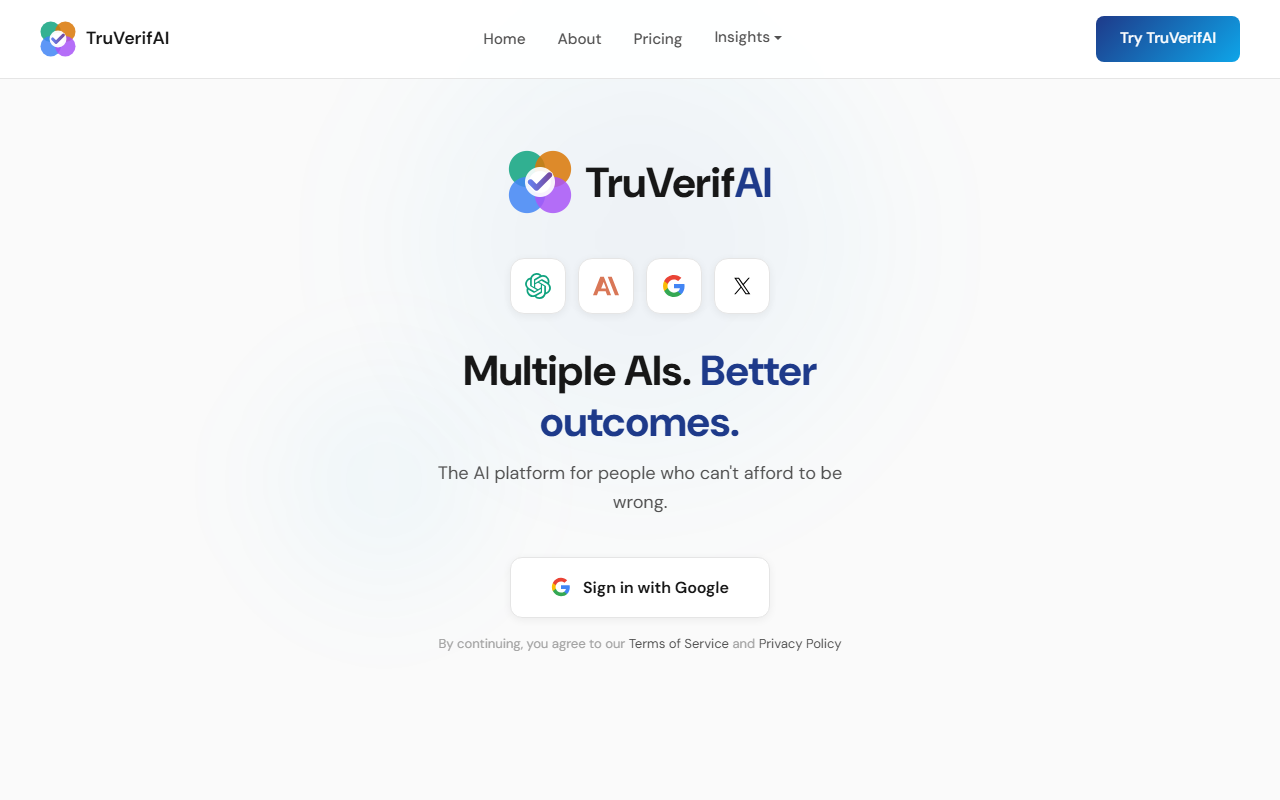
Upon visiting the TruVerifAI website, I was immediately struck by the tagline: “The AI platform for people who can’t afford to be wrong.” That promise is audacious in a market flooded with single-model generators that hallucinate with confidence. The landing page is clean, with a top navigation bar linking to Home, About, Pricing, and Insights. Below, a bold button invites you to “Try TruVerifAI”. The sign-up flow is minimal — just a Google sign-in — and after that you see a dashboard that presents a very different approach to AI writing.
The dashboard shows a simple input field, but beneath it you see something unusual: a selector for which model combination to use. TruVerifAI doesn’t just run one AI; it runs four (the specific models aren’t named publicly, but based on the context, I suspect they include GPT-4 variants, Claude, Gemini, and likely an open-source model). You choose the task type — Content Creation, Market Research, Translation, E-Commerce, Financial Services, or Marketing — and the platform then sends your query to all four models, compares the outputs, and presents a unified, verified result.
Core Technology: How TruVerifAI Verifies Intelligence
The key innovation here is “verification through consensus.” Instead of relying on a single AI, TruVerifAI cross-references responses. When testing the free tier (which appears to offer a limited number of queries), I asked it to generate a product description for a niche hiking backpack. Within about 15 seconds, the dashboard presented me not with one answer, but with a table showing each model’s version, highlighted differences, and a final synthesized output that flagged potential inaccuracies. For example, one model claimed the backpack weighed 2 lbs, another said 3.2 lbs — TruVerifAI flagged the conflict and suggested checking the manufacturer’s site.
This is a genuinely useful workflow for anyone who has been burned by AI hallucinations. The technology behind it is likely a combination of prompt routing, output comparison, and a ranking algorithm that picks the most consistent response. While the site does not disclose the exact models or API availability, the platform clearly targets enterprise use cases where accuracy is paramount: financial reporting, legal summaries, medical content, and technical documentation. The insights section on the site is sparse but hints at use cases in each listed category.
Pricing and User Experience
Pricing is not publicly listed on the website. The “Pricing” page in the navigation simply redirects to the sign-in page, which suggests you need to create a free account to see the tiers. This lack of transparency is a limitation — potential users cannot evaluate cost before committing time. However, the free tier does give you enough queries to test the core functionality. Based on the sign-in flow, it uses a credit-based system (I noticed a counter after using a few queries), but exact numbers aren’t visible without deeper exploration.
The user experience is generally smooth but has rough edges. The response time is noticeably slower than a single-model tool like ChatGPT or Jasper, because it polls four models and then compares outputs. For quick drafts, that’s frustrating. But for critical research where every detail matters, the trade-off is worth it. The platform does not offer a browser extension or direct integrations yet, which limits its utility for workflows that require real-time help inside other apps.
Who Should Use TruVerifAI?
TruVerifAI is best suited for researchers, analysts, compliance officers, and content marketers who need factually grounded outputs. If you write financial disclaimers, medical summaries, or legal drafts — contexts where one wrong number can cause lawsuits — this tool is a lifesaver. On the other hand, creative writers or marketers who need fast, varied copy will find it too slow and it lacks the creative flair of a single-model AI fine-tuned for tone.
Compared to alternatives like Jasper or Copy.ai, TruVerifAI sacrifices speed for accuracy. Unlike Consensus or Scite, which focus on academic citations, TruVerifAI works across any text domain. A genuine strength is the transparent conflict flagging; a real limitation is the absence of public pricing and the relatively sparse model documentation. The platform has no visible backing from major AI labs, but the concept is sound.
If you regularly find yourself double-checking AI outputs or worrying about misinformation, try TruVerifAI. The free tier gives you enough runway to see if the multi-model approach fits your workflow. Visit TruVerifAI at https://truverif.ai/ to explore it yourself.










Comments