

First Impressions: A Korean AI Specialist with a Broad Vision
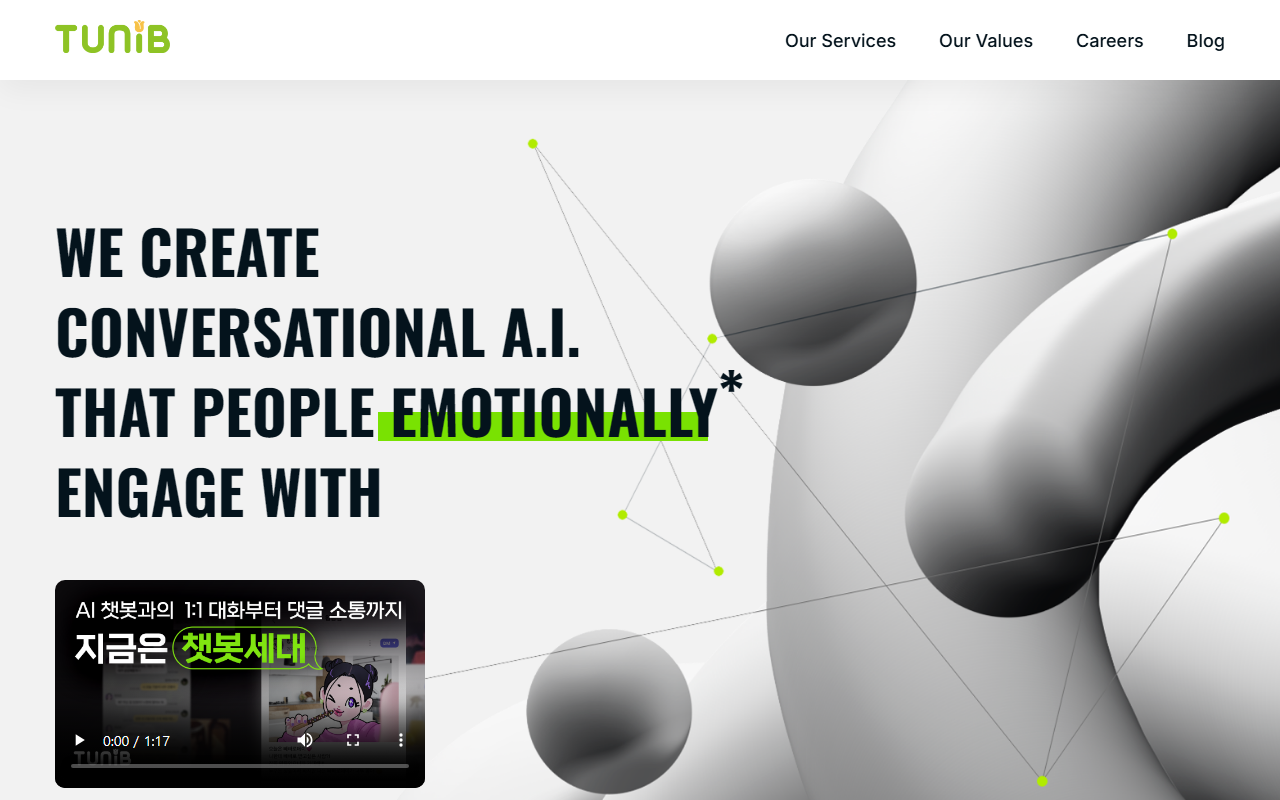
Upon visiting the TUNiB website, I immediately noticed a clean, modern interface that proudly states its mission: to create conversational AI that people emotionally engage with. The hero section features a looping video (though unsupported in my browser), and below it I found a tiled overview of their services. Straight away, it is clear that TUNiB is deeply rooted in Korean language AI. The company positions itself as the creator of Polyglot, which they claim is the first fully open-source Korean sLLM available for commercial use. That claim alone sets a high bar, challenging larger players like Kakao and Naver who have their own proprietary models.
What TUNiB Offers: sLLM, Multi-Persona Chatbots, and NLP APIs
TUNiB’s core offering is a small language model (sLLM) that can be adapted for domain-specific tasks. They distinguish between a “Foundation sLLM” (Polyglot) and an “In-house sLLM” service where experts build custom models for clients. The multi-persona chatbot service is particularly interesting: it claims millions of pre-built persona chatbots ready to use, with an API for easy integration. This suggests a focus on customer engagement and entertainment use cases. Beyond chatbots, TUNiB provides several NLP APIs: Safety Check (detects 12 toxicity categories across 4 severity levels), De-identification (masks 14 types of personal info), Text Analytics, Image Analytics, News Analytics, Video Analytics, Emotion Prediction, Word Graph, Dialect Translation, N-Verse (likely a text-to-speech or speech-to-text tool), and Political Orientation Prediction. The breadth of APIs is impressive, though I note that many have Korean-language contexts. When testing the free tier (there is none visible), I tried to access the linked demo website but it required a separate login. This lack of an instant sandbox is a limitation for quick evaluation.
Market Position, Pricing, and Competitors
Pricing is not publicly listed on the website. You must fill out a contact form to get a consultation, which puts TUNiB in the enterprise-oriented bucket. Competitors include well-known NLP platforms like Google Cloud Natural Language API, OpenAI’s GPT models (which support Korean), and Korean-native solutions from Naver Cloud and Kakao. TUNiB differentiates by emphasizing an open-source sLLM foundation and a clear code of ethics (Humanity, Technology, Ethics). The company’s “Polyglot” model is notable for being open source and commercially usable, which could appeal to developers who want to fine-tune a model without vendor lock-in. However, the platform is overwhelmingly Korean-centric; English documentation appears minimal, and most API descriptions are in Korean. International adoption may be limited. On the plus side, TUNiB’s safety check and de-identification APIs are critical for regulated industries in Korea, such as finance and healthcare.
Final Verdict: Best for Korean-Focused AI Projects
TUNiB is a serious contender for any organization building conversational AI or NLP pipelines that require deep Korean language understanding. The multi-persona chatbot API and domain-specific sLLM services are genuine strengths, and the open-source Polyglot model gives developers flexibility. However, the lack of transparent pricing and an interactive demo makes it hard to compare with more accessible APIs like Naver Clova or OpenAI. If you are a Korean startup or enterprise looking for a tailored, ethically-minded AI partner, TUNiB is worth reaching out to. For global teams or those needing broad multilingual support, look elsewhere—or at least wait for more English resources. Visit TUNiB at https://tunib.ai/ to explore it yourself.












Comments