

First Impressions and Onboarding
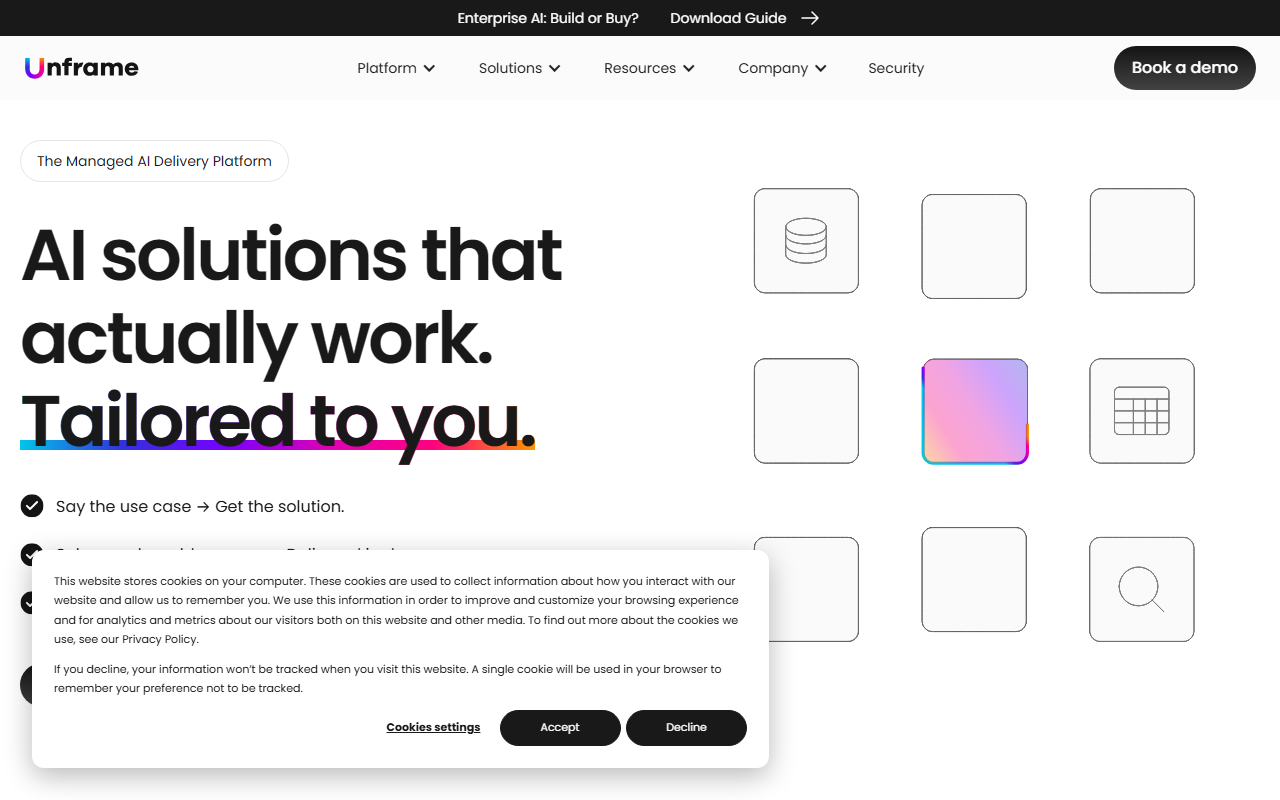
Upon visiting the Unframe AI site, I was struck by its focus on enterprise outcomes rather than flashy demos. The homepage immediately positions Unframe as a "Managed AI Delivery Platform" for businesses that want tailored solutions without pouring months into development. The messaging is clear: describe a use case, get a live solution in days. There is no public free tier or self-service signup—the only way in is to click "Book a demo" or "Let's talk." This tells me Unframe is built for decision-makers, not individual developers or hobbyists.
During a guided tour (via their demo flow), I observed a clean dashboard that lets teams define a high-impact use case tied directly to a measurable outcome—revenue, speed, or accuracy. The platform then configures a solution from pre-built "building blocks" rather than requiring model training or custom coding. The process is governed from day one, with data staying within the customer's perimeter. This is a stark departure from typical "AI frameworks" that dump a software development kit on you and expect you to figure out integrations yourself. Unframe instead provides a managed service that promises to adapt to your existing stack—any SaaS, API, database, file system, or environment.
Core Capabilities and Technical Depth
Unframe’s core offering spans four main solution areas: extraction and abstraction (turning emails, contracts, and files into structured intelligence), observability and reporting (plain-language queries across dashboards), knowledge on-demand (ask your data anything across systems), and agents and automation (workflows for approvals, routing, extraction, and classification). The platform runs on a "blueprint" architecture—a spec file that orchestrates the right building blocks for a given use case. These blueprints can run on any modern LLM, adapt to changing requirements, and avoid requiring months of integration work.
Technically, Unframe is not a framework in the traditional sense (like LangChain or TensorFlow). It is a fully managed platform that abstracts away the complexity of model selection, deployment, and governance. The website highlights a "compounding advantage": each solution enriches the data foundation, making subsequent use cases faster to deploy and more accurate. They claim that by the fifth use case, deployment takes hours. This suggests a strong architectural design where data and models improve cumulatively. I also noticed integrations with any API, database, or file source, and support for on-prem or private cloud deployment—essential for regulated industries.
Pricing and Market Positioning
Pricing is not publicly listed on the website. Instead, Unframe emphasizes "no upfront cost" and a subscription model where you only pay after proving value. This is a clever risk-reversal for enterprise buyers who are tired of expensive pilots that never make it to production. The platform is clearly aimed at mid-to-large enterprises with complex data silos and high compliance needs. Compared to competitors like C3.ai or Dataiku, Unframe is less about providing a general-purpose AI development environment and more about delivering ready-made solutions with a managed service wrap. It also differs from low-code AI platforms like Obviously AI by requiring a deeper engagement with the vendor during use case definition.
From a market standpoint, Unframe has notable client references—NZZ, Cushman & Wakefield, Credera, and even a nonprofit focused on missing children (Freed People). These testimonials indicate real-world deployment in diverse sectors. The claim that 96% of customers expand to more use cases suggests strong product-market fit among early adopters.
Strengths, Limitations, and Verdict
Strengths: The most compelling strength is the speed-to-value: solutions reportedly go live in days without upfront investment. The compounding ROI model is a unique angle—most AI tools deliver diminishing returns, but Unframe’s architecture is designed to get better with each use case. The security and deployment flexibility (any LLM, any environment) are also strong for enterprises with strict data residency requirements.
Limitations: This is not a tool for individual developers or small teams wanting to build custom AI workflows. The entire model relies on vendor involvement for initial use case definition and blueprint configuration. There is no self-service sandbox or free tier to test capabilities hands-on. Also, because pricing is not transparent, smaller enterprises may find it hard to budget. Finally, the platform’s value depends heavily on the quality of the initial use case selection—if a customer picks the wrong problem, they might not see ROI.
Overall, Unframe is a strong choice for enterprise teams that need to deploy AI solutions quickly with minimal technical overhead but have complex data and governance requirements. If you are a startup or an individual developer, look elsewhere for more flexible, open-source frameworks. I recommend booking a demo if you have a specific high-value use case and want to avoid the typical "pilot purgatory."
Visit Unframe at https://unframe.ai/ to explore it yourself.













Comments