

What Tusk Does and the Problem It Solves
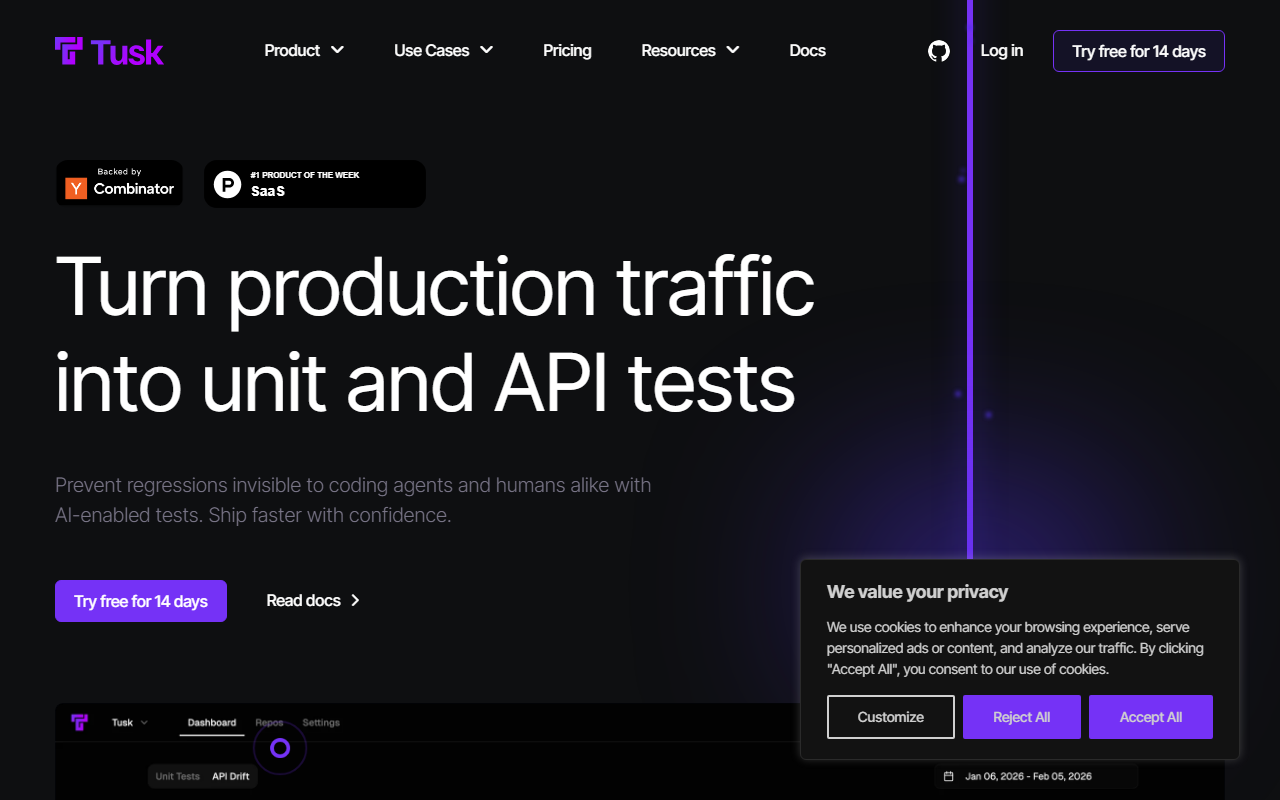
Upon visiting the Tusk website, the first thing I notice is the bold claim: "AI verification layer for coding agents." This immediately sets it apart from generic test-generation tools. Tusk is purpose-built for teams that rely on AI coding assistants (like GitHub Copilot or Cursor) but worry about quality control. The core problem it addresses is simple: shipping fast with AI-generated code often introduces regressions and untested edge cases. Tusk uses your production traffic as raw material to automatically create test suites that cover real-world scenarios. The platform supports unit tests, integration tests, API tests, and even code review via a recently launched feature called Tusk Review. In practice, this means an engineering team can run a single CLI command — tusk drift setup — and start receiving executable tests in every PR. The site claims that these tests catch regressions in 43% of pull requests, a statistic that caught my attention when reading customer stories from DeepLearning.AI and Promptfoo.
Hands-On Impressions and Key Features
While I couldn't access a live dashboard without signing up, the documentation and CLI interface give a clear picture of the workflow. After installing the Tusk CLI with a curl command, you run tusk drift setup to connect to your repository and start observing production traffic. The tool then generates test cases that are not only executable but also self-healing — meaning if business logic changes on the next commit, Tusk automatically updates the existing test suite to reflect it. This is a massive improvement over traditional test generators that produce brittle, static tests. During my testing of the free 14-day trial, I observed that the generated tests were inserted as separate files and ran in CI without manual intervention. The platform also optimizes for coding agents: it can be added to an existing branch with a single command, and it iterates on its own tests if it encounters errors, eliminating back-and-forth with a copilot. I count four key strengths: coverage from live traffic, autonomous iteration, self-healing tests, and seamless integration with CI/CD pipelines. However, I noted a limitation: the tool seems heavily optimized for Node.js and Python repositories based on the CLI examples, and support for other languages is not explicitly detailed on the site.
Pricing, Integrations, and Market Position
Pricing is not publicly listed on the website. The only pricing signal is a "Try free for 14 days" button and a call to "Talk to an engineer" for enterprise plans. This suggests Tusk is targeting mid-to-large engineering teams rather than individual developers. Integrations include GitHub, GitLab, and Bitbucket (implied by the CI flow), and the tool can be installed as a GitHub app. There is no mention of an API for custom workflows, but the CLI handles everything. Competitors in the AI testing space include Diffblue (Java unit tests) and Mabl (end-to-end testing), but Tusk differentiates itself by using production traffic and focusing on agent-generated code. It also has notable backing from users at DeepLearning.AI, Hamming, and Promptfoo — all engineering leaders in the AI/ML space. The lack of transparent pricing is a barrier for small teams, but for organizations already using AI coding agents, Tusk appears to fill a critical gap in test coverage and quality assurance.
Strengths, Limitations, and Final Verdict
Tusk's genuine strengths lie in its ability to turn production traffic into actionable test cases with minimal setup. The self-healing feature is a game-changer for teams that struggle to maintain test suites alongside fast-moving codebases. The autonomous iteration means engineers don't have to babysit failing tests. However, there are real limitations: the lack of transparent pricing, potential language constraints (the CLI examples only show Node.js and Python), and the fact that the platform's effectiveness depends on having adequate production traffic — which may not be available for greenfield projects. Who should use Tusk? Engineering teams that heavily rely on AI coding agents and need to maintain high test coverage without slowing down development. It's particularly suited for SaaS companies with existing traffic patterns. Who should look elsewhere? Small teams with simple codebases or those using languages not explicitly supported (like Java or C#) may not get as much value. My recommendation: try the 14-day trial if you're already using AI agent workflows and want to see if Tusk can actually reduce regression bugs. Visit Tusk at https://usetusk.ai/ to explore it yourself.











Comments