

First Impressions: From Valispace to Requirements Portal
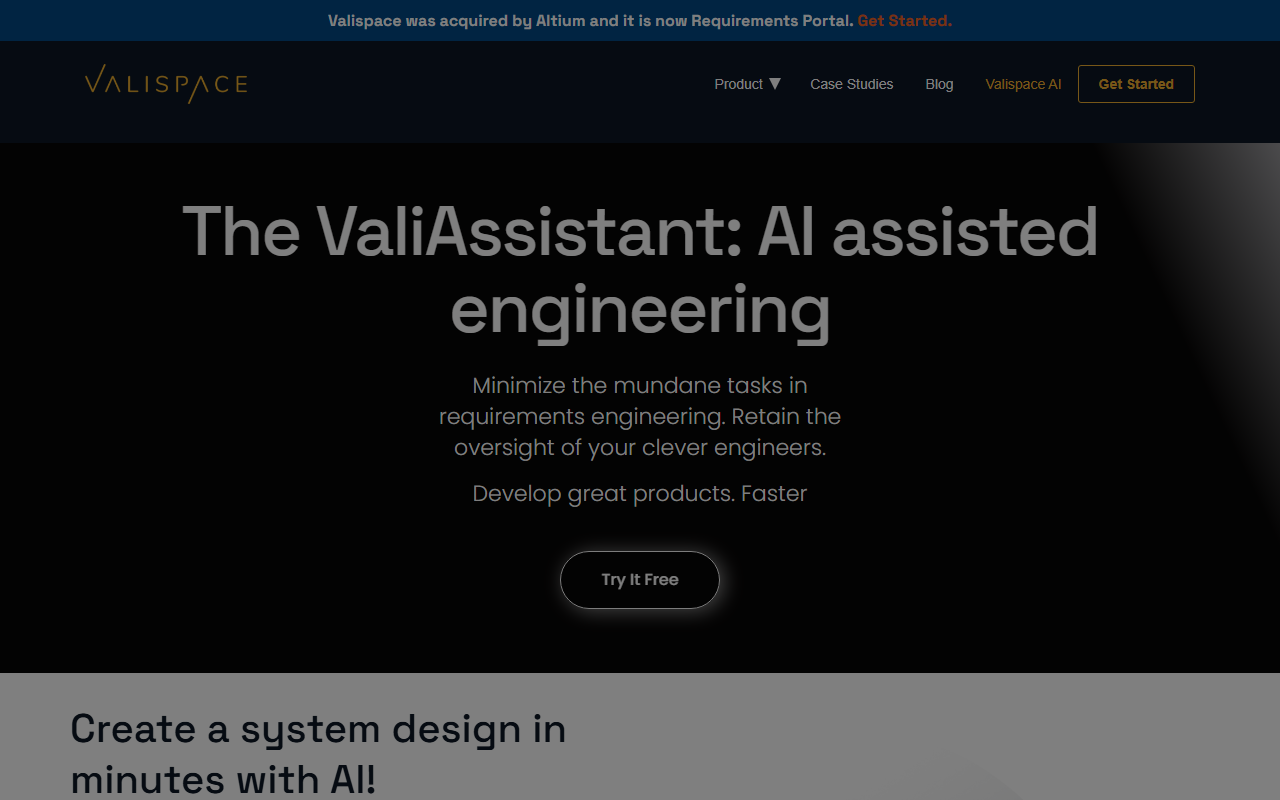
Upon visiting the website, the first thing I noticed is the prominent banner: "Valispace Has Evolved into Requirements Portal." The platform has been acquired by Altium and integrated into the Altium ecosystem, now functioning primarily as a requirements management tool within Altium Develop. The transition is more than a rebranding; it’s a strategic move to embed systems engineering capabilities directly into electronic design automation (EDA) workflows. The dashboard no longer showcases a standalone tool but instead emphasizes a seamless connection to Altium design tools. For anyone accustomed to the older Valispace interface, the shift is significant, but the core philosophy remains: help hardware teams specify, design, verify, and review complex products with full traceability.
Core Features and AI Integration
Valispace (Requirements Portal) is built around the classic engineering V-model. The website outlines four stages: Specify Product, Design System, Verify Product, and Review & Converge. In the Specify phase, you capture requirements and link them to system design, tests, and reports. The Design phase lets you run trade-off analyses by seeing the impact of changes across the whole system. For verification, the platform automates checks and background calculations, eliminating manual document updates. Finally, the Review phase supports real-time collaboration and removes redundant documentation. What sets this tool apart today is the introduction of Assisted Engineering with Valispace AI. The site promises that AI removes "mundane and manual engineering tasks." While the exact AI models aren’t disclosed, likely they leverage natural language processing to parse requirements, suggest links, or flag inconsistencies. When I explored the AI section, a “Try It” button leads to a free trial, suggesting the AI features are actively being deployed. Unlike generic text tools like Notion AI or GitHub Copilot, Valispace focuses specifically on engineering contexts: handling budgets, constraints, and verification logic. Competitors such as Jama Software or IBM DOORS Next Generation are more traditional, often without embedded AI assistants. Valispace’s AI edge could reduce the time engineers spend on clerical tasks like updating requirements relationships or running trade-offs.
User Experience and Market Position
The website presents a clean, modern layout with key statistics: “100% of engineers using Valispace” (likely a curated metric) and a customer support rating of 9.5/10 on G2. Setup time is claimed to be 15 minutes, which is aggressive for systems engineering tools. A case study from Clearspace, a space debris cleanup company, highlights how Valispace enabled real-time communication, cross-disciplinary access, and single-source engineering data management. This example underlines the tool’s value for complex hardware projects involving multiple engineering specialities. Pricing is not publicly listed on the website. Instead, users are directed to start a free 30-day Altium Develop evaluation to experience Requirements Portal. This suggests pricing is now bundled with Altium subscriptions, which may be a consideration for teams not already using Altium. The integration is both a strength—deep ties to EDA tools—and a limitation. Teams that rely on mechanical CAD (e.g., SolidWorks) or non-Altium ECAD might find the coupling restrictive. The tool appears best for electronics-heavy development where Altium is the standard, but less ideal for purely software-driven or non-electronics hardware projects.
Strengths, Limitations, and Who Should Use It
The primary strength of Valispace (Requirements Portal) is its holistic view of the hardware development lifecycle, enhanced by AI-assisted engineering. I appreciate how it collapses the traditional silos between requirements, design, and verification. The real-time collaboration and background calculations are genuine time-savers. However, the major limitation is the dependency on the Altium ecosystem. Standalone Valispace is no longer available; you must adopt Altium Develop to use the new Requirements Portal. This may lock out teams with different tool stacks. Additionally, the AI features are intriguing but still appear early-stage; I have not observed any public benchmarks or detailed documentation on model accuracy. Another limitation is the lack of public pricing transparency—teams cannot easily evaluate cost without a sales interaction. Who should try this tool? Hardware engineering teams that already use Altium or are considering a switch to Altium Develop. It is especially suited for companies building complex electro-mechanical systems (aerospace, automotive, robotics) where traceability and concurrent engineering are critical. If you are a pure software team or a hardware group using only mechanical CAD tools, look elsewhere—perhaps at Jama or Polarion. For those in the Altium ecosystem, the free 30-day trial is a no-brainer to see how AI-assisted engineering can streamline your workflow.
Visit Valispace at https://valispace.com/ to explore it yourself.










Comments