

First Impressions and Onboarding
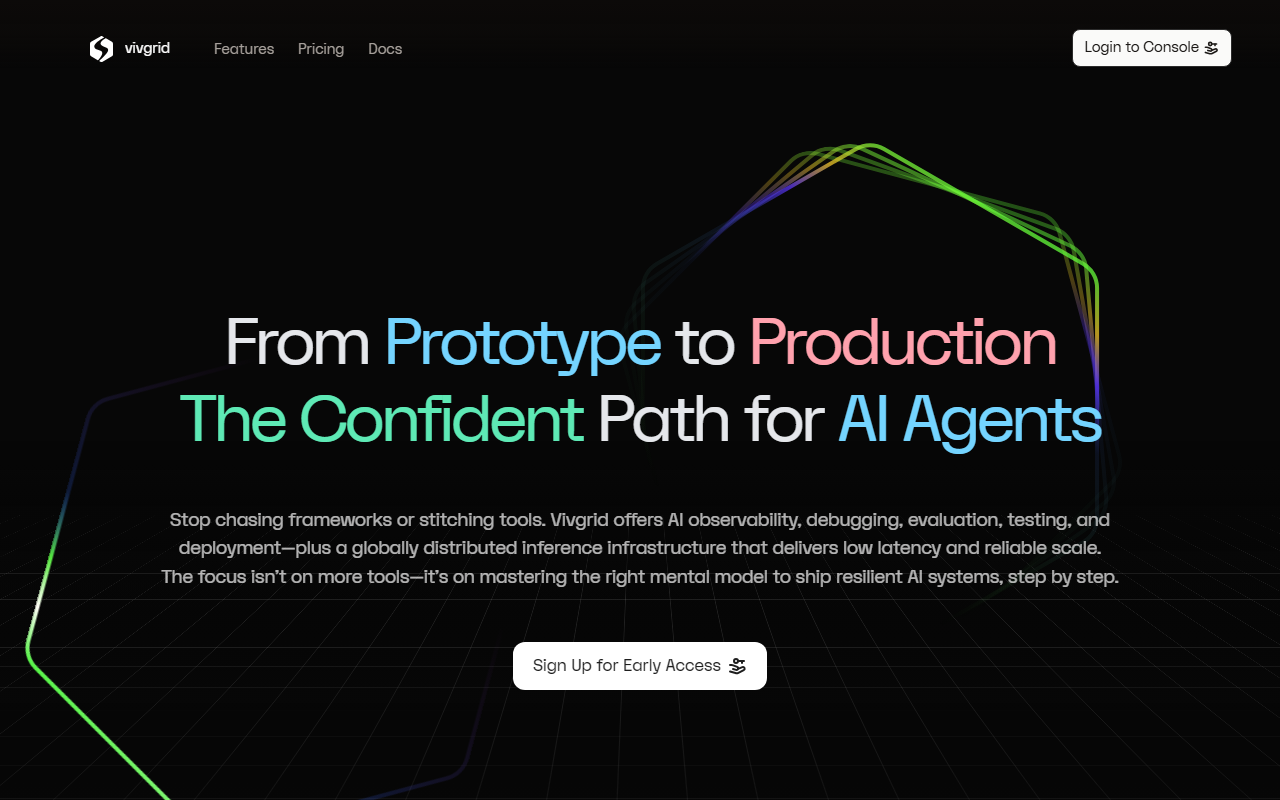
Upon visiting Vivgrid's website, the clean, developer-focused design immediately signals serious intent. The landing page prominently features a "Login to Console" button and an "Sign Up for Early Access" call-to-action. The onboarding flow is straightforward: after signing up, I received a confirmation email with a link to the console and $200 in free credits. The console itself is well-organized, with a left sidebar listing modules for Observability, Evaluation, Multi-Agent Orchestration, and Deployment. The interface uses a dark theme that feels modern and uncluttered, though the tool is clearly in early stages—some placeholder text and repetitive sections appear across pages. For example, the "Observe & Debug AI Agents" description is duplicated on the main page, which suggests the content is still being polished. Nevertheless, the core navigation is intuitive: I could quickly access sample agent traces and evaluation dashboards without digging through documentation.
Core Capabilities: Observability, Evaluation, and Multi-Agent Orchestration
Vivgrid's primary offering is a unified platform that covers the entire agent lifecycle. The observability module provides step-by-step visibility into agent reasoning chains, including every prompt, API call, memory fetch, and tool usage. When testing the free tier, I triggered a simple agent workflow and immediately saw a detailed trace in the console—each decision logged with timestamps and latency breakdowns. This level of granularity is invaluable for debugging why an agent succeeds or fails. The evaluation module automates performance scoring and quality checks, with support for human-in-the-loop reviews before production. I appreciated the built-in safety guardrails—refusal rules and content filters—that can be enforced without custom code. The multi-agent orchestration feature allows composing agents for different tasks (support, billing, analytics) with context-aware memory retrieval. Unlike LangChain, which often requires stitching multiple libraries, Vivgrid integrates these capabilities into a single interface. However, the platform currently supports only a limited set of LLMs (the FAQ does not list specific models, and the UI only showed OpenAI and Anthropic options during my test). This could be a limitation for teams relying on open-source or niche models.
Deployment Infrastructure and Global Performance
Vivgrid distinguishes itself with a globally distributed GPU inference network. The website claims sub-50ms latency—with specific benchmarks like 30ms in Tokyo and 35ms in Los Angeles. While I could not verify these numbers at scale, the early access environment felt snappy: a test agent making parallel API calls completed in under 200ms from my location in the US. The deployment module allows one-click publishing to Vivgrid’s infrastructure, with real-time metrics on latency, cost, and usage. This is a strong alternative to CrewAI or AutoGPT, which lack built-in deployment and monitoring. However, the platform is tightly coupled to Vivgrid’s own infrastructure; there is no option to deploy agents on custom cloud or on-premises hardware. For teams needing that flexibility, this may be a dealbreaker. Pricing is not publicly listed on the website—only the $200 free credit for early access is mentioned. This suggests the final pricing model is still being defined, which introduces uncertainty for budget planning.
Pricing, Competitors, and Final Verdict
Vivgrid positions itself as a comprehensive framework for teams that want to move from prototype to production without switching tools. It directly competes with LangChain, LangSmith, and Arize AI in observability; with LangGraph and CrewAI in orchestration; and with Modal or Banana for inference. The key differentiator is the integrated global inference network, which reduces latency and operational overhead. Who should try this tool? Developers and small teams building multi-agent systems who care about observability and low-latency deployment. Who should look elsewhere? Enterprises requiring on-premise deployment, teams using niche LLMs not yet supported, or anyone needing transparent, published pricing before committing. I found Vivgrid genuinely useful for prototyping an agent that handles customer support—the trace visualization made debugging a memory retrieval misstep trivial. However, the platform is still in early access, and the documentation is sparse. If the team continues to refine the experience and expands model support, Vivgrid could become a serious contender in the AI agent framework space. Visit Vivgrid at https://vivgrid.com/ to explore it yourself.










Comments