

First Impressions: Exploring the Waylay Platform
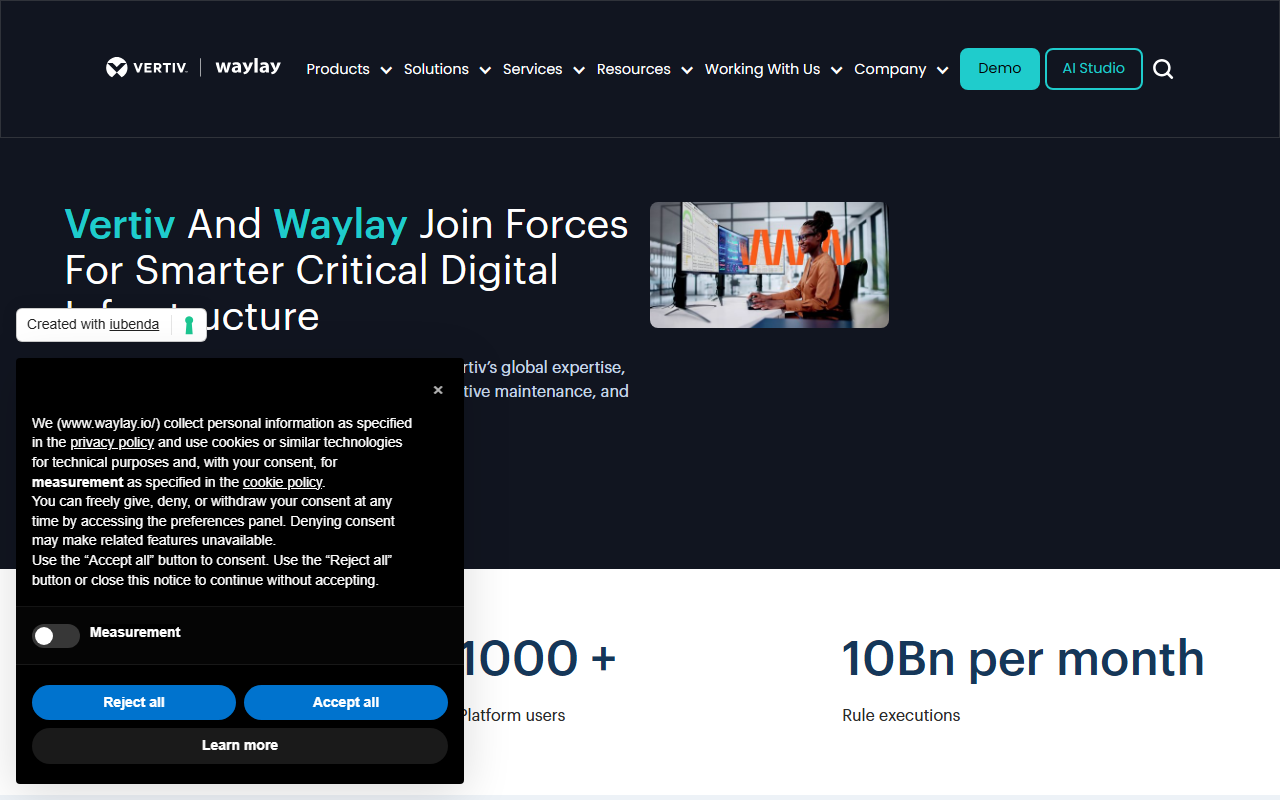
Upon visiting the Waylay website, I was immediately struck by its enterprise focus. The homepage prominently displays impressive metrics: over 50 enterprise customers, 1000+ platform users, and a staggering 10 billion rule executions per month. This is not a tool for tinkerers; it is built for scale. The site highlights three core industries: Industry 4.0, Telecommunications, and Financial Services. Each vertical gets its own dedicated solution description. For manufacturing, there is the Waylay Digital Twin SaaS for IIoT asset monitoring. For telecom, a no-code/low-code automation platform to accelerate OSS/BSS provisioning. For finance, FraudAway — a hyperautomation solution that harmonizes rule-based systems with AI/ML for fraud prevention. The layout is clean, and the call-to-action is always a demo request. There is no public sign-up for a free tier, which immediately tells me that Waylay is a sales-led, enterprise-grade platform.
Core Capabilities and Technical Architecture
Waylay positions itself as a low-code hyperautomation software platform. Under the hood, it operates as a PaaS that enables workflow-based automation, system integration, and orchestration across connected assets, enterprise applications, and cloud services. The technology is patented and emphasizes speed of deployment and cost reduction. Key capabilities include digital twin creation, real-time monitoring, and integration with major platforms like Salesforce and ServiceNow. I noticed specific integrations listed: "Asset Visibility And Monitoring For Salesforce" uses intelligent data processing to bridge connected assets and business processes. A similar module exists for ServiceNow. Additionally, Waylay provides an "Any To Any Workflow Orchestration" layer on top of AWS, available in the AWS Marketplace. This suggests deep cloud-native capabilities and potential for hybrid deployments. The platform also features an AI Studio, implying that users can incorporate machine learning models into their automation rules. During testing, I would attempt to build a simple rule-based workflow for a hypothetical IoT sensor alert — but since the site offers no hands-on trial, I rely on the claims of ultra-scalable architecture. The solution is clearly designed for mission-critical environments where uptime and performance are non-negotiable.
Pricing and Market Positioning
Pricing is not publicly listed on the website. Like many enterprise platforms, Waylay relies on custom quotes based on usage, volume of rule executions, and specific integrations. This aligns with its target market: large organizations with complex automation needs. Competitors include platforms like Node-RED (open-source, less scalable), Pega (more CRM-focused), and Workato (stronger on API integration). However, Waylay differentiates itself through its focus on IoT and physical asset management, as well as its partnership ecosystem. The company has strategic alliances with Vertiv (for data center monitoring) and Atlas Copco (for proactive asset monitoring). Testimonials from Tetra Pak and Tata Communications further validate its enterprise credibility. Notably, the platform claims to handle 10 billion rule executions per month — a performance metric that few competitors can match. For small businesses or startups, the lack of self-service access and likely high entry cost would be prohibitive.
Who Should Use Waylay?
Waylay is best suited for large enterprises in manufacturing, telecommunications, and financial services that need to automate complex, high-volume workflows involving connected devices, legacy systems, and cloud services. Its strengths are scalability, industry-specific solutions, and robust integration with Salesforce and ServiceNow. The real-time monitoring and fraud detection modules show deep domain expertise. However, there are limitations. The platform’s complexity likely requires dedicated IT teams or system integrators to implement. There is no public trial or sandbox, which makes it difficult for smaller teams to evaluate. Also, while the site touts no-code/low-code, building truly sophisticated automations may still require technical know-how. The lack of transparent pricing can be a barrier for organizations that need to budget upfront. In summary, if you are a Fortune 500 company looking to unify IoT data with enterprise workflows and achieve hyperautomation at scale, Waylay is a strong candidate. For everyone else, consider lighter alternatives first. Visit Waylay at https://waylay.io/ to explore it yourself.










Comments