

First Impressions and Onboarding
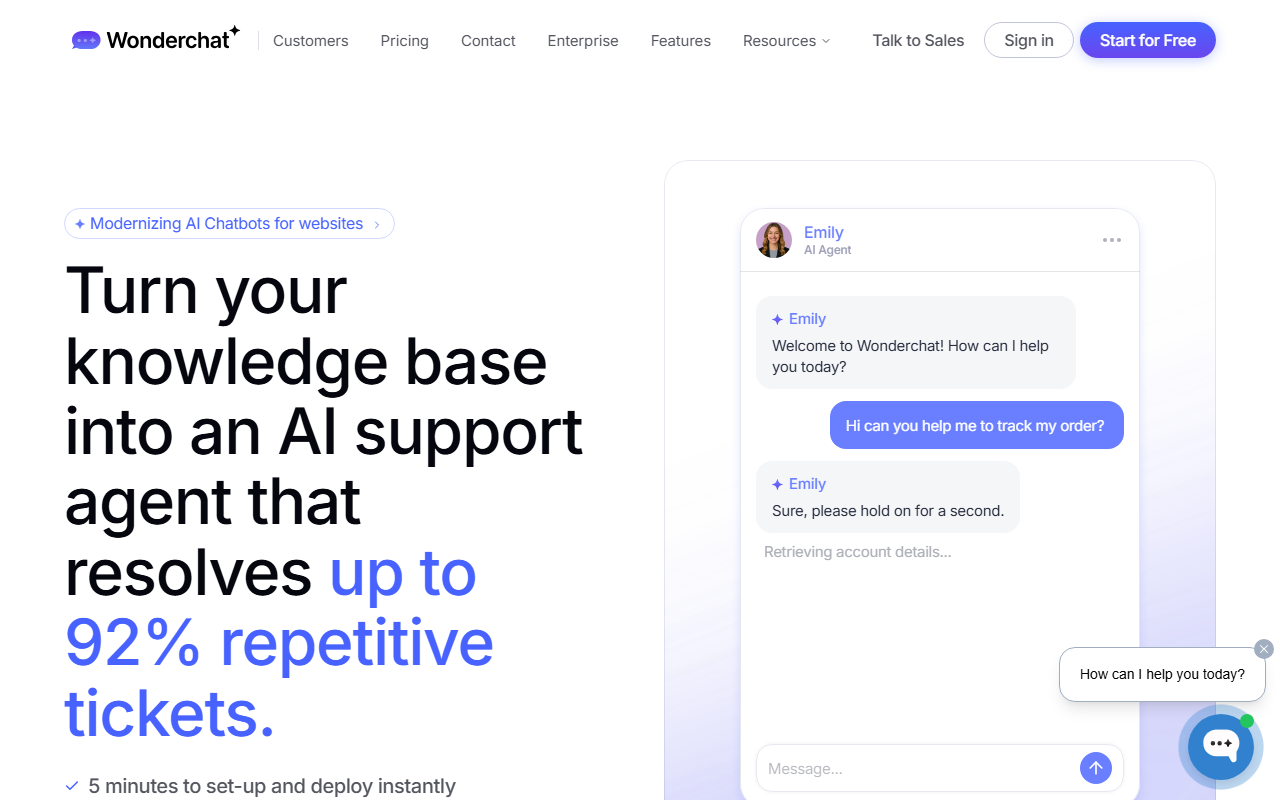
Upon visiting the site, a demo chatbot immediately pops up with a friendly welcome. I tested it by asking to upgrade to enterprise, and it quickly retrieved mock account details and offered to charge $480/year. This fluid interaction gives a taste of what the final product can do. The onboarding is remarkably streamlined: Wonderchat claims a five-minute setup, and the dashboard reflects that philosophy. After signing up with no credit card, I was guided to upload PDFs, add URLs, or connect helpdesk systems like Zendesk. The interface is clean and well-organized, with a left sidebar for configuration and a preview pane showing how the chatbot behaves in real time.
Core Features and Capabilities
Wonderchat shines in its ability to train on multiple data sources simultaneously. You can feed it documentation in all common file formats, index entire websites, and sync automatically with your knowledge base. I uploaded a few product PDFs, and within minutes the chatbot was answering specific questions with citations. The platform lets you customize the agent's tone, role, and even write custom instructions, so the bot can match your brand voice. What truly impressed me is the choice of underlying models: you can pick from OpenAI, Claude, Gemini, Mistral, Llama, Deepseek, and more, and swap them without any lock-in. The analytics dashboard tracks resolution rates, top queries, and knowledge gaps, giving you clear ROI metrics. There's also built-in human escalation: if the bot can't answer, it can hand off to a ticketing system like Zendesk or Freshdesk automatically. For advanced automation, Wonderchat supports multi-step workflows with conditional branching.
Pricing, Compliance, and Market Positioning
Pricing is not publicly listed on the website. The demo hints at an enterprise tier at $480/year, but the exact plans are only revealed during sign-up. This lack of transparency could frustrate potential buyers who want to evaluate costs upfront. That said, the free tier lets you test the full functionality, and the platform is SOC 2 certified and GDPR compliant, which is reassuring for businesses handling sensitive data. Compared to alternatives like Intercom's Fin or Zendesk Answer Bot, Wonderchat positions itself as a more flexible, no-code solution with broader model support. It appeals strongly to SMBs and teams that need a quick, self-service chatbot without deep technical integration.
Trusted by over 1,000 businesses, the testimonials highlight up to 70% reduction in support tickets. But I noticed that while the basics are easy, building truly complex, multi-step workflows may require understanding the conditional logic builder. Also, the voice and phone AI agent feature is only included in the Turbo plan, not the free tier, so advanced omnichannel support comes at a premium.
Strengths, Limitations, and Final Verdict
Wonderchat's biggest strength is its ease of use combined with enterprise-grade compliance and model flexibility. You can be up and running in under ten minutes with a fully trained agent. The analytics are genuinely useful for optimizing your knowledge base. However, the opaque pricing is a notable limitation, and users with very niche or highly technical queries may find the bot occasionally lacks depth.
I recommend Wonderchat for small to medium e-commerce or SaaS teams that want to automate common support queries without hiring developers. If you need deep customization or have extremely complex support flows, consider testing the free tier first to see if it meets your needs. For most businesses, Wonderchat offers a compelling balance of speed, accuracy, and control.
Visit Wonderchat at https://wonderchat.io/ to explore it yourself.










Comments