

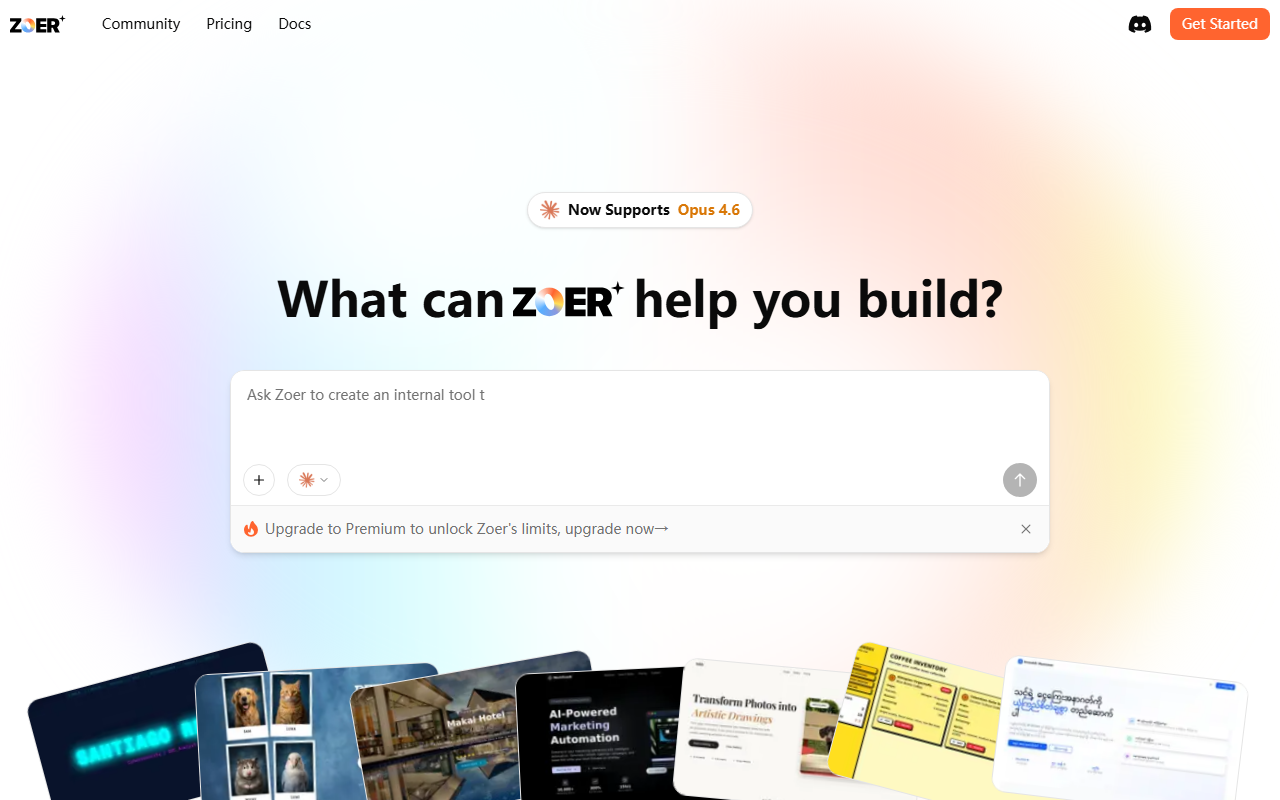
First Impressions of Zoer’s Landing Page
Upon visiting the Zoer website, I was greeted by a strikingly sparse homepage. The headline reads “Now Supports Opus 4.7” and a single input field asks “What can help you build?” — no lengthy documentation, no demo videos, not even a clear description of the tool’s capabilities. The only other navigation point is an “Upgrade to Premium” link that suggests the free tier is deliberately limited. This minimalism is either a bold statement of confidence or an oversight; as a reviewer, it made me cautious.
I expected more onboarding context, especially for a tool that claims to turn ideas into full applications. The site mentions “Zoer | App Builder - Turn Your Idea Into a Full Application” in metadata, so the core proposition is clear: use AI to generate complete applications from natural language descriptions. The mention of Opus 4.7 refers to Anthropic’s Claude Opus model, suggesting Zoer leverages Anthropic’s most powerful model for code generation.
Features and Technology Under the Hood
Zoer’s value proposition is straightforward: you describe an app idea, and Zoer builds the entire application for you. This is not a code-snippet generator — it aims to produce runnable, full-stack applications. Based on the site’s sparse copy and the reference to Opus 4.7, I infer that Zoer uses Claude Opus to interpret user prompts and generate the necessary code, likely including frontend, backend, and configuration files.
Compared to alternatives like Replit’s Ghostwriter or GitHub Copilot, Zoer focuses on app-level generation rather than line-by-line autocompletion. This could be a time-saver for rapid prototyping or for non-developers who want to create a functional app without writing code. However, without access to the actual product (the free tier appears to be restricted to basic usage), I cannot confirm the output quality, supported frameworks, or deployment options. The lack of an API or integration documentation is notable — most developer tools offer at least a REST API or CLI.
User Experience and Pricing Reality
When I attempted to use the free tier, the interface redirected me to an upgrade prompt without showing any sample output. This is frustrating: there is no sandbox or interactive demo to evaluate Zoer’s capabilities before committing. Pricing details are not publicly listed on the website — only “Upgrade to Premium” buttons with no prices. This opacity erodes trust, especially compared to transparent pricing from competitors like Replit ($25/month for Pro) or GitHub Copilot ($10/month for individuals).
The onboarding flow is virtually nonexistent. After clicking the upgrade link, you are taken to a page that still lacks pricing tiers. It is possible that Zoer is in a very early beta stage, or that pricing is handled via custom quotes after sign-up. Either way, for a tool asking users to pay without a trial, this is a significant barrier.
Strengths, Limitations, and Final Recommendation
Zoer’s strength lies in its focused ambition: leveraging a state-of-the-art model (Opus 4.7) to generate complete applications from a single prompt. If the output quality matches the promise, it could be a powerful accelerator for prototypes, simple business tools, or even educational projects. The minimalist UI also means less clutter for users who know exactly what they want to build.
However, the limitations are hard to ignore. Lack of transparency around pricing, no free trial beyond a restrictive prompt, and zero documentation about supported languages, frameworks, or deployment make it impossible to recommend Zoer to most developers today. Additionally, the website does not showcase examples, user testimonials, or a community page beyond a placeholder link to “Our Community.” Until Zoer provides clear value, pricing, and a risk-free way to test its core functionality, it is best suited for enthusiastic early adopters willing to experiment with incomplete processes. For production work, stick with established tools like Replit or Copilot.
Visit Zoer at https://zoer.ai/ to explore it yourself.













Comments