

First Impressions and Onboarding
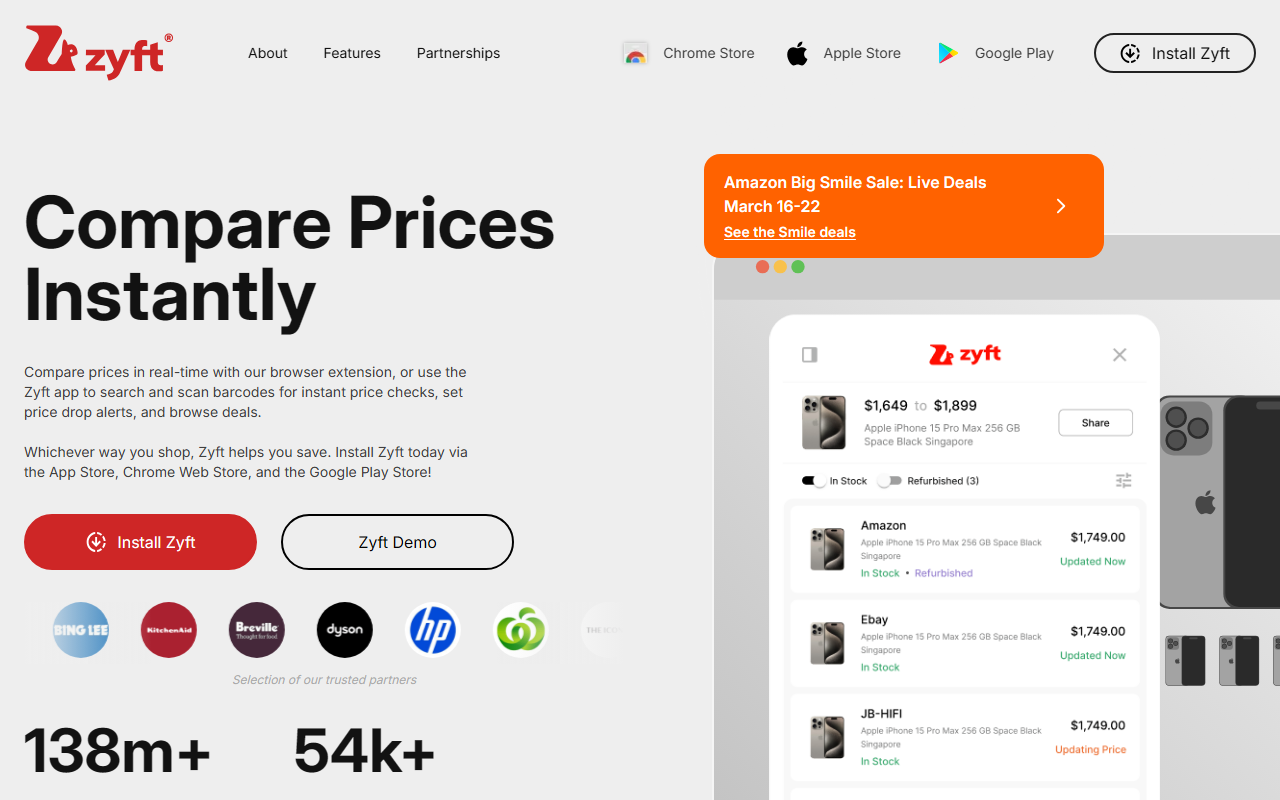
Upon visiting the Zyft website, the first thing I noticed was a clean, modern design with a strong emphasis on saving money. The homepage immediately presents a clear value proposition: compare prices in real-time using a browser extension or mobile app. The site prominently features a counter boasting over 138 million products and 54,000 retailers, which is impressive for an Australia-focused tool. The onboarding is straightforward—users can install the Chrome extension, download the iOS or Android app, or simply try a demo product on the site to see how it works. When I tested the free tier, I selected a product from the demo list and watched Zyft instantly display price comparisons from multiple retailers. The interface showed results in a clean overlay with retailer names, prices, and direct links. No account creation was required for the demo, which lowered the barrier to entry. The extension installation process took under a minute, and I appreciated that it didn't require excessive permissions.
Core Features and AI Integration
Zyft positions itself as an AI-powered shopping assistant, and its features reflect that ambition. The core functionality is instant price comparison: while browsing online, the extension automatically detects product pages and shows alternative prices. I tested this on a few popular Australian retail sites like JB Hi-Fi and Woolworths, and Zyft pulled up relevant comparisons within seconds. The barcode scanner is a standout—currently in beta, it lets users scan product barcodes in physical stores to instantly compare prices online. I simulated a scan using a sample barcode from the app, and the results were fast, though Zyft notes not all retailers price match. Another useful feature is price drop alerts: you can set alerts for specific products, and Zyft will notify you when the price falls. The AI component is described as helping “find more retailers and better prices.” In practice, the AI seems to aggregate data from third-party sources and affiliate networks. Zyft acknowledges that its AI “is constantly learning” and relies on third-party retailer data, which means results are not always perfectly up-to-date. The search-to-compare and share-to-compare features are straightforward, allowing users to manually search for a product or share a URL into the app.
Pricing and Market Positioning
Pricing is not publicly listed on the website. The extension and app appear to be free to download and use—there is no mention of subscription fees or paid tiers. Zyft likely generates revenue through affiliate links (which it discloses). This makes it a zero-cost tool for consumers, which is a strong advantage. In terms of market positioning, Zyft competes with general price comparison sites like PriceGrabber and ShopBot, but its focus on the Australian market and AI-powered features sets it apart. Another alternative is the browser extension The Camelizer (from CamelCamelCamel), but that is limited to Amazon. Zyft covers a much broader set of retailers (50,000+ Australian stores). The company has garnered media attention, as seen on the site, including coverage about helping with the cost-of-living crisis. However, Zyft is currently only available in Australia, which sharply limits its user base internationally.
Strengths and Limitations
Strengths: Zyft delivers on its promise of quick, multi-retailer price comparisons. The browser extension is lightweight and unobtrusive. User testimonials on the site show real savings—$300 on a TV, $179 on a Dyson vacuum, etc.—which adds credibility. The barcode scanner, while beta, is a clever way to bridge online and offline shopping. The tool is completely free with no sign-up required for basic use. Limitations: The biggest drawback is geographic lock-in—Zyft only works with Australian retailers and stores. If you shop internationally, it's useless. Data freshness is another concern: Zyft explicitly states it does not guarantee the cheapest prices or real-time stock availability. Some results may include outdated pricing or miss certain retailers. Additionally, the AI’s “learning” claim lacks transparency—users don’t see how the AI improves over time. The reliance on affiliate links means results could be biased toward partners, though Zyft says results are “unbiased.” Finally, the barcode scanner is still in beta and not fully reliable.
Recommendation: Zyft is best suited for cost-conscious Australian shoppers who frequently compare prices on electronics, home appliances, and groceries. It’s also useful for anyone trying to beat the current cost-of-living crisis. If you shop primarily on Amazon or live outside Australia, look at alternatives like CamelCamelCamel or global price trackers. Overall, Zyft is a handy, free tool that does what it says—but with limitations on accuracy and scope. Visit Zyft at https://zyft.com/ to explore it yourself.










Comments