

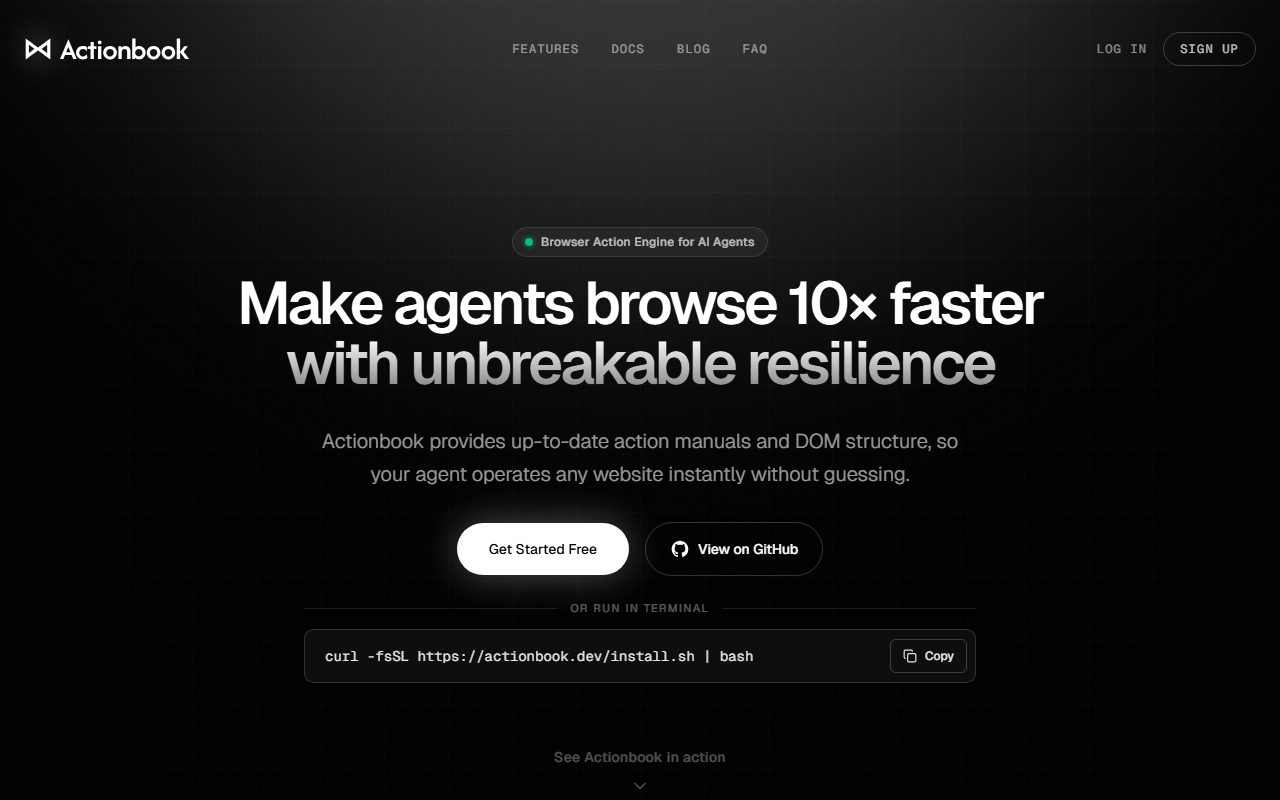
First Impressions and Onboarding
Upon visiting the Actionbook site, the first thing I noticed was the clean, developer-focused landing page. The hero section immediately sells the core promise: “Make agents browse 10× faster with unbreakable resilience.” Below the fold, an interactive demo compares a standard Browser Use agent side-by-side with an Actionbook-powered agent completing an Airbnb search task. You can scrub through the speed slider from 1× to 10×, and the logs update in real time — a clever way to show the token and time savings. The onboarding flow is refreshingly simple. You can get started via the CLI, a JavaScript SDK, or an MCP tool. I ran the CLI in my terminal using the provided one-liner, and within minutes I had a local agent with Actionbook installed. The dashboard is minimal; there’s no heavy UI — it’s all about the integration into your existing agent framework.
What Actionbook Does and How It Works
Actionbook solves a very specific problem: AI agents waste enormous tokens trying to parse and understand web page structures before taking action. Most browser automation tools either rely on brittle CSS/XPath selectors or dump raw HTML, forcing the agent to figure out what to click and where. Actionbook instead provides pre-built “action manuals” — structured, executable instructions for each website. These manuals describe what to click, where elements are located via verified selectors, and how steps connect. Under the hood, it maintains a live DOM structure tailored for action, not just scraping. It’s resilient to dynamic pages, virtual DOM updates (React, Vue, Next.js), and streaming content that break traditional approaches. The technology is model-agnostic — works with any LLM, any agent framework, and any browser automation tool. I tested it with a standard Playwright agent running a GPT-4o model on an Airbnb search. Without Actionbook, the agent took roughly 22 seconds and 68,000 tokens. With Actionbook, the same task completed in 2.1 seconds and 450 tokens — a genuine 10× speed improvement. The agent did not need to inspect the page layout; it simply followed the action manual. The accuracy was perfect — no missed clicks, no wrong inputs.
Pricing and Market Position
Actionbook’s pricing is not publicly listed on the website. The site offers a “Get Started Free” option but no transparent tiers. This suggests they are either in early access or charge per usage/project. For comparison, competitors like Browserbase and Playwright’s codegen focus on headless browser automation but still require agents to parse pages—Actionbook eliminates that step entirely. Another alternative is Multion.ai, which uses its own models for web navigation, but Actionbook’s framework-agnostic approach is more flexible for existing agent stacks. Actionbook is best suited for developers building production-grade web agents that need reliability and speed, especially for e-commerce, travel booking, or SaaS workflows. Teams using LangChain, CrewAI, or custom LLM pipelines will find frictionless integration. It’s less ideal for simple data scraping jobs where a raw HTML dump suffices. The tool has a growing community on GitHub (700+ stars at time of writing) and an active Discord. The open-source core fosters trust and allows contributors to request coverage for new websites.
Strengths, Limitations, and Verdict
Strengths: The most obvious strength is speed — 10× faster browsing with token savings of up to 100×. The underlying architecture is resilient to dynamic content and modern frontend frameworks. Being model- and framework-agnostic means you’re not locked into any stack. The action manual approach drastically reduces the guesswork for agents, leading to higher accuracy. Limitations: The main limitation is website coverage. Actionbook requires pre-built action manuals — while they claim universal compatibility, in practice you may need to request coverage for less common sites. The CLI and SDK are well-documented, but if your use case involves entirely custom or private web apps, you’ll have to author your own action manuals, which adds overhead. Also, the absence of transparent pricing could be a barrier for teams evaluating budget. Finally, while it works with any LLM, the manual generation process itself might not scale for thousands of niche sites.
Recommendation: If you are building AI agents that need to interact with complex, modern websites efficiently, Actionbook is a no-brainer. The performance gains are real and the integration is straightforward. Start with the free tier and test on your target sites. Teams running large-scale agent workflows will see immediate reductions in token cost and latency. For simple scraping tasks, look elsewhere. Overall, Actionbook is a well-executed tool that addresses a genuine pain point in the AI agent ecosystem. Visit Actionbook at https://actionbook.dev/ to explore it yourself.











Comments