
First Impressions of the AIED 2026 Website
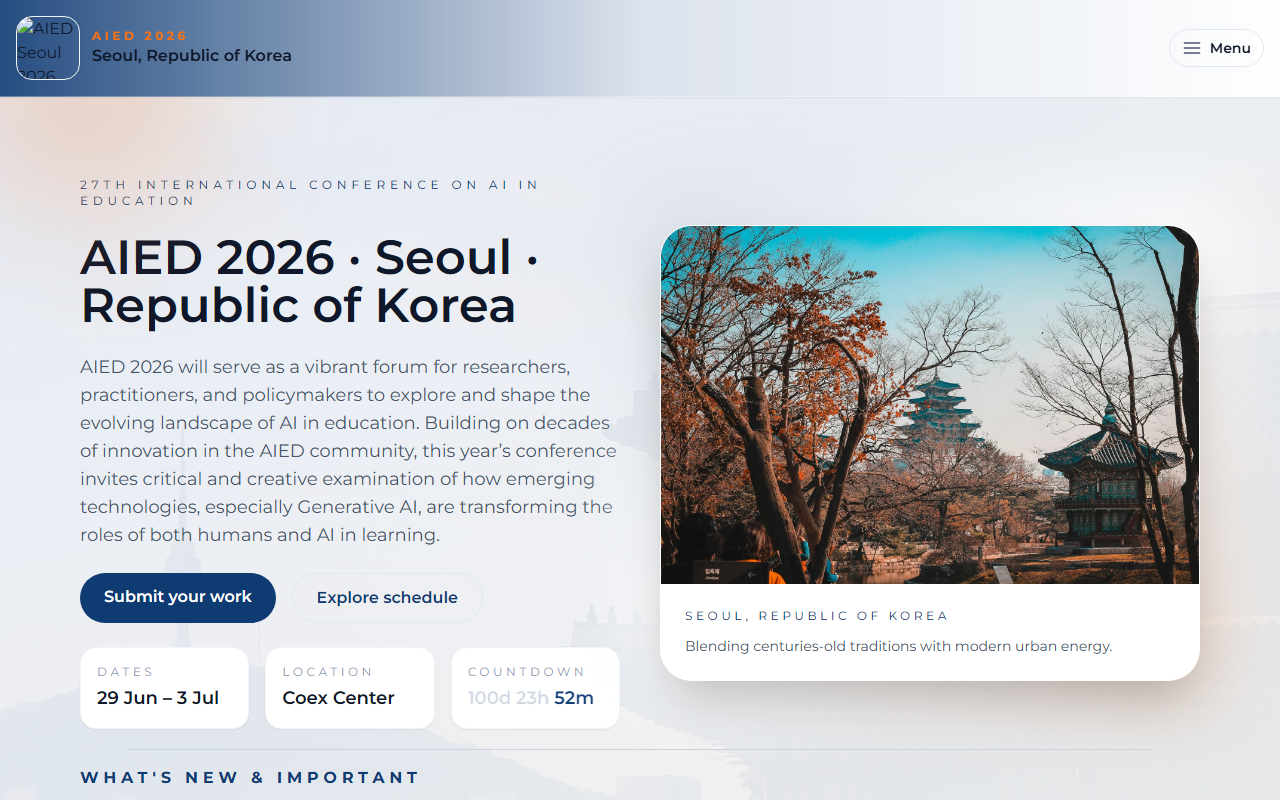
Upon visiting the AIED 2026 conference site, I was immediately struck by its clean, modern layout. The landing page features Seoul's skyline and a clear countdown timer, setting an energetic tone. The dashboard highlights key dates—camera-ready deadlines and important notifications—right at the top, which is helpful for authors. The menu is straightforward, though I noticed that many subpages (like schedule and submissions) are not yet fully fleshed out, likely because the conference is still months away.
During my exploration, I clicked through the available research tracks. The site presents three distinct tracks: Core Research, BlueSky, and WideAIED. Each has a brief description and a link to submission details, but the actual call for papers pages are not linked in the scraped content. This suggests the website is in an early stage of content population. Still, the overall design is responsive and easy to navigate, reflecting the professionalism expected from a 27-year-old conference series.
What Makes AIED 2026 Stand Out?
The conference theme, “From Tools to Teammates: Human-AI Synergy for Augmented Learning,” is timely and provocative. It directly addresses the shift from viewing AI as a simple support tool to co-equal teammate in learning environments. This is a problem many researchers are grappling with: how do we design AI systems that genuinely collaborate with learners and teachers? AIED 2026 positions itself at the forefront of that conversation.
Technically, the conference invites work on emerging technologies including generative AI, collaborative intelligence, and adaptive learning systems. The BlueSky track is particularly interesting—it encourages visionary ideas that go beyond incremental improvements. This is a strong differentiator from other AI in education conferences like the Educational Data Mining (EDM) conference, which leans heavily on data-driven methods, or the Learning Analytics and Knowledge (LAK) conference, which focuses more on measurement and analytics. AIED 2026 explicitly calls for research that reimagines AI not as a tool but as a teammate, which could attract a more diverse range of contributions, including socio-technical and critical perspectives.
The conference is organized by the International AI in Education (IAIED) Society and is part of the Festival of Learning 2026—a collaboration that may offer cross-fertilization with other education technology events.
However, I found a notable limitation: pricing is not publicly listed on the website. There is no registration page or fee structure visible. For a conference that bills itself as a vibrant forum, this lack of transparency about costs could deter potential attendees, especially those from under-resourced institutions. The WideAIED track does emphasize equity and global inclusion, but without pricing details, it is hard to know whether the organizers practice what they preach.
Who Should Attend and Who Should Pass?
AIED 2026 is best suited for academic researchers in artificial intelligence and education, particularly those working on human-AI collaboration, adaptive learning systems, or generative AI in learning. Doctoral students and early-career researchers will benefit from the explicit inclusion of future directions tracks. Practitioners who build AI-powered educational tools will also find value in the core research presentations, though the website does not yet showcase any workshops or industry panels.
Those who should look elsewhere include educators simply looking for classroom AI integration tips—the conference is deeply research-oriented. Similarly, vendors seeking commercial partnerships may find the content too academic. The lack of a detailed program or sponsor list suggests the conference may not yet be targeting industry attendance heavily.
I also noted that while the site mentions a schedule and venue (Coex Center in Seoul), there are no downloadable brochures, list of keynotes, or social events. This makes it difficult to plan an attendance unless you are already committed to the community. As a senior reviewer, I advise waiting until the full program is published before making travel decisions—unless you are submitting a paper, in which case the submission deadlines are clear.
Final Verdict
AIED 2026 shows genuine promise as a thought-leading conference that addresses the next wave of AI in education. Its theme is both ambitious and necessary. The strengths include a well-organized website (so far), diverse research tracks, and a clear focus on human-AI synergy. The main limitations are the incomplete content and missing practical details like registration fees and a concrete program. For a conference in its 27th edition, I expected a slightly more polished online presence, but the important dates and submission information are sufficient for authors.
I recommend this event for researchers who want to engage with cutting-edge ideas on AI as a learning partner. The BlueSky and WideAIED tracks are standout features that few competitors offer so explicitly. If the organizers deliver on their promises, AIED 2026 will be a milestone for the field. Visit AIED 2026 at https://aied-conference.org/ to explore it yourself.










Comments