

What Is AIEE?
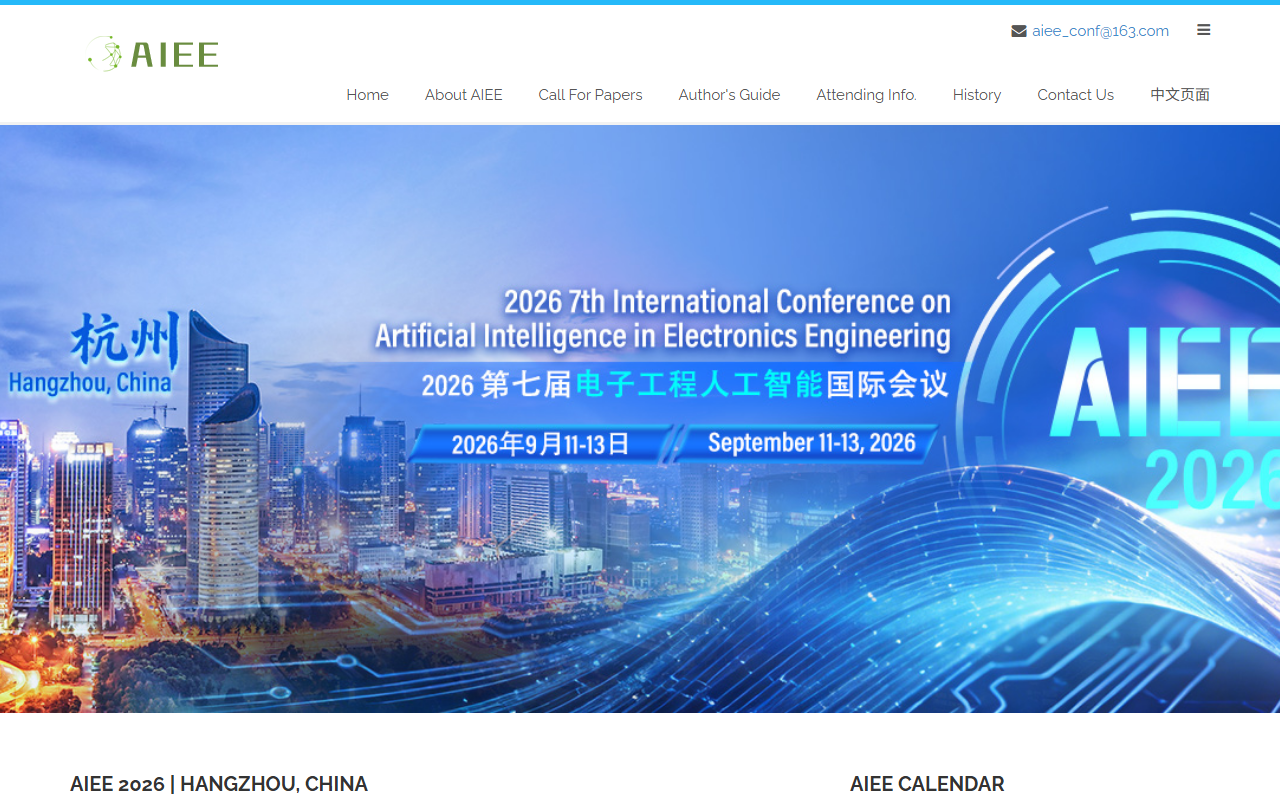
Upon visiting aiee.net, I expected an AI-driven learning platform for text generation or interactive tutorials, given the category "Text AI > Learning Platform." Instead, the site presents the 2026 7th International Conference on Artificial Intelligence in Electronics Engineering (AIEE 2026), an academic event to be held in Hangzhou, China, from September 11–13, 2026. Sponsored by the Hangzhou International Innovation Institute of Beihang University, the conference aims to bring together scientists, engineers, and researchers to discuss novel ideas in AI applied to electronics engineering. There is no software tool, chatbot, or learning platform here — it is a call-for-papers webpage for a traditional academic conference. This mismatch is significant: if you came looking for an interactive AI tutor or a text-generation assistant, you will be disappointed.
AIEE is a forum for exchanging research, not a product you can "use." The site outlines paper submission deadlines, proceedings publication (in the ACM Digital Library), and a template download for Microsoft Word or LaTeX (minimum four pages). The conference topics include AI in circuit design, signal processing, embedded systems, and related fields. For researchers in electronics engineering who want to present work, get peer feedback, and network, AIEE is a legitimate venue. But for anyone expecting an API, a free trial, or a dashboard to generate text, the site delivers none of that.
Observing the Interface and Workflow
The website itself is a straightforward landing page with a clean menu, dual-language text (English and Chinese), and key dates. The dashboard — if you can call it that — shows a submission deadline of May 1, 2026, notification by June 1, and registration closing June 15, 2026. When testing the "Submission" link, you are redirected to a separate submission system that requires an account. There is no AI-powered tool to test; the only workflow is submitting an academic paper. I clicked through the menu items, but all lead to static pages with no interactive AI functionality. The "Proceedings" section lists past proceedings (AIEE 2021–2025) hosted on the ACM Library, which is typical for conference series. No model, API, or software integration is mentioned anywhere on the site.
For a tech journalist accustomed to reviewing tools with onboarding flows, this was a stark contrast. There is no free tier, no sign-up for a product, and no documentation about underlying AI models. The only "technology" visible is the conference management system that handles paper submissions. If the category intended to categorize AIEE as a conference-related resource, the "Learning Platform" label is misleading — unless one considers attending a conference as a form of learning.
Audience and Alternatives
AIEE is best suited for academics, postdocs, and graduate students working at the intersection of artificial intelligence and electronics engineering. It offers a venue for publishing peer-reviewed work and connecting with international experts. For those seeking an online learning platform with AI-generated content, alternatives include Coursera, Udacity, or Khan Academy, which actually provide structured courses. Unlike those platforms, AIEE does not offer tutorials, quizzes, or hands-on exercises. Another alternative is the IEEE Xplore digital library for accessing conference papers, but that is a repository, not a learning tool. For researchers specifically interested in AI in electronics, other conferences like the IEEE International Conference on Electronics, Circuits and Systems (ICECS) or the International Conference on AI in Engineering (ICAINE) might also align with their needs. AIEE has notable backing from Beihang University and a history of ACM-published proceedings, conferring academic credibility, but it lacks the interactive, always-available nature of a learning tool.
Strengths and Limitations
Strengths: The conference provides a legitimate platform for disseminating research, with past proceedings indexed in the ACM Digital Library — a trusted source for computer science and engineering research. The dual-language support (English and Chinese) broadens accessibility for international and Chinese-speaking scholars. The timeline is clearly laid out, and the sponsors (Beihang University, International Innovation Institute) add institutional weight. For young researchers, the opportunity to receive feedback from global peers is a genuine plus.
Limitations: Most critically, this is not an AI tool or a learning platform in the conventional sense. There is no software to test, no API to integrate, no free tier to explore. The website itself offers no educational content — only information about submitting a paper. If you want to learn about AI in electronics engineering through interactive modules or generated explanations, you will find nothing here. Additionally, the conference is still a year away (2026), so immediate engagement is impossible. The submission system requires an account, but I could not test it without a paper to submit. Pricing is limited to registration fees, which are not publicly listed on the website — only a "Registration Deadline" date is given.
Recommendation: If you are a researcher with a ready paper in AI and electronics engineering, consider submitting to AIEE 2026 — the venue is reputable and the proceedings are ACM-published. But if you are looking for a tool to improve your writing, study AI concepts, or generate learning materials, look elsewhere. This is a conference, not a product. Visit AIEE at https://aiee.net/ to explore it yourself.













Comments