

First Impressions and Onboarding
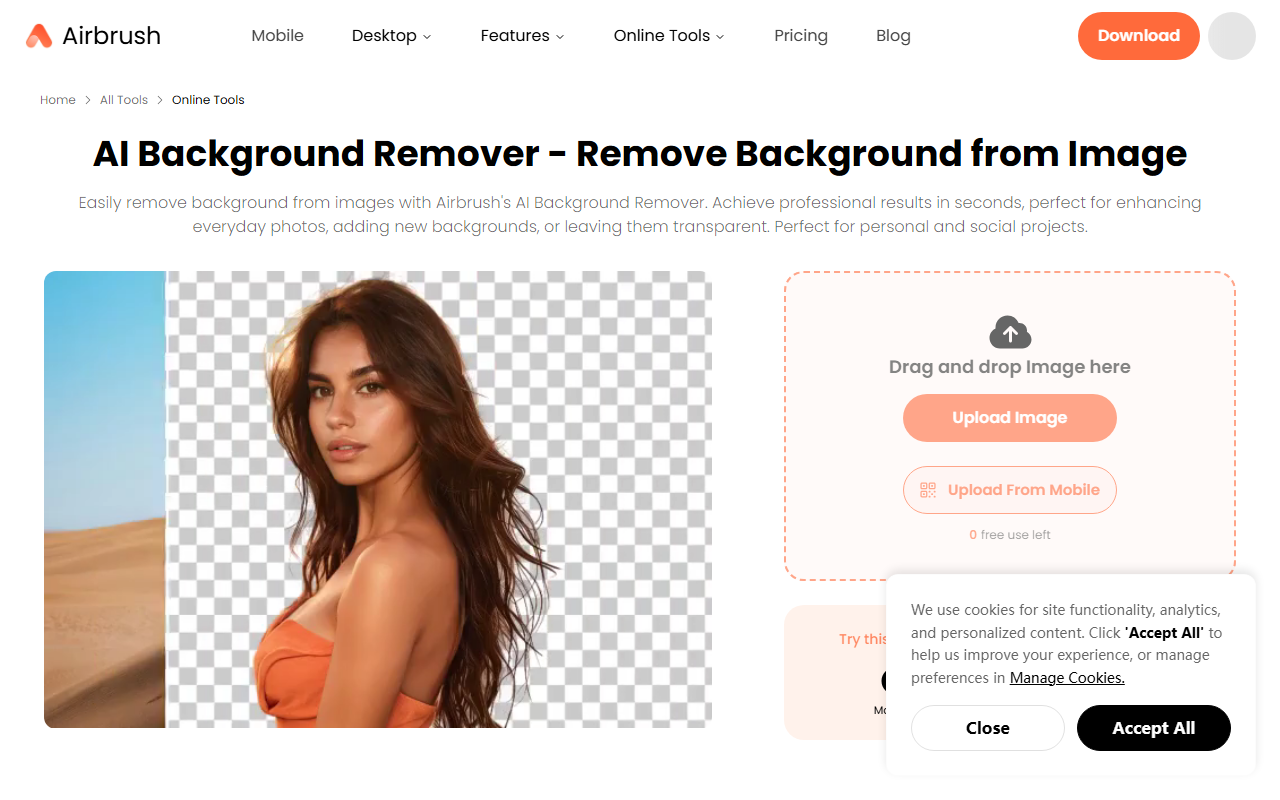
Upon visiting the Airbrush website, the interface is clean and modern, immediately presenting the core tools: Image Eraser, AI Retouch, Image Enhancer, Body Tuner, and AI Outfit. The homepage emphasizes a free 7-day trial for desktop and mobile. I downloaded the macOS version to test the onboarding flow. After installation, the app prompts you to upload a photo; I chose a portrait with unflattering lighting and a cluttered background. The dashboard shows a split-screen preview with sliders for each AI tool. The onboarding tutorial is minimal but sufficient—hovering over each tool reveals a brief tooltip. I started with the AI Retouch feature, which processed the image in about 3 seconds and smoothed skin while preserving texture. The result was natural, not plasticky, which impressed me.
Core Features and Performance
Airbrush offers five primary tools, each addressing a specific editing pain point. The Image Eraser is excellent for removing unwanted objects or people—I tested it on a group photo distraction, and the AI accurately filled the gap with background content. The Body Tuner lets you subtly reshape body proportions; sliders control waist, shoulders, and legs. Unlike some competitors, the results stayed realistic, though I noticed occasional edge artifacts near clothing. The AI Outfit tool is a standout: you can change the clothing in a portrait by selecting from preset styles (casual, formal, etc.). It took about 10 seconds to render and produced convincing texture and shading. The Image Enhancer boosted resolution and sharpness—great for old photos. All tools run locally on the device, which means no cloud dependency, but it does require a reasonably modern GPU. The mobile app delivers similar speed, though the smaller screen makes slider adjustments less precise.
Pricing, Platforms, and Market Position
Pricing is not publicly listed on the website beyond the 7-day free trial and a mention of “Try It Free” for Airbrush Studio. The app is available on Mac, Windows, iOS, and Android, and there is an online editor version as well. Based on common industry patterns, I suspect a subscription model similar to FaceApp or Remini, but without official tiers, users must download to see pricing. Competitors like Adobe Photoshop (with AI features) offer more advanced layers and controls, while FaceApp focuses narrowly on face modifications. Airbrush sits in between: simpler than Photoshop, more versatile than FaceApp. It is best suited for social media managers, influencers, and professionals who need quick, polished headshots without learning complex tools. Users who require raw file editing, layer masks, or fine-grained manual adjustments should look elsewhere.
Verdict and Recommendation
Strengths of Airbrush include its speed, natural-looking AI output, and cross-platform availability. The Body Tuner and AI Outfit are genuinely useful for content creators. However, its limitations become clear if you need batch processing or advanced retouching—there is no undo history beyond the last action, and the free trial forces you into a subscription to keep edited photos. The lack of transparent pricing on the website is a minor annoyance. I recommend Airbrush for anyone who wants one-click professional results for portraits and social media posts. Try the free trial on a few images to see if the output meets your standards. Visit Airbrush at https://airbrush.com/ to explore it yourself.












Comments