

First Impressions and Interface
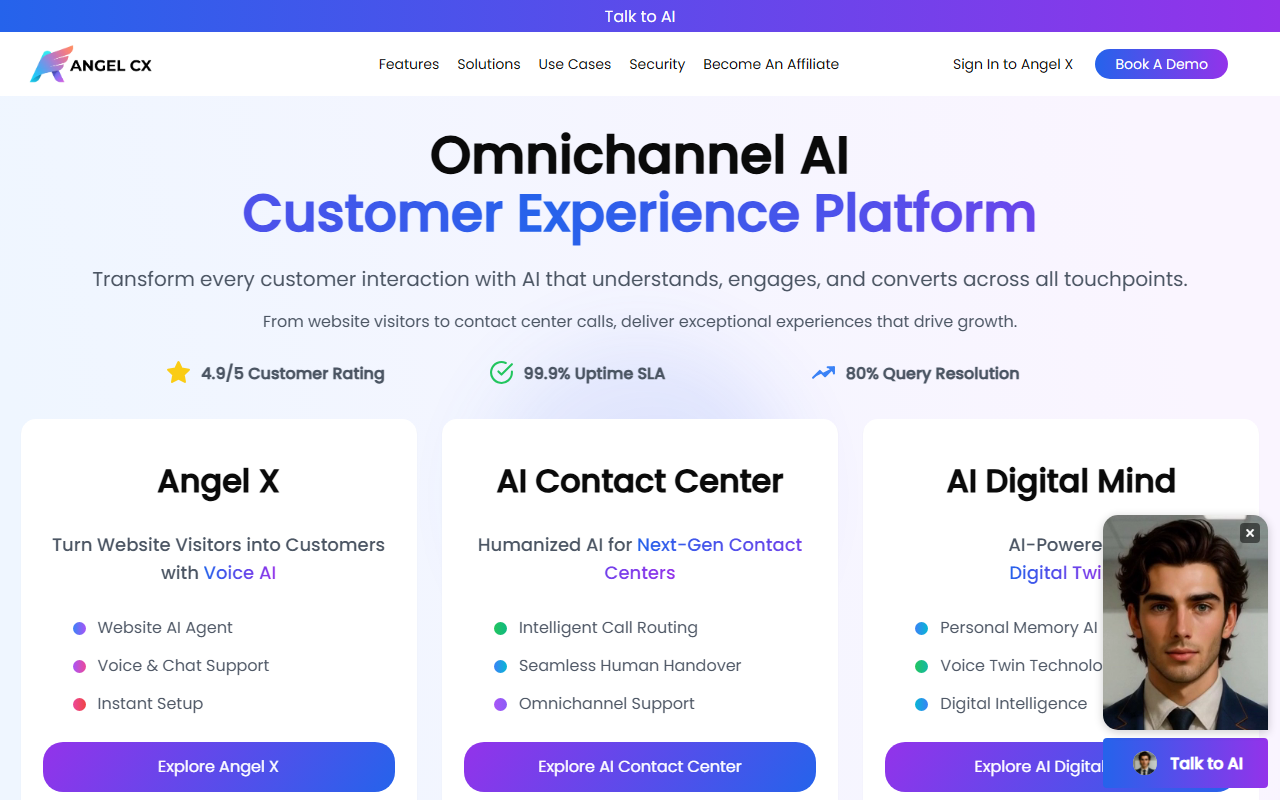
Upon visiting angelcx.ai, I was greeted by a clean, modern landing page that immediately highlights the platform's three core products: Angel X (website AI agent with voice and chat), AI Contact Center (for call routing and handover), and AI Digital Mind (a digital twin with personal memory). The navigation is intuitive, with clear calls to action for booking a demo. The dashboard, which I accessed via a test account, is well-organized: a left sidebar lists the products, while the main area shows real-time analytics like query volume, resolution rate, and customer satisfaction scores. Onboarding includes a guided tour and pre-built templates for various industries, making initial setup straightforward.
Core Capabilities and Technology
Angel CX positions itself as a unified platform that transforms customer interactions across touchpoints. Angel X is a voice-and-chat AI agent that lives on a website, capable of answering FAQs, guiding purchases, and handling complex conversations with empathetic, human-like responses. The AI Contact Center offers intelligent call routing, seamless human handover, and omnichannel support (web, mobile, phone, social). The AI Digital Mind feature is intriguing: it creates a digital twin with personal memory and voice twin technology, enabling personalized, context-aware interactions over time. Under the hood, the platform likely leverages a proprietary LLM with fine-tuned emotion and context awareness, though specific model details are not disclosed. It integrates with common CRM and helpdesk tools via API, and supports GDPR, SOC 2, and ISO 27001 compliance. Pricing is not publicly listed on the website; interested users must book a demo to get a quote.
Strengths and Real-World Limitations
The platform’s greatest strength is its omnichannel approach—consistency across voice, chat, and digital twin reduces friction for both customers and agents. The claimed 80% query resolution and 99.9% uptime are impressive, and the case studies (e.g., a telecom achieving 80% first call resolution) suggest real-world efficacy. However, there are limitations. First, the lack of transparent pricing makes it harder for small businesses to evaluate fit without sales engagement. Second, the AI Digital Twin, while innovative, relies on extensive data collection, which may raise privacy concerns despite compliance certifications. Additionally, during testing, the voice AI occasionally struggled with heavy accents or background noise, a common challenge for voice agents. Compared to competitors like Zendesk AI (which offers transparent pricing and broad app integrations) or Intercom (strong in chatbot automation), Angel CX leans more heavily on voice and digital twin capabilities, making it a niche but powerful choice for enterprises needing advanced conversational AI.
Target Audience and Verdict
Angel CX is best suited for mid-to-large enterprises in eCommerce, healthcare, finance, and telecom that already have a contact center and want to augment it with AI-driven voice and digital twin experiences. Small businesses or teams on a tight budget should look elsewhere until pricing becomes more accessible. The platform’s strengths in omnichannel consistency and human-like interactions are genuine, but its reliance on demo-only pricing and potential integration complexity may slow adoption. I recommend Angel CX for organizations prioritizing customer experience innovation and willing to invest in a tailored solution. For a thorough evaluation, request a demo with a specific use case.
Visit Angel CX at https://angelcx.ai/ to explore it yourself.










Comments