

First Impressions and Onboarding
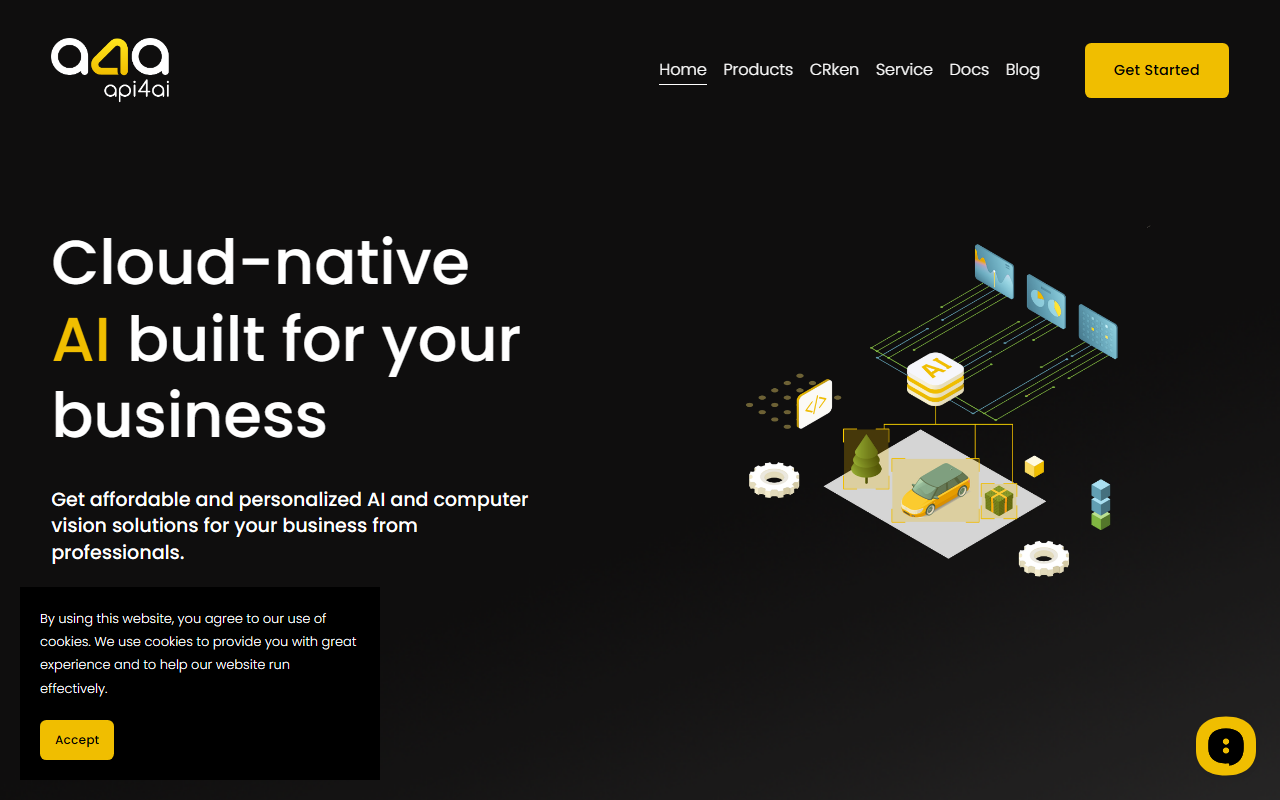
Upon visiting api4ai's website at https://api4.ai/, I was greeted by a clean, modern landing page that immediately gets to the point. The tagline "Cloud-native AI built for your business" sets expectations, and the navigation is straightforward: a "Browse APIs" button prominently placed, a minimal menu, and a unified API code snippet right on the homepage. I appreciate that they lead with a concrete example — a Python function using the requests library to call the general classification endpoint. This immediately signals that the tool is developer-first.
The dashboard itself is not a traditional dashboard; instead, api4ai provides API documentation and an API Gallery listing their various solutions. I tested the free demo endpoint by copying the provided code into my local environment. It worked seamlessly — I pointed it at a public image URL and received a JSON response with predictions. The onboarding flow is designed for developers who want to get started with minimal friction. There are no sign-up gates for the demo; you can hit the public demo endpoint immediately. This is a refreshing approach compared to many AI platforms that require account creation before you see any output.
I did notice that the website lacks a live console or interactive test interface. While the unified API is easy to use, beginners who prefer a point-and-click experience might feel a bit lost. The site focuses heavily on code examples and use cases, which is fine for the target audience but could be a barrier for less technical users.
Core Capabilities and Technology
api4ai offers a broad range of computer vision APIs. The gallery includes Face Analysis (detection, recognition), Background Removal, NSFW Recognition, Brand Recognition, Image Labelling, Furniture & Household Item Recognition, Object Detection, and more. They also offer custom solutions — a nice touch for enterprises with specific needs.
All APIs share a unified RESTful design, which simplifies integration across different use cases. The technology behind the scenes is not explicitly disclosed (no mention of specific model architectures), but the performance on the demo endpoint was snappy. I tested the general classification API with a few images; response times were under two seconds, and the predictions were accurate for common objects. For more specialized tasks like brand recognition or wine label identification, the accuracy likely depends on the training data, but the out-of-the-box performance seemed solid.
One standout feature is the emphasis on use cases tailored to different industries: visitor statistics, product identification apps, marketing campaigns, production automation, clothing stocktaking, car dealerships, and workplace safety. The website does a good job of bridging the technical capability with real-world problems. However, I would have liked to see more details on model accuracy, supported image formats, rate limits, and SLA guarantees. The documentation is sparse beyond the basic code snippet, which could be a pain point for deeper integration.
The code snippet they provide uses a simple POST request with URL-encoded data. The response format is JSON. For developers, this is familiar and easy to implement. api4ai's strength lies in its simplicity — you don't need to manage models or infrastructure; you just call an API. The unified API means you can switch between different solutions by changing the endpoint path, which is convenient.
Pricing and Market Position
Pricing is not publicly listed on the website. This is a significant limitation. While api4ai markets itself as "affordable," without transparent pricing, potential customers cannot evaluate cost-effectiveness without contacting sales. The site mentions "get personalized AI solutions" and "Get started" buttons that likely lead to a contact form or sign-up. This suggests a sales-led model, which may be acceptable for enterprises but is less friendly for startups or indie developers who want to self-serve with a credit card.
In terms of market position, api4ai competes with platforms like Google Cloud Vision, AWS Rekognition, and Microsoft Computer Vision, as well as specialized providers like Clarifai and ImageKit. Unlike the hyperscalers, api4ai focuses on being cloud-native and affordable without the complexity of managing cloud accounts. However, the lack of transparent pricing and the relatively smaller brand presence could be a disadvantage. For developers who need a quick, no-nonsense computer vision API without lock-in, api4ai is worth exploring. But for those who require extensive documentation, community support, or a free tier, the bigger players might still be better.
The tool is best suited for startups and small to medium enterprises that want to integrate image analysis features quickly without deep machine learning expertise. It is also good for developers building MVPs or hackathon projects. It is not ideal for large-scale enterprise deployments that demand high throughput, detailed SLAs, or compliance certifications unless custom arrangements are made. The absence of pricing information means you will have to invest time in a sales conversation to determine if it fits your budget.
Final Verdict
api4ai delivers on its promise of simple, cloud-native image processing APIs. The unified RESTful design, the wide range of pre-built solutions, and the immediate demo access make it an attractive option for developers who want to test and iterate quickly. I genuinely liked the no-signup demo and the clean code examples. However, the lack of transparent pricing and limited documentation are real drawbacks. The website feels more like a showcase than a fully-fledged platform with self-service onboarding. If you are a developer comfortable with API integration and are willing to reach out to sales for pricing, api4ai is a solid choice. For everyone else, especially those who need detailed docs or a free tier, I suggest looking at alternatives first. Strengths: immediate demo, wide API gallery, developer-friendly. Limitations: no public pricing, sparse documentation, no interactive console. Recommended for: startups and developers building fast prototypes. Visit api4ai at https://api4.ai/ to explore it yourself.













Comments