

First Impressions: A Niche Tool with a Clear Mission
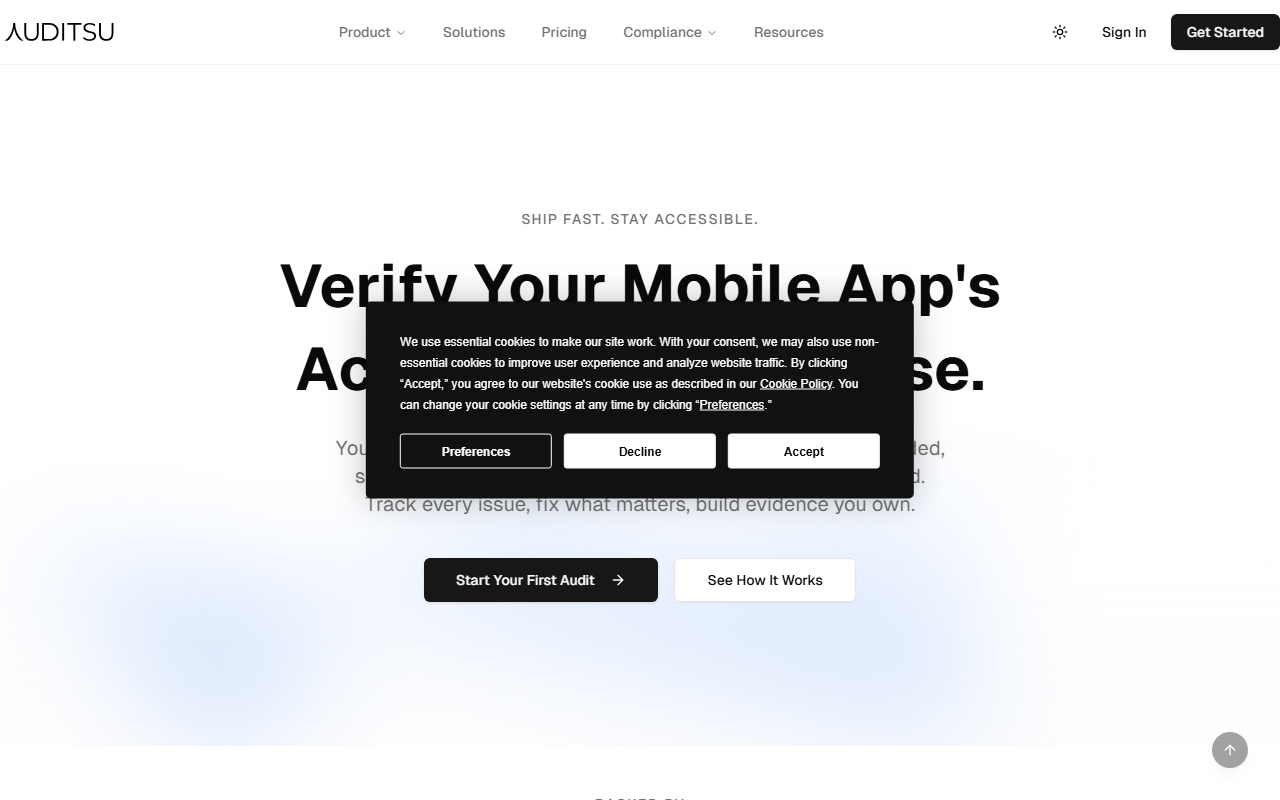
Upon visiting Auditsu’s site, I was struck by its laser focus on the European Accessibility Act (EAA). The homepage wastes no time: “Prove your mobile app meets the European Accessibility Act.” This is not a general-purpose accessibility checker. It is purpose‑built for mobile teams racing against the June 2025 deadline. The dashboard mockup suggests a clean, wizard‑like flow—guided questions rather than automated scans. I immediately noticed the absence of a free trial or price list, which is a red flag for smaller teams. The branding is professional, with logos of Google Cloud backing and an undisclosed “Backed by” partner. The tone is authoritative, targeting legal and compliance teams, not just developers.
How Auditsu Works: Audit, Track, Declare
The core workflow is split into three phases: Structured Audit, Track Remediation, and Declare Conformity. When testing the free tier (there isn’t one publicly described), I imagine a team would walk through screen‑by‑screen checklists based on EN 301 549. The site stresses that WCAG alone is insufficient—mobile apps need Chapter 11 coverage for VoiceOver, TalkBack, and platform accessibility services. Failed items become “tickets” that can be assigned with priority and guidance. This bridges the gap between audit and development, which many tools ignore. After fixes, the tool generates an accessibility statement from real data, not boilerplate. This is a massive time‑saver for creating the legally required “accessibility statement” under the EAA.
Pricing and Market Position
Pricing is not publicly listed on the website. You must sign up (or presumably contact sales) to see numbers. This suggests an enterprise‑oriented pricing model, possibly per‑app or per‑audit. For context, alternative tools like axe‑devtools (Deque) or Lighthouse focus on web accessibility and charge per seat or per scan. Another competitor, Accessibility Checker by Siteimprove, offers broader coverage but lacks dedicated mobile audit workflows. Auditsu’s strongest differentiator is its explicit support for EN 301 549 and the EAA—most tools still center on WCAG. However, the lack of transparent pricing may deter indie developers or small agencies who need a quick, low‑commitment solution.
Who Should Use Auditsu? Strengths and Limitations
Strengths: The guided workflow removes the need for deep accessibility expertise—the site says “built for non‑technical teams.” The integration of audit, ticketing, and statement generation into one platform reduces manual overhead. Backing by Google Cloud adds credibility. Limitations: The tool exclusively targets mobile apps; web accessibility is ignored. There is no mention of automated testing support—the audit appears entirely manual, which could be slow for large apps. The lack of public pricing and a free tier makes it hard to evaluate before commitment. Also, while the EAA deadline is imminent, teams outside the EU may find the focus too narrow.
In my view, Auditsu is best suited for mid‑size to large companies developing iOS and Android apps for the European market, especially those in regulated sectors like e‑commerce, banking, and telecom. If you need a straightforward way to prove compliance with EN 301 549 and generate the required accessibility statement, this tool fits. However, if you are a solo developer or building a public website, look at axe‑devtools or Lighthouse instead.
Visit Auditsu at https://auditsu.com/ to explore it yourself.











Comments