

First Impressions and Onboarding
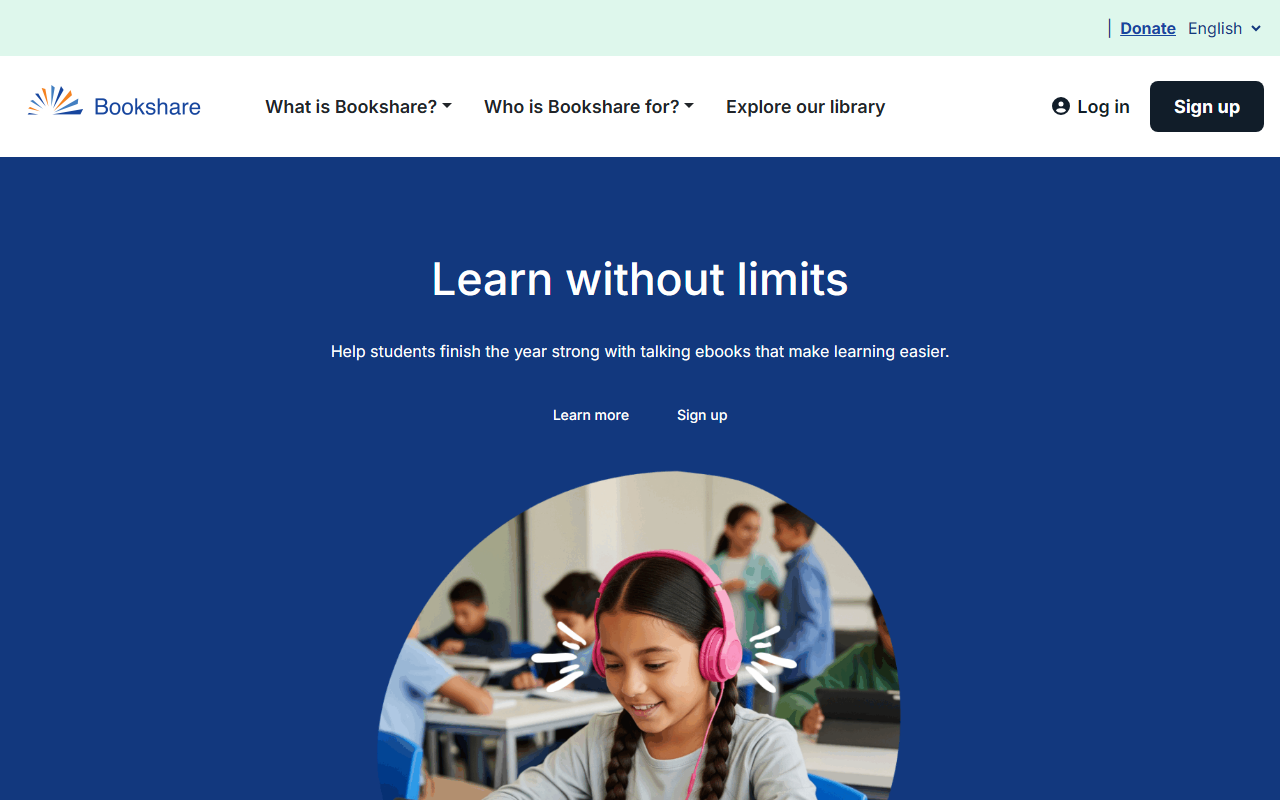
Upon visiting Bookshare.org, I was immediately struck by the clean, accessible layout. The homepage clearly states the tool’s mission: to provide reading assistance for people with print disabilities. I noticed a prominent “Donate” button and language options (English and Spanish). The top navigation offers a straightforward path to explore the library, learn about the service, and sign up. While the site is not flashy, it is highly functional and loads quickly. When I clicked “Learn more” about the assisted reading features, a short video demonstrated karaoke-style highlighting and text enlargement. The onboarding flow directs new users to sign up for either an individual or organizational membership. I tested the free tier—there are over 10,000 public domain books available to anyone without registration. I searched for “Moby Dick” and was able to read it immediately in my browser. The interface is minimal: a sidebar shows reading options (text, audio, braille), and the book opens with adjustable font size and playback controls. It was remarkably smooth.
Reading Experience and Feature Set
Bookshare is more than a digital library; it is an accessible reading platform. The core feature is the Bookshare Reader app, available on web browsers, smartphones, tablets, and Alexa devices. While reading, you can listen to words read aloud with high-quality audio, follow along with karaoke-style highlighting, enlarge text, or switch to braille output. I tested the web reader with a public domain title. The text-to-speech voice was clear and natural, and the highlighting made it easy to follow each word. You can adjust reading speed, font style, and text color. The lack of wait times is a huge plus—you can borrow any of the over 1.3 million titles instantly, with no due dates. The library includes bestsellers, children’s books, educational textbooks, career resources, and award-winning titles (Newbery, Pulitzer, etc.). I browsed the “NY Times fiction” category and saw recent bestsellers. However, note that the full library requires a qualifying disability (such as blindness, dyslexia, or a physical impairment) and individual membership costs $50 per year after a free 30-day trial. Organizations and schools can get bulk subscriptions. Compared to alternatives like Audible (which is pay-per-title) or Kindle (limited accessibility), Bookshare focuses exclusively on making reading accessible and is subsidized by the US Department of Education.
Pricing and Accessibility
Bookshare’s pricing structure is transparent. Individual memberships cost $50 per year after a 30-day free trial. Students, veterans, and individuals in certain programs may qualify for free or reduced pricing. Organizational pricing varies based on the number of users. The free tier of 10,000 public domain books is open to anyone worldwide—no documentation required. For the full library, you must provide proof of a qualifying print disability (e.g., a doctor’s note or IEP). This is a limitation for curious readers without any disability, but it ensures the service targets those who truly need it. I found the accessibility features robust: the reading app supports screen readers, keyboard navigation, and customizable display. Bookshare also partners with schools, libraries, and nonprofits to distribute memberships. One strength is the vast number of textbooks and educational materials, which are often unavailable in accessible formats elsewhere. A weakness: the web reader interface can feel a bit dated compared to mainstream e-readers, and the selection of recent bestsellers is slightly smaller than subscription services like Kindle Unlimited. Still, for its target audience, this is a game-changer.
Final Verdict and Recommendations
Bookshare is best suited for individuals with print disabilities who need accessible ebooks for school, work, or leisure. It is also ideal for educators, librarians, and parents of children with reading challenges. If you do not have a qualifying disability and simply want an audiobook or e-reader, look elsewhere—Audible or your local library’s OverDrive will serve you better. Genuine strengths include the massive library, no-wait borrowing, and quality assistive reading tools. Limitations involve the membership qualification process and a slightly clunky web interface. I recommend Bookshare to anyone who qualifies; it is a lifeline for independent reading. The commitment to accessibility and partnerships with the US Department of Education gives it strong credibility. Visit Bookshare at https://bookshare.org/ to explore it yourself.











Comments