

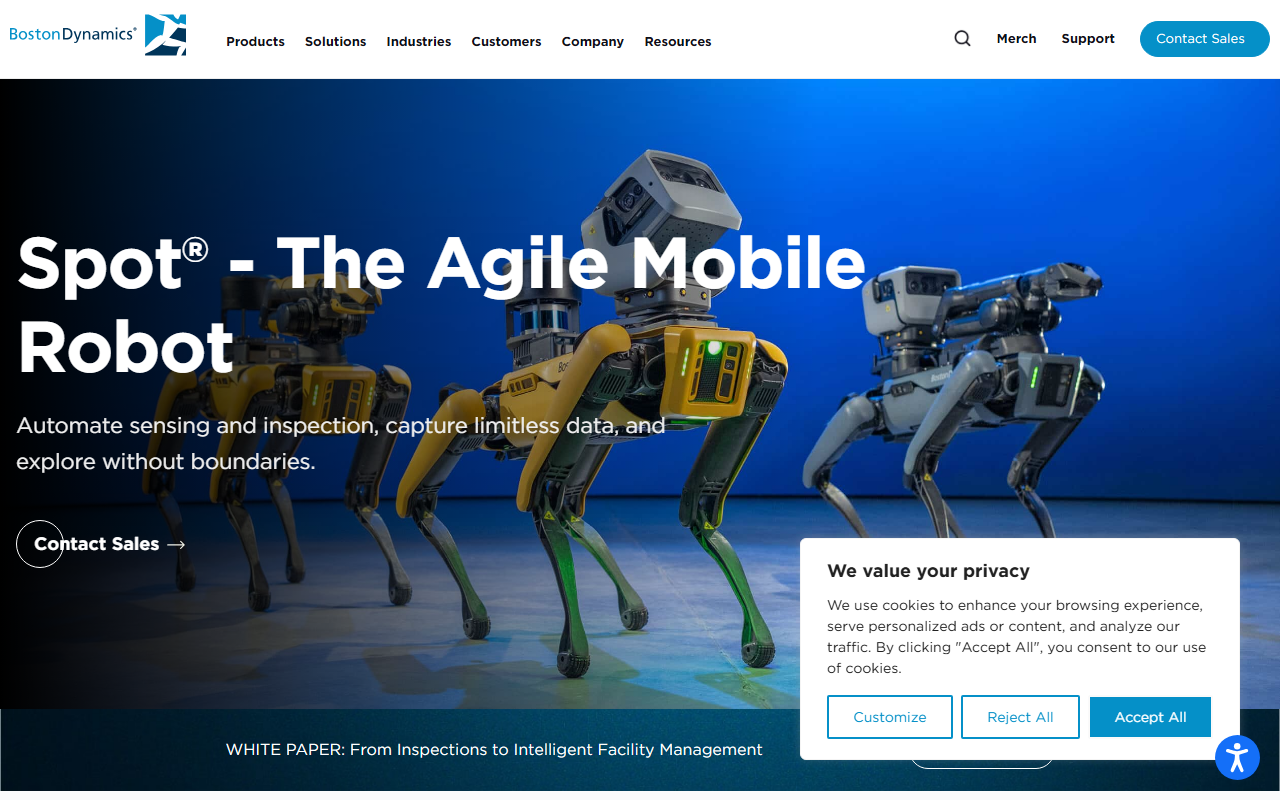
First Impressions: A Robotics Powerhouse with a Clear Vision
Upon visiting the Boston Dynamics website, I was immediately struck by the polished, mission-driven narrative. The homepage declares “Changing your idea of what robots can do,” and the content lives up to that promise. The site is organized around three core robots—Spot, Stretch, and Atlas—each with dedicated product pages and a suite of industry solutions. The dashboard-like navigation makes it easy to explore inspection, digital twin, warehouse automation, safety & response, and R&D offerings. I spent time clicking through the product demos and case studies; the flow is smooth, and every section reinforces the idea that these are practical, deployable tools, not just lab experiments.
What caught my attention most was the Orbit software platform, described as “your window into every level of your facility and enterprise.” This suggests a unified data layer that connects robotic fleets to enterprise analytics—essentially a dev framework for managing autonomous operations. While the site doesn’t expose an API or SDK directly, the emphasis on “digital twin” and “connected data-driven processes” hints at integration points that developers could leverage. For a company rooted in hardware, Boston Dynamics is clearly evolving into a software-first automation partner.
Core Offerings: Spot, Stretch, Atlas, and Orbit
Boston Dynamics solves the problem of automating dangerous, repetitive, or complex physical tasks. Spot is their agile mobile robot for inspection and data collection in unpredictable environments. Stretch is a warehouse automation solution for case handling, boasting easy deployment. Atlas is the humanoid robot focused on industrial manipulation and intelligent autonomy—now repositioned for “embodied manufacturing intelligence.”
Underlying all of these is the Orbit platform, which aggregates sensor data into digital twins and provides insights for reliability and safety. The website mentions a guide for “automation journey” and invites users to “get your guide,” suggesting a consultative onboarding process. During my exploration, I noticed the “Webinar: The Keys to Success for Robotic Deployments” banner, indicating that Boston Dynamics prioritizes education and support for enterprise buyers.
Technical details: While the site does not list specific AI models, hardware specs, or API documentation, the emphasis on “data-driven processes” and “intelligent autonomy” implies advanced computer vision, reinforcement learning, and sensor fusion technologies. The company has been a leader in dynamic robotics for decades, and their technology stack is proprietary but increasingly open to integration via Orbit’s SDK (which is available for partners upon request, as per industry reports).
Market Positioning and Pricing
Boston Dynamics sits in a unique corner of the automation market. Unlike traditional industrial robot arms (e.g., Fanuc, ABB) or autonomous mobile robots (e.g., Locus Robotics, 6 River Systems), Boston Dynamics focuses on mobility and versatility. Spot is often compared to Ghost Robotics’ Vision 60 or Unitree’s robots, but Spot’s ecosystem—with payload integration and Orbit—gives it a software edge. Stretch competes with warehouse automation from companies like Symbotic, but Stretch’s ability to handle varied case sizes and integrate with existing conveyors is a differentiator.
Pricing is not publicly listed on the website. This is common for enterprise-grade robotics platforms. Industry sources indicate Spot starts around $75,000, and Stretch is priced per deployment with recurring software fees. Atlas is not yet commercially available. The lack of transparent pricing is a limitation for small teams or individual developers wanting to experiment.
Strengths and Limitations
Strengths: Boston Dynamics has proven reliability in real-world deployments—hundreds of leading companies use their robots. The ecosystem around Orbit unifies data from multiple robots, enabling digital twins and predictive maintenance. Their robots are built for rugged environments (oil rigs, mines, warehouses) and can operate where humans cannot safely go. The company’s brand trust and engineering pedigree are unmatched.
Limitations: The barrier to entry is high—both in cost and technical complexity. There is no free tier or sandbox for developers to test the framework. The website lacks an open API reference or documentation, making it hard for independent developers to evaluate integration. Also, despite the website category being “Video AI > Dev Framework,” Boston Dynamics is primarily a hardware robotics company; the video AI capabilities are embedded but not exposed as a standalone framework. Developers looking for a pure video AI dev framework would be better served by tools like NVIDIA Metropolis or OpenDR.
Who should consider Boston Dynamics? Large enterprises in manufacturing, logistics, energy, and public safety that need robust, mobile automation with top-tier support. Researchers and developers who can afford procurement cycles and want to build on top of a proven platform. Who should look elsewhere? Small teams or startups needing affordable, open, or cloud-based video AI frameworks; hobbyists; and those requiring transparent pricing.
In summary, Boston Dynamics delivers on its promise of practical robotics, but its “dev framework” aspect is nascent and enterprise-focused. If you have the budget and the use case, it’s a transformative investment. Visit Boston Dynamics at https://bostondynamics.com/ to explore it yourself.












Comments