

First Impressions and Onboarding
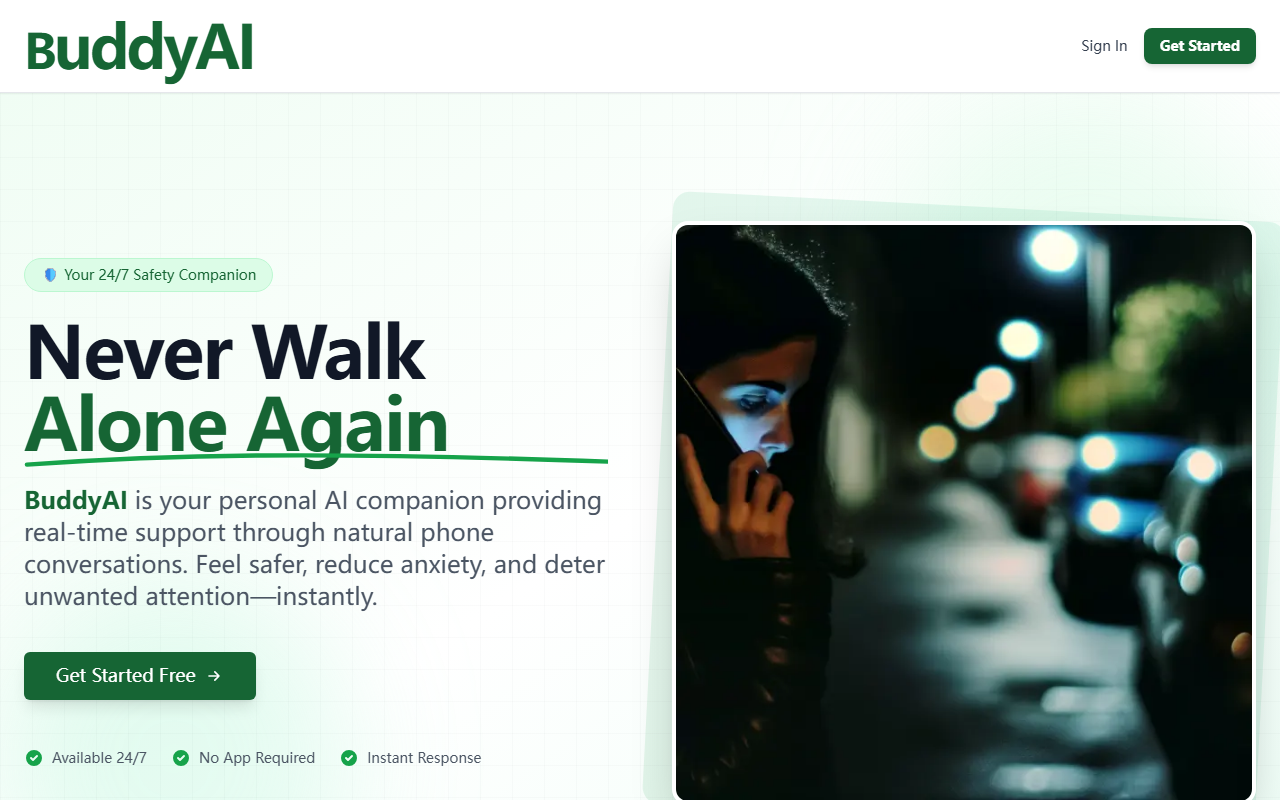
Upon visiting the BuddyAI website at buddyai.org, the first thing I noticed is the clean, reassuring design. The hero section immediately pitches a service that promises never to let you walk alone again. There’s a prominent demo button labeled Meet Chloe, Your Virtual Buddy. Clicking it plays a realistic, natural voice conversation—no robotic tones. The audio quality is impressive; the AI even pauses naturally and adjusts tone based on context. That demo effectively sets expectations.
Getting started is frictionless. The site claims no app is required, which holds true: you sign up with just a phone number, and BuddyAI calls you directly. I tested the free tier (no credit card requested) and within seconds I received a call from Chloe. The onboarding was a brief, guided conversation where Chloe explained her capabilities: she can stay on the line during walks, alert emergency contacts if needed, and offer supportive conversation. There’s no dashboard to configure at this stage—the phone call itself is the interface. For users who prefer a visual dashboard, a secure web portal later shows call history and emergency contacts. The simplicity is intentional, but it may leave some wanting more control upfront.
Core Features and How They Work
BuddyAI functions as more than a chatbot—it’s an intelligent voice companion optimized for safety. The core use case is walking home at night or navigating unfamiliar areas. You call (or the AI calls you) and maintain a natural conversation. The system listens for stress cues or explicit emergency phrases. If you say something like “I need help,” it can automatically trigger an alert to pre-set emergency contacts, sharing your real-time location from the phone’s network data. Importantly, no app means the service works on any phone, even basic feature phones.
Another standout feature is the Empowering Conversation mode. Unlike many safety apps that focus solely on panic buttons, BuddyAI aims to reduce anxiety through genuine dialogue. The AI uses advanced language models (likely GPT-based) to ask about your day, keep you engaged, and check on your well-being. It’s not just an alarm—it’s a companion. During my test, Chloe asked about my surroundings and suggested alternative routes. The voice felt human, with appropriate emotional intonation. For users who feel isolated or anxious, this conversational aspect can be a game-changer.
The service runs 24/7. There is no human operator, which is both a strength (always available) and a limitation (can’t handle nuanced emergency scenarios like a real dispatcher). BuddyAI is clear about its role: a deterrence and comfort tool, not a replacement for 911. That honesty builds trust.
Pricing and Limitations
BuddyAI’s pricing model is not publicly listed in detail on the website. The landing page emphasizes Get Started Free and No credit card required. After signing up, I received a free trial period (exact length not stated). There are no visible premium tiers or monthly subscriptions on the site. This transparency gap is a limitation—users may hesitate to commit if they don’t know future costs. Competitors like Noonlight (a subscription-based safety app) clearly charge $4.99/month for similar geofencing and monitoring. In contrast, BuddyAI’s pricing remains ambiguous until after signup, which could be a trust barrier.
Another limitation: the service relies entirely on cellular voice calls. If you’re in a no-signal area, BuddyAI won’t work. Also, the AI’s ability to detect genuine emergencies is limited—it might misinterpret a casual statement as a crisis or miss a subtle plea for help. For users with severe anxiety or history of trauma, a purely AI companion may not provide enough reassurance. BuddyAI is best for mild to moderate safety concerns, not high-risk situations.
Who Should Use BuddyAI?
BuddyAI is ideal for anyone who frequently walks alone at night, commuters, students on campus, or older adults living alone who want a periodic check-in. The no-app requirement makes it accessible to non-tech-savvy users. It also serves as a digital companion for those feeling isolated, providing a human-like conversation without social judgment. Travelers in unfamiliar cities will find the immediate, always-on support valuable.
However, for individuals in immediate danger or with complex medical needs, a human-monitored service (like ADT or Noonlight Plus) would be more appropriate. BuddyAI does not replace professional security or emergency services. The company does not disclose specific model details or security certifications, but the service feels polished and the demo works flawlessly. BuddyAI is a thoughtful, innovative tool within a narrow niche. If you value discreet, voice-only safety support and are comfortable with AI, it’s worth the free trial. Visit BuddyAI at https://buddyai.org/ to explore it yourself.













Comments