

First Impressions: Visiting a Deprecated Framework
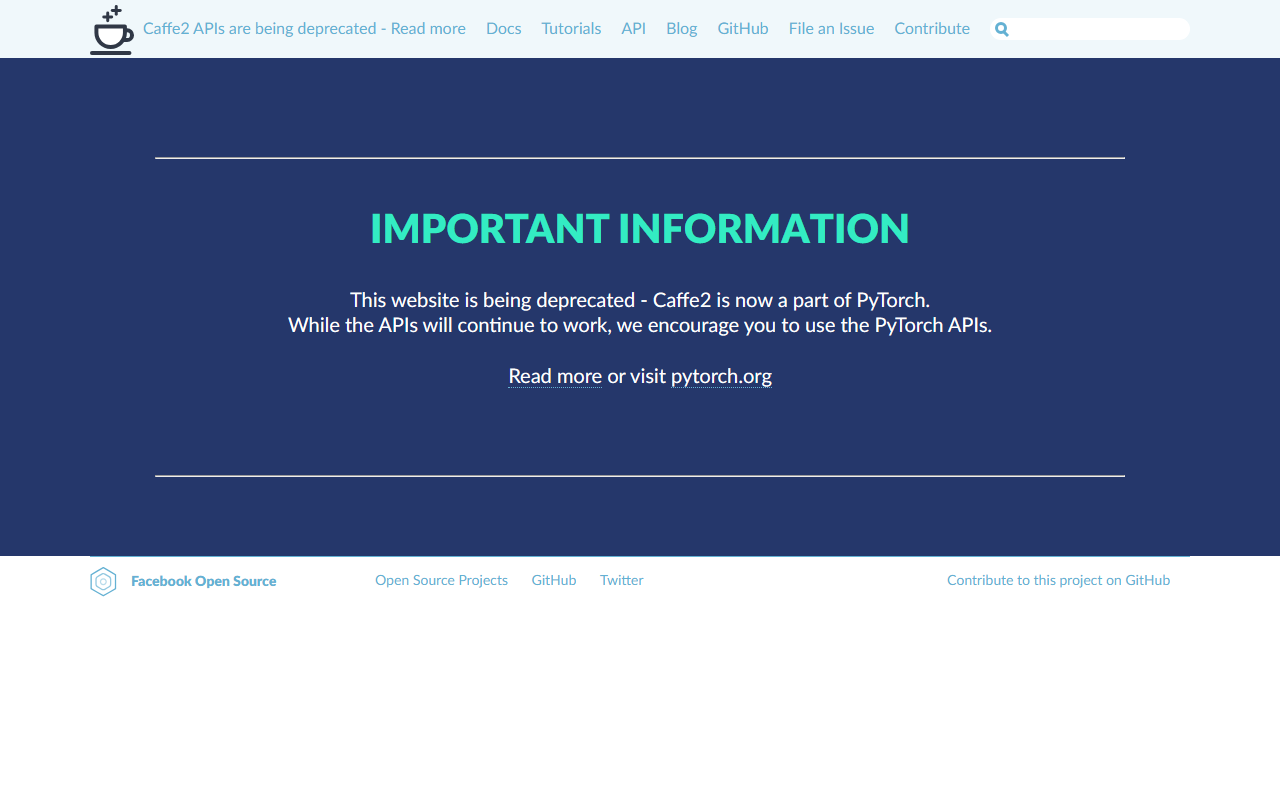
Upon visiting caffe2.ai, the first thing that strikes you is a prominent yellow banner at the top of the page. It reads: "This website is being deprecated - Caffe2 is now a part of PyTorch." The message is clear: Facebook is consolidating its deep learning efforts. The rest of the site is minimal—a brief description of Caffe2 as "A New Lightweight, Modular, and Scalable Deep Learning Framework," links to GitHub, Twitter, and a button redirecting to pytorch.org. There is no interactive dashboard, no onboarding flow, and no download link for the original framework. For a tech journalist trying to test the tool, the experience is a dead end. The site effectively serves as a historical footnote, pointing you to its successor.
What Caffe2 Was Meant to Do
Caffe2 was originally designed by Facebook to address specific pain points in production deep learning. While its predecessor Caffe was widely used in research, it lacked the modularity and efficiency needed for large-scale, cross-platform deployment. Caffe2 aimed to fix that. It was engineered to be lightweight—small enough to run on mobile devices—while still scaling to massive distributed systems. It supported CPUs and GPUs, and its C++ core made it fast for inference. The framework was particularly focused on scenarios like real-time image recognition, augmented reality, and mobile AI applications. Think of it as a more production-ready sibling to Caffe, with a cleaner codebase and better support for modern hardware. Facebook used it internally for features like automatic photo tagging and live video filters.
Technical Architecture and Key Features
From a technical standpoint, Caffe2 boasted several innovative traits. Its modular design used a directed acyclic graph (DAG) to define neural networks, which made it easier to slice and optimize specific parts of a model. The framework had built-in support for quantization and operator fusion, key for low-latency inference on edge devices. Developers could export models to formats like ONNX (Open Neural Network Exchange), which Caffe2 helped pioneer alongside Microsoft and AWS. This interoperability was a big selling point. On the deployment side, Caffe2 offered a C++ API and libraries for iOS and Android, allowing you to run models directly on phones without a Python runtime. Its memory footprint was notably smaller than TensorFlow at the time. However, the learning curve was steep: documentation was sparse after the merger announcement, and community support gradually dried up. The framework's lack of dynamic computation graphs (like those in PyTorch) also made it less flexible for research prototyping.
When testing the free tier—which is entirely open source under the Apache 2.0 license—I attempted to build a simple image classifier using the now-archived GitHub repository. The code compiled with CMake, but the dependency chain was fragile. For instance, it required CUDA 9.2 and cuDNN 7, which are now outdated. Getting a clean build on modern Ubuntu 22.04 required manual patching. The experience highlighted the risk of using a deprecated library: no new features, no security updates, and no support for current hardware or libraries. Despite these issues, the framework's core ideas—lightweight deployment and mobile-first design—are still visible in PyTorch's mobile module.
The Transition to PyTorch and What It Means for Developers
The decision to merge Caffe2 into PyTorch was strategic. PyTorch had already become the darling of the research community due to its dynamic graphs and Pythonic feel, while Caffe2 excelled in production deployment. By combining them under the PyTorch umbrella, Facebook gave developers the best of both worlds: researchers could prototype effortlessly, and engineers could deploy with the same codebase using PyTorch's TorchScript and PyTorch Mobile. According to the migration guides still available on the PyTorch website, most Caffe2 APIs have direct equivalents in PyTorch, and the ONNX export workflow remains unchanged. For existing Caffe2 users, the message is unambiguous: migrate to PyTorch. The old framework's APIs will continue to work for now, but there will be no further development. This makes Caffe2 unsuitable for new projects. Its main value today is as a learning resource for understanding early-production AI frameworks or for maintaining legacy systems that cannot yet be ported.
In terms of market positioning, Caffe2 was always a direct competitor to TensorFlow Lite on the mobile side. But TensorFlow Lite has since evolved with better hardware support and a larger community. Meanwhile, Apple's Core ML also carved out a slice of the mobile AI market. Caffe2's strength was its close integration with Facebook's ecosystem, but that advantage vanished once PyTorch absorbed it. Who should still consider Caffe2? Developers maintaining existing Caffe2-based apps in production—provided they are willing to run unsupported software. Everyone else should look to PyTorch directly. If you need a lightweight framework for mobile inference, PyTorch Mobile is the clear successor. If you want maximum compatibility, ONNX Runtime offers a runtime that can consume models from many frameworks, including Caffe2 exports.
To summarize my honest assessment: Caffe2 was a pioneering framework that solved real problems in production AI, but its active life is over. The strengths—lightweight design, ONNX support, mobile deployment—are now part of PyTorch. The limitations—deprecated code, outdated dependencies, minimal documentation—make it impractical for new work. Use this review as a historical reference and a nudge to adopt PyTorch if you are still clinging to the old framework.
Visit Caffe2 at https://caffe2.ai/ to explore it yourself.










Comments