
First Impressions and Navigation
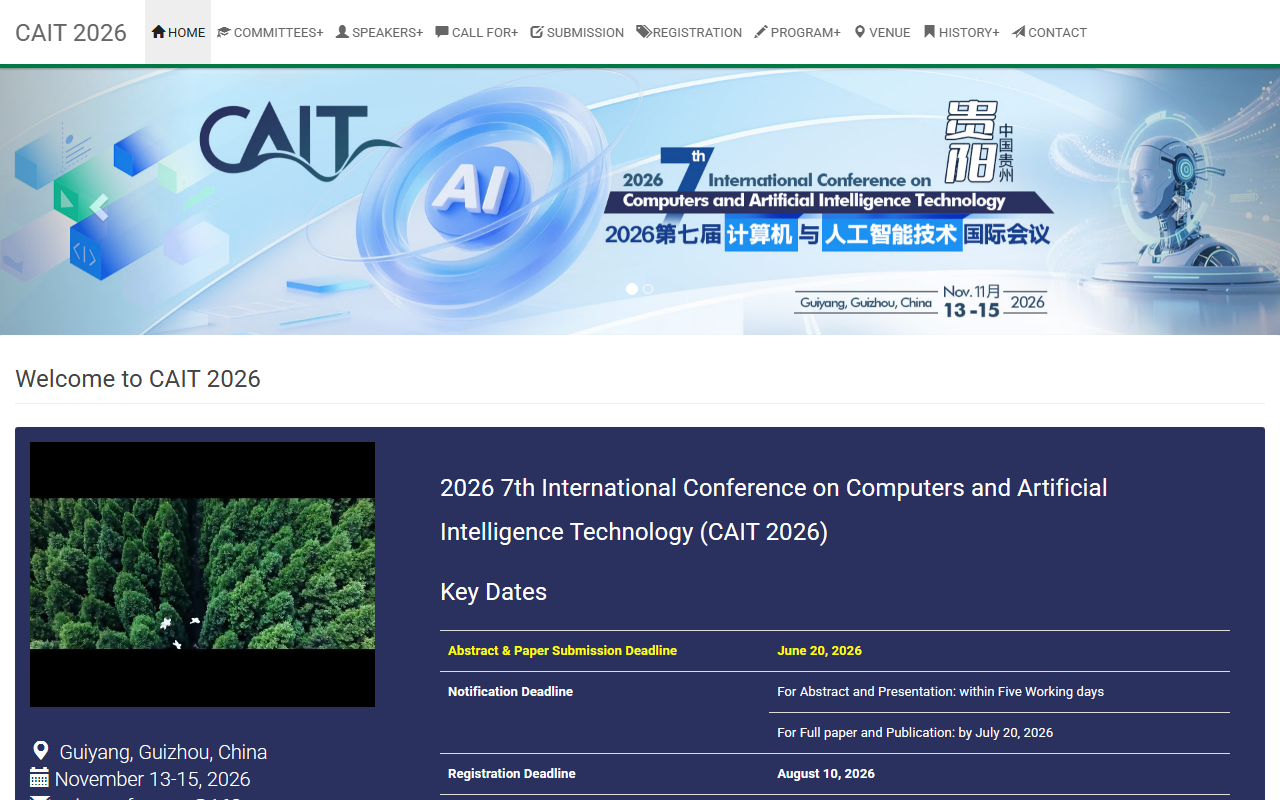
Upon visiting the CAIT website at cait.net, I was greeted by a straightforward, text-heavy landing page that focuses entirely on the 2026 conference details. The layout is simple: a top banner with the conference logo, followed by key dates, an introduction, proceedings information, special session listings, and submission links. There is no interactive dashboard, but the information is clearly organized. The page loads quickly, and all deadlines are prominently displayed. As a first-time visitor, I found it easy to locate the submission templates and registration links within seconds.
The overall design is functional rather than flashy, which is typical for academic conference sites. However, for a platform that claims to be a learning tool, it lacks any educational content beyond the call for papers. The “Quick Linkage” section provides direct access to paper submission and delegate registration, but there are no sample lectures, demo videos, or curated learning paths. This is a conference announcement site, not a self-paced learning platform.
What CAIT Offers and How It Works
CAIT stands for “Computers and Artificial Intelligence Technology” and is an annual IEEE international conference. The 2026 edition is the seventh, hosted by Guizhou University and patronized by multiple universities and institutes. The conference serves as a platform for researchers to present peer-reviewed papers, attend special sessions, and network with industry experts. The special sessions cover a wide range of AI subfields—from computer vision and digital economy to security for large language models and photonic AI. This breadth suggests a strong effort to include emerging and interdisciplinary topics.
When testing the submission process, I clicked through the “Submission linkage for full paper and abstract” link, which redirected to an external submission system (likely Microsoft CMT or similar). The site provides LaTeX and Word templates, and the review process is clearly described: papers are peer-reviewed, and accepted papers are published in IEEE proceedings indexed in IEEE Xplore, EI Compendex, and SCOPUS. For a researcher, this indexing is a major value add. However, for a typical “learning platform” user who just wants to learn AI, the conference does not offer tutorials or training modules—you would have to attend the event or purchase the proceedings afterward.
The conference does not list specific AI models or technologies used; instead, it focuses on the research the attendees contribute. The technology behind the conference itself is standard email-based communication and online submission. There is no API or software integration. The only way to “use” CAIT as a learning tool is to either submit a paper, register as a delegate, or purchase the proceedings. This is a significant limitation for anyone expecting a hands-on AI tool like a chatbot or coding platform.
Positioning and Audience
CAIT competes in the crowded space of international AI conferences. Unlike flagship venues such as NeurIPS or ICML, which draw thousands of attendees and have years of prestige, CAIT is a younger, smaller conference focusing on the Asia-Pacific region. Its advantage is the guaranteed IEEE indexing and the opportunity for early-career researchers to get their work published in a reputable venue. The special sessions are curated by known academics, which adds credibility. For practitioners in industry, the conference offers networking and exposure to current trends, but the value is time- and location-specific.
Pricing is not publicly listed on the website. Typically, registration fees vary by category (author, student, delegate) and are disclosed only after logging into the submission system. This lack of transparency is a minor annoyance but common among academic conferences. The website does not mention any funding, backing, or user base statistics; however, the list of patron institutions (including Macau University of Science and Technology and Beijing University of Posts and Telecommunications) signals respectable academic support.
This platform is best suited for academic researchers and graduate students who need to publish and present their AI work. It is also useful for industry professionals who want to stay current on research and network with academics. On the other hand, anyone seeking a self-contained learning tool (e.g., an interactive course or AI assistant) should look elsewhere—consider Google’s AI learning platform or Coursera courses instead.
Strengths and Limitations
Genuine strengths: The conference offers high-quality peer review and publication in IEEE Xplore with EI/SCOPUS indexing, which is crucial for academic career advancement. The special sessions are well-organized and cover diverse AI domains, from biometrics to photonic AI. The location in Guiyang, China, provides a unique experience for international attendees. Additionally, the website provides clear deadlines and submission templates, making the process straightforward.
Real limitations: The website is essentially a static information page—there are no interactive learning tools, demo videos, or tutorials. The conference only happens once a year, so it is not an on-demand learning resource. Also, the site lacks pricing details and does not offer any preview of the content quality. For a tool categorized as a “Learning Platform,” it falls short: there is no structured curriculum, no assessments, and no community forum for ongoing discussion. The conference is a valuable event, but not a tool you can use daily.
Final recommendation: Researchers looking to publish an AI paper in a reputable IEEE-indexed venue should consider submitting to CAIT 2026. Early-career academics will benefit from the supportive environment and networking opportunities. If you are a practitioner seeking a hands-on learning platform, this is not the right choice—you would be better served by Google’s TensorFlow tutorials or a MOOC. However, if you can attend, the conference promises a rich exchange of ideas. Visit CAIT at https://cait.net/ to explore it yourself.










Comments