

First Impressions and Onboarding
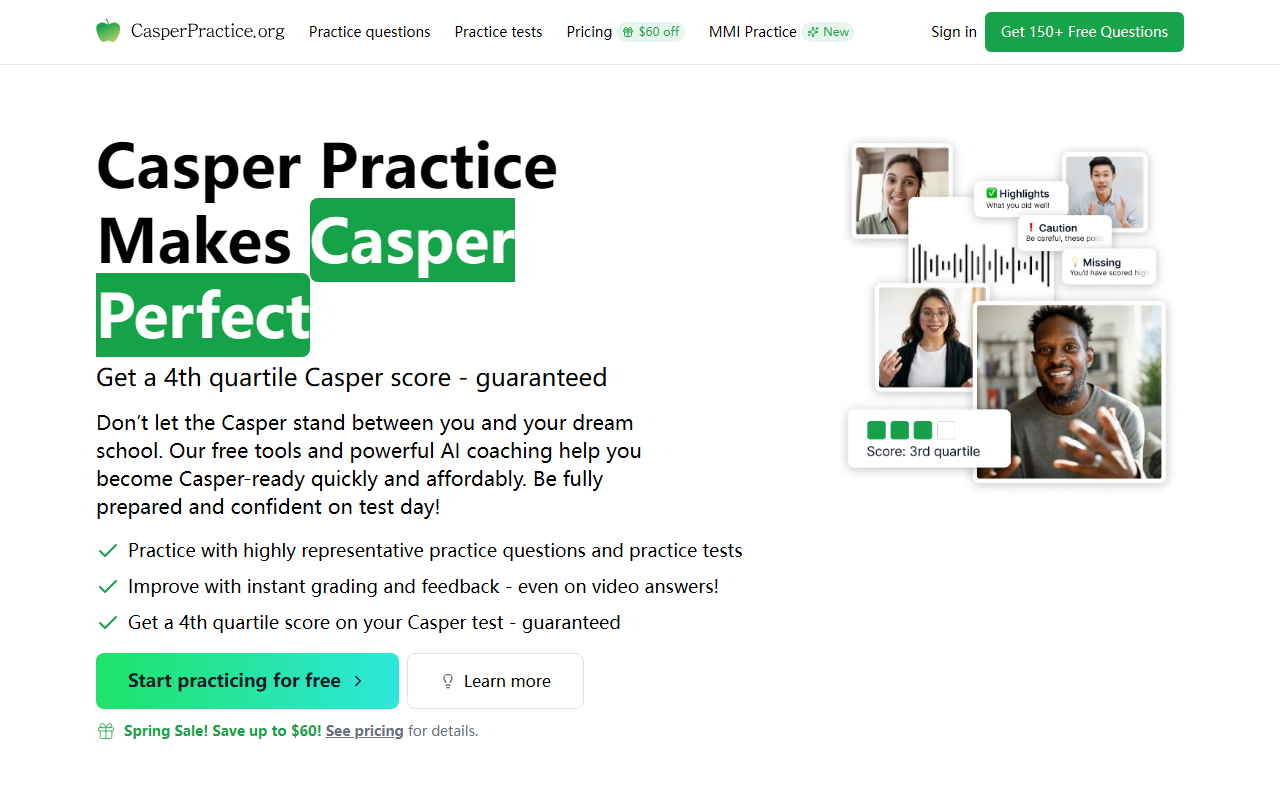
Upon visiting CasperPractice, I noticed a clean, focused landing page that immediately highlights a free tier with “150+ Free Questions.” The dashboard is straightforward — there’s a clear call-to-action to start practicing. I signed up using a simple email flow; no credit card was required for the free tier. The interface mimics the real CASPer test format: you answer text and video-based scenarios under timed conditions. The simulation felt authentic, and the initial practice question loaded without lag. For a first-time user, the onboarding is frictionless, letting you jump straight into a test or individual practice questions.
How CasperPractice Works — Tech and Feedback
CasperPractice uses a purpose-built AI model, not a generic ChatGPT wrapper. The platform analyzes each response across multiple dimensions: scenario understanding, ethical reasoning, communication clarity. After submitting an answer, I received a multi-paragraph analysis covering what I did well, what I missed, and specific recommendations. Notably, it also rewrites my answer into a “model answer” — showing exactly how a top-quartile response would look. This is where the tool shines. The feedback is far more detailed than what I’ve seen from general AI tools. The AI also assigns a quartile score, giving a rough benchmark of my performance. The technology appears to be trained on CASPer-specific frameworks and best practices, which adds credibility. The platform also supports video answers, using speech-to-text (I assume) to analyze spoken responses. I tested a text response; the feedback was delivered in under 30 seconds.
Pricing and Market Position
CasperPractice is not fully transparent with its pricing structure on the homepage. There is a mention of “Spring Sale! Save up to $60!” which suggests premium tiers exist beyond the free tier. The free tier gives access to 150+ questions and basic feedback, but the truly personalized AI coaching — including video analysis and unlimited practice tests — is likely part of a subscription. Compared to generic AI tools like ChatGPT, CasperPractice is specialized: it knows the CASPer rubric and won’t give you generic advice. Unlike traditional CASPer prep courses that can cost hundreds of dollars, CasperPractice positions itself as a more affordable alternative. The website claims to have served 26,272 happy students, and the testimonials are overwhelmingly positive, though they are user-submitted. Competitors include other CASPer-specific platforms like PrepMatch or BeMo, but CasperPractice differentiates with instant AI grading and rewritten model answers.
Final Verdict — Who Should Use CasperPractice
The tool’s main strength is its specialized AI feedback, which is actionable and framework-driven. It’s excellent for self‑motivated applicants who want affordable, on‑demand practice. However, it has limitations: the AI cannot replace human nuance in evaluating soft skills, and the quartile score is an estimation, not a guarantee. There is no live tutor interaction, so users who need hands‑on coaching may feel unsupported. The platform is best suited for pre‑med, pre‑dent, and other health program applicants who have a few weeks to practice. If you are already scoring high and need only fine-tuning, the free tier may be sufficient. For those starting from scratch, investing in the premium plan could be worthwhile. CasperPractice delivers on its promise of realistic simulation and fast, detailed feedback — a solid choice for CASPer prep.
Visit CasperPractice at https://casperpractice.org/ to explore it yourself.










Comments