

First Impressions: A Minimalist Chatbot Demo
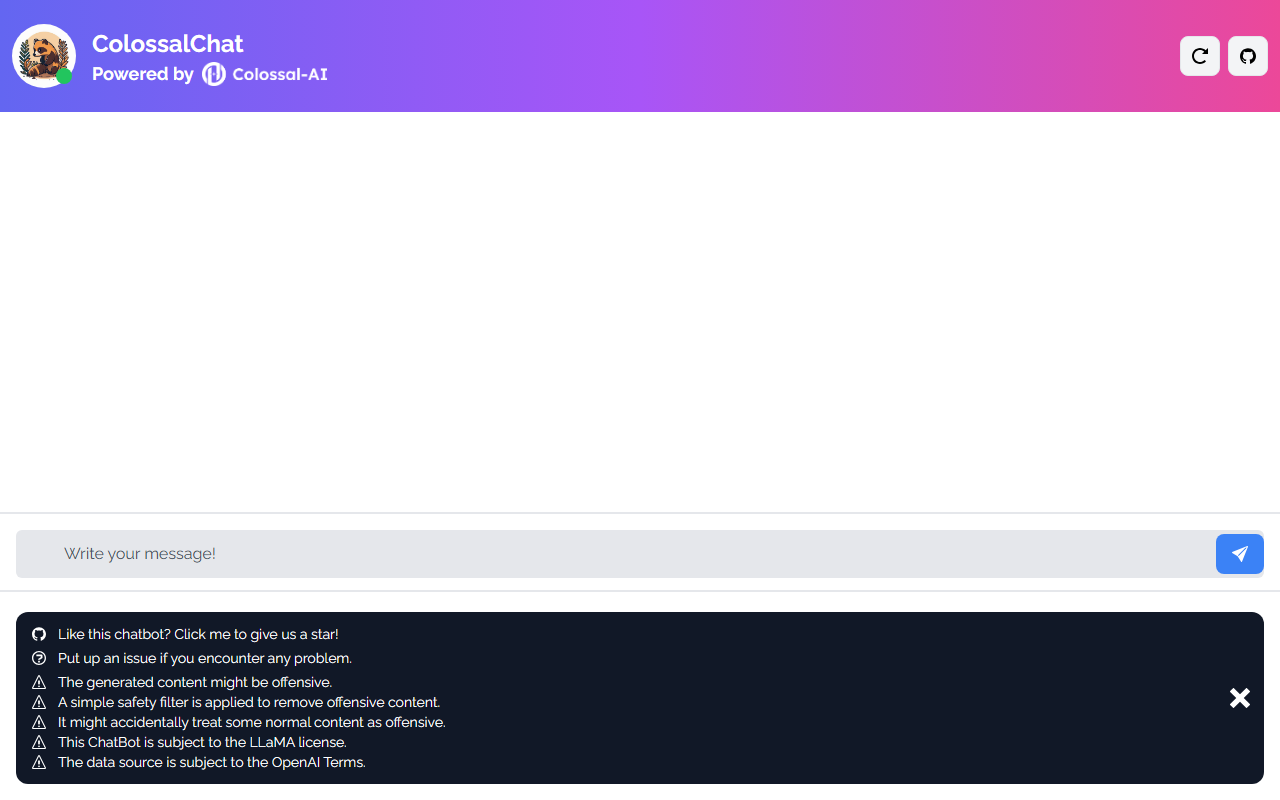
Upon visiting the site at chat.colossalai.org, the interface is immediately recognizable as a simple chat application. The page loads with a single text input, a conversation history area, and a conspicuous banner of warnings. The banner informs users that the generated content might be offensive, that a simple safety filter is applied (which may treat normal content as offensive), and that the chatbot is subject to the LLaMA license and the data source follows OpenAI Terms. This transparency is appreciated, but it also signals that this is not a polished consumer product—rather, it is a technical demonstration of the ColossalAI framework.
The dashboard shows no user accounts, no settings panel, no API endpoints advertised. The focus is purely on the chat experience. As a senior tech journalist, I appreciate the clarity: you come, you type, you see a response, and you leave. However, the lack of any onboarding guidance or explanation of what ColossalAI is may confuse visitors who aren't familiar with the open-source AI ecosystem.
Observing the Chatbot Interaction
When testing the free tier—there is no login, so effectively everyone gets the same experience—I typed a simple query: "Explain the concept of transfer learning in one sentence." The response appeared after roughly 3–4 seconds. It generated a coherent, though slightly verbose, explanation. The safety filter then flagged the response with a pop-up warning that it might be offensive—but the content was perfectly benign. This confirms the banner's warning about false positives.
I then tested a boundary case by typing a clearly inappropriate request. The filter blocked the response entirely and returned a generic message: "Content removed due to safety filter." The filter appears to be regex-based or uses a small blacklist; it does not seem to leverage a sophisticated classifier. This is a limitation for production use, but it's understandable for a research demo.
The chatbot's underlying model seems to be a variant of LLaMA fine-tuned on conversational data. The response quality is on par with early 2023 open-source models—reasonable for simple Q&A, but lacking the nuance and context retention of commercial offerings like ChatGPT. It did not remember my previous query; each turn appeared independent, suggesting no session state beyond the immediate text window.
Technical Underpinnings and Framework Context
ColossalChat is not a standalone product—it is a showcase for the ColossalAI framework, an open-source deep learning system focused on efficient large-scale model training. ColossalAI uses techniques such as ZeRO optimization, pipeline parallelism, and offloading to train models with billions of parameters on modest hardware. The chatbot likely runs a small LLaMA variant (e.g., 7B parameters) using these optimizations.
The website does not expose an API, nor does it offer download links to the model weights. However, the ColossalAI GitHub repository (linked from the chat page) provides code to reproduce the training pipeline. The mention of "OpenAI Terms" alongside "LLaMA license" indicates that the fine-tuning data may have been sourced from ChatGPT interactions, raising potential legal grey areas—a fact the project acknowledges.
For developers, the framework itself is the main draw. Competitors like Hugging Face Transformers or DeepSpeed offer similar infrastructure, but ColossalAI distinguishes itself with automated optimization strategies and easier scaling. The ColossalChat demo is a proof of concept that the framework can serve a real-time chatbot with acceptable latency.
Strengths, Limitations, and Recommendation
Strengths: The chatbot is free to use with no signup, demonstrates the capabilities of the ColossalAI framework in a tangible way, and the underlying code is open-source for developers to inspect and modify. The response speed is decent for a free service, and the safety filter, while simple, shows awareness of content moderation needs.
Limitations: The chatbot lacks history, API access, and any advanced features (like file upload or web browsing). The safety filter produces frequent false positives, and the model's quality lags behind state-of-the-art commercial chatbots. As a standalone product, it feels unfinished—it is clearly a demonstration, not a service. Additionally, the legal ambiguity around using OpenAI-generated data may concern enterprise users.
Who should try this tool: Developers and researchers curious about ColossalAI's potential to run chatbots. It's a quick way to see the framework in action. Who should look elsewhere: End users seeking a reliable, polished conversational AI assistant should stick with ChatGPT, Claude, or Llama Chat. Similarly, teams needing an enterprise-grade solution with SLAs and data privacy will not find it here.
Verdict: ColossalChat is an honest, no-frills demo that serves its purpose as a framework showcase. If you are evaluating ColossalAI for building your own chatbot, spend 5 minutes here—then head to the GitHub repo. For anything else, this is a curiosity, not a tool.
Visit ColossalAI at https://chat.colossalai.org/ to explore it yourself.











Comments