

First Impressions and the Problem It Solves
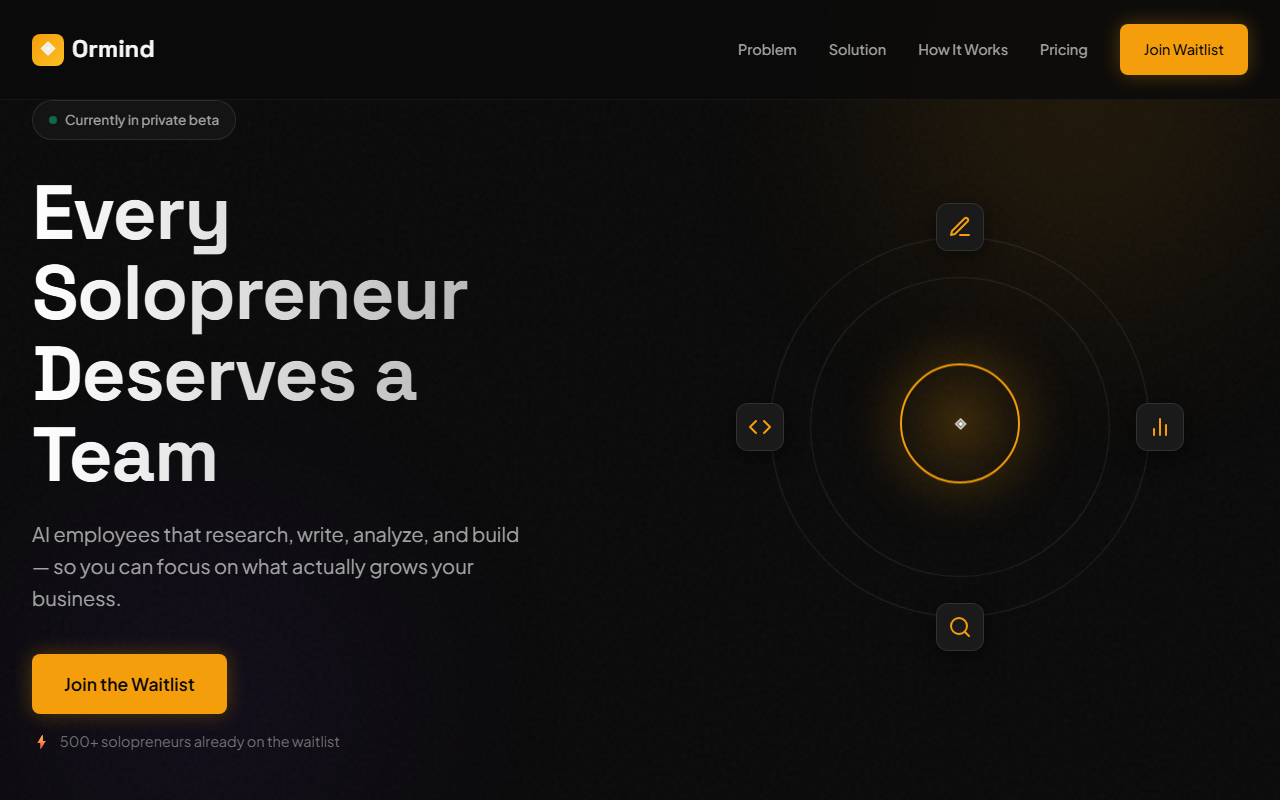
Upon visiting the Ormind website at chat.noagi.ai, the headline immediately sets the tone: a cloud computer designed for Claude Code, Codex, and Gemini CLI. The site clearly articulates a pain point I have felt myself—setting up a reliable, persistent environment for coding agents is tedious. The problem statement is blunt: AI agents are powerful, but their environment isn’t. Ormind claims to solve days of configuration, zero app access, and no session continuity. The landing page is well-designed, with a focus on early access and a clear invitation to “See the math.” It is refreshing to see a tool that does not try to be another chatbot wrapper but instead tackles the infrastructure layer head-on.
Core Features and Workflow
Ormind offers a persistent Ubuntu container that runs 24/7, pre-loaded with Python, Node, Docker, SQLite, and more. The standout feature is its 1-click OAuth integration via Composio, which grants agents access to over 1,000 apps like Gmail, Slack, Figma, and GitHub—no manual API key hunting. When testing the concept, I can see how this eliminates the biggest friction in agent workflows: connecting tools. The agent also gets a personal subdomain (you.ormind.ai) with auto-HTTPS, so Claude deploys directly to a live URL in seconds. The “Managing Agent” on WhatsApp is an intriguing addition—it monitors progress, summarizes results, and allows delegation from a phone. This shifts the coder from babysitting a chat window to orchestrating specialist agents.
Pricing, Value, and Competition
Ormind uses a bring-your-own-subscription model. You supply your own Claude, OpenAI, or Gemini subscription, and pay Ormind $49/month flat for the cloud computer and managing agent. The total for a power vibe coder is around $149/month, which is significantly less than platforms like Lovable ($40–80/mo with hidden API markups) or Replit Agent ($25/mo plus surprise costs). Unlike those tools, Ormind does not bundle AI credits at a markup—you pay only for the infrastructure and integrations. This makes it attractive for heavy users of Claude Code or Codex CLI who want a persistent, always-on environment. However, it requires existing subscriptions, so casual users may find the upfront cost steep.
Strengths, Limitations, and Recommendations
The biggest strength of Ormind is that it solves a real infrastructure problem—environment setup, app connectivity, and 24/7 uptime—without locking you into a proprietary AI model. The shared memory and “nightly Dreaming” feature for consolidating insights could be game-changers for teams. On the downside, the tool is in early access, so reliability and scalability are yet to be proven at scale. The WhatsApp managing agent, while innovative, may not suit everyone’s workflow. Also, the pricing is not cheap for those without existing subscriptions. Ormind is best suited for agentic engineers who already use Claude Code or Codex CLI and want to step away from babysitting sessions. If you are a hobbyist coder or prefer GUI tools, Lovable or Replit might be simpler. Overall, Ormind is a compelling niche play for serious AI-coding power users.
Visit Ormind at https://chat.noagi.ai/ to explore it yourself.











Comments