

First Impressions and Onboarding
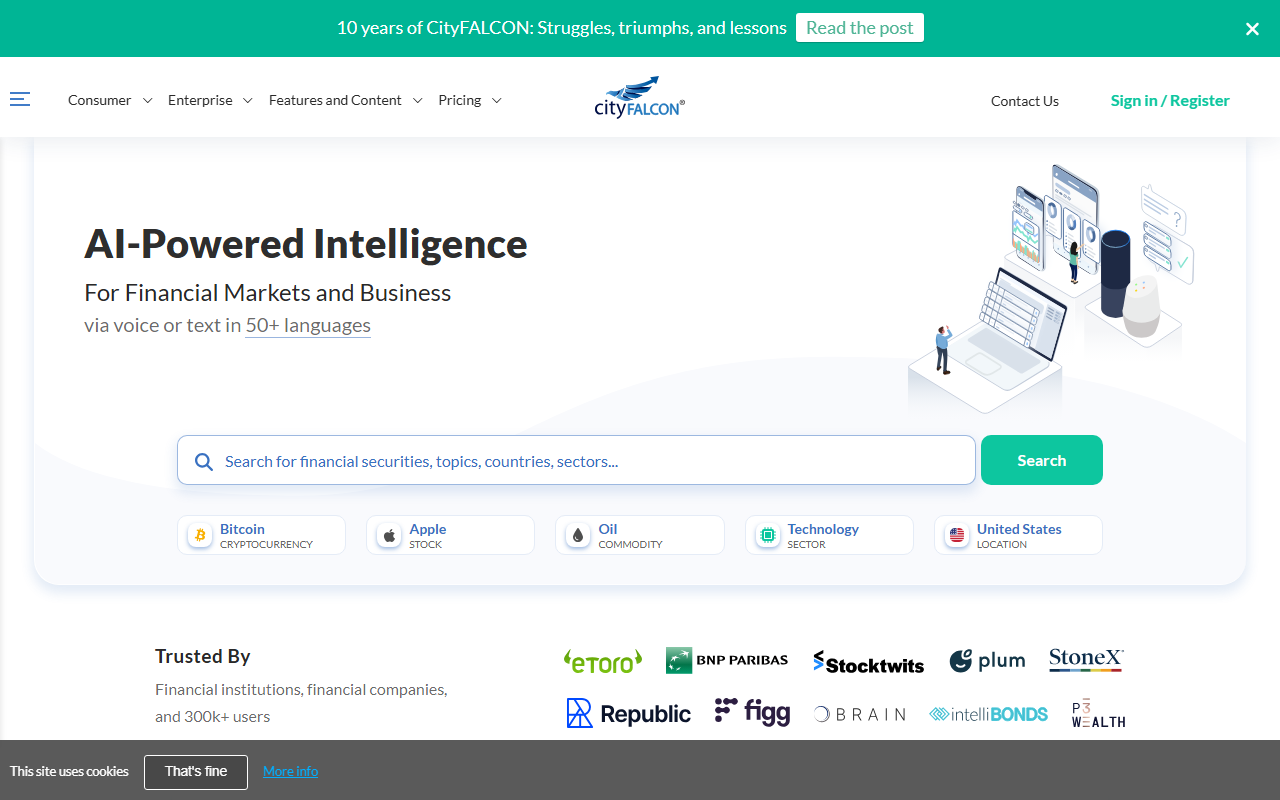
Upon visiting the CityFALCON website, I was struck by how cleanly the dashboard presents financial data. The interface immediately offers a search bar with sample queries like Bitcoin, Apple stock, Oil, Technology, and United States, inviting you to dive in. I tried searching for "Apple" and within seconds the system returned a mix of recent news, sentiment analysis, and related filings. The layout options — Rows, Compact, and Tiles View — let you tailor how news appears, which is a small but welcome touch for heavy users.
Registration is straightforward: you can sign in or create a free account. The free tier gives you access to a limited set of features, enough to gauge the tool's value. I noticed a prominent "Get Started for Free" button, and after signing up, I was guided through setting up my location and language preferences. The onboarding flow is quick, and within five minutes I had my first watchlist running. The tool claims to monitor "thousands of sources" and I saw evidence of that immediately — news from Reuters, Bloomberg, and regional outlets appeared side by side.
Core Features and AI Capabilities
CityFALCON positions itself as an AI-powered intelligence platform for financial markets and business due diligence. The core feature is its ability to aggregate news, official company filings, insider transactions, ESG reports, and investor relations content from around the world. What sets it apart is the CityFALCON Score, a proprietary metric that attempts to quantify the relevance and impact of news items. I tested the sentiment analysis on a few stocks, and the tool provided a clear positive/negative sentiment bar chart for the selected time period (1 day, 1 week, 1 month). The sentiment seemed reasonable, though I’d want to verify the underlying NLP model's accuracy over time.
Another standout is the Similar Stories Grouping feature. When scrolling through news, the tool automatically clusters related articles, saving you from reading the same story ten times from different sources. I found this particularly useful for tracking the COVID-19 impact on airline stocks. The platform also offers push notifications, content translation (50+ languages are supported), and the ability to create watchlists for specific securities, sectors, or locations.
For enterprise users, CityFALCON provides an API for real-time data, an NLP extraction API for structuring insights from custom content, and a Financial News MCP (likely a model context protocol integration). The technology appears to rely on natural language processing to extract entities, events, and sentiment. I didn't have access to the API during my test, but the documentation on the site suggests it's robust.
Pricing and Target Audience
CityFALCON offers several subscription plans for consumers, but exact pricing is not publicly listed on the website. You need to contact sales or sign up to see specific numbers. The site does mention "Enterprise Solutions" with categories like Brokers, Academia, Wealth Managers, and Institutional Investors. The free tier is generous enough for casual use, but power users will likely need a paid plan to unlock advanced features like insider transactions, ESG content, and unlimited watchlists.
Compared to competitors like Yahoo Finance or Bloomberg Terminal, CityFALCON occupies a middle ground: it offers a more curated, AI-driven experience than basic free aggregators, but it's not as deep or expensive as a full Bloomberg subscription. For a retail investor or a student, the free tier alone provides excellent value. For a professional analyst, the API and enterprise plans could replace multiple costly data feeds.
Verdict: Who Should Use CityFALCON?
CityFALCON's greatest strength is its breadth of content in one place — news, filings, insider trades, and ESG data all accessible through a single search. The AI-powered summarization and sentiment analysis are genuinely useful shortcuts. However, there are limitations: the free tier restricts some features (e.g., ESG reports are behind a paywall), and the sentiment analysis sometimes flags ambiguous news as neutral when a human might see nuance. Also, the reliance on user-provided location settings means your results might miss local sources if you don't configure them carefully.
This tool is best for: retail investors who want a comprehensive daily briefing without switching tabs, finance students conducting research, and wealth managers looking for an affordable due diligence layer. It is less suited for high-frequency traders who need millisecond updates (the API might help, but latency isn't the focus) or for users who already have access to Bloomberg Terminal and need very specific proprietary data.
Overall, CityFALCON delivers on its promise of personalised financial intelligence. The 300k+ user base and trust from financial institutions suggest it's a reliable tool. I recommend trying the free tier for a week — set up a watchlist for a few stocks you follow and see if the AI-enhanced reading experience saves you time. If it does, the subscription is worth the investment.
Visit CityFALCON at https://cityfalcon.ai/ to explore it yourself.










Comments