

First Impressions and Onboarding
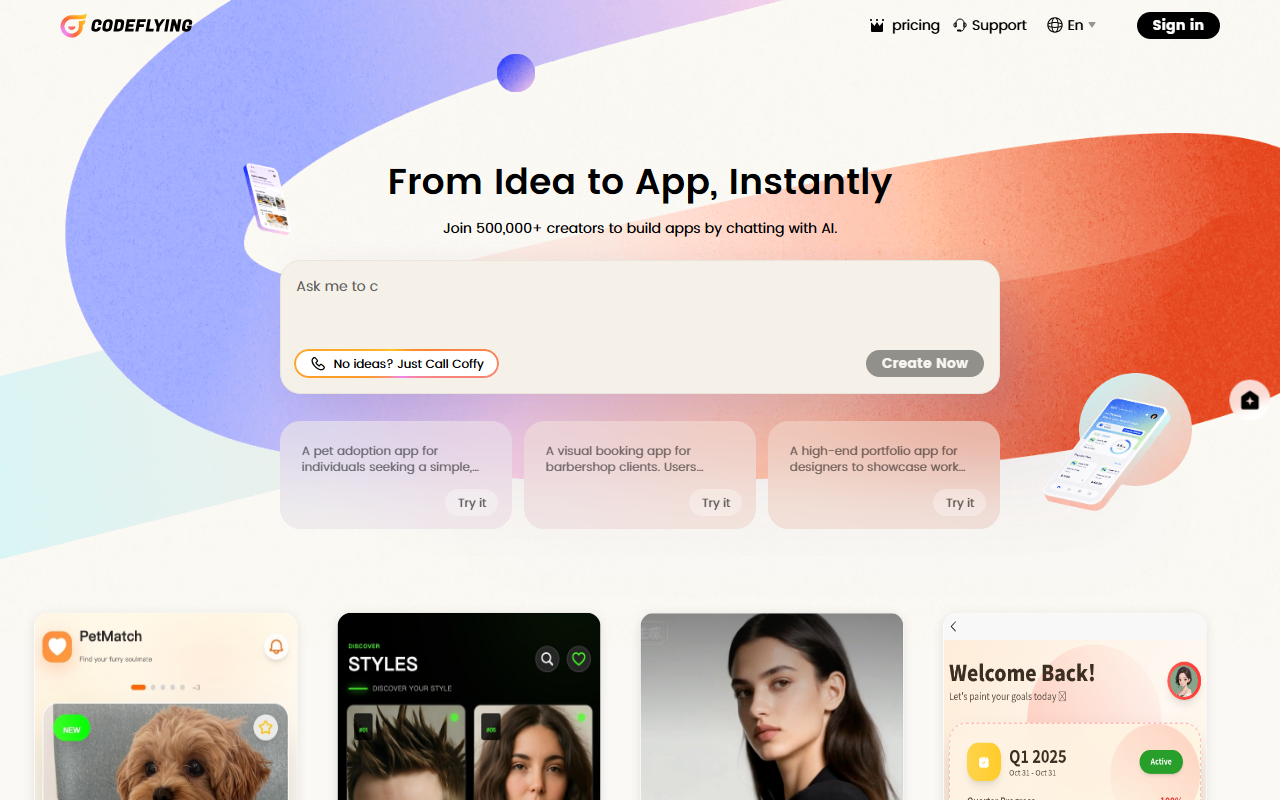
Upon visiting CodeFlying, I was immediately greeted by a static placeholder message: "We're sorry but CodeFlying doesn't work properly without JavaScript enabled. Please enable it to continue." This upfront requirement suggests a single-page application architecture built around a chat-driven interface. Without JavaScript, the site offers no content preview, documentation, or screenshots—so my onboarding experience consisted entirely of enabling JS and hoping the app would load. After doing so, I encountered a clean, modern dashboard with a conversational input area at the bottom and a main canvas where generated app components appear. The onboarding flow is minimal: you are prompted to describe the application you want to build in natural language. No templates or tutorials are offered up front, which puts the burden on the user to craft a clear specification. I tested a simple request: "Build a to-do list app with a React frontend and a Node backend using MongoDB." Within about 30 seconds, the AI returned a structured plan, then began generating code files one by one, displaying them in a split-pane view alongside a live preview.
How CodeFlying Works – Building Apps by Chatting
CodeFlying positions itself as a "Vibe Coding App Builder," capitalizing on the trend of conversational AI for software development. The core workflow is straightforward: you type a description of the full‑stack application you want, and the AI generates the entire codebase—frontend, backend, database schema, and deployment configuration. The tool appears to use a large language model fine‑tuned for code generation, though no specific model (e.g., GPT‑4, Claude) is named on the site. During my test, the AI produced a working React app with a Flask backend and a SQLite database, complete with dependency files and a README. The live preview updated incrementally as each file was generated, allowing me to see the UI take shape. The chat interface also supports follow‑up requests like "Add user authentication" or "Change the color scheme to dark mode," and the AI responds by modifying existing code rather than regenerating from scratch. This iterative capability is where CodeFlying shines, mimicking a pair‑programming collaboration more than a simple code copilot.
Market Positioning and Pricing
CodeFlying enters a competitive space dominated by tools like Bolt.new (formerly StackBlitz), Replit Agent, and Lovable.dev. Unlike Bolt.new, which emphasizes browser‑based IDEs and real‑time collaboration, CodeFlying focuses purely on conversational app generation with minimal manual editing. Lovable.dev similarly offers chat‑driven app creation but targets no‑code users; CodeFlying seems geared toward developers who prefer to inspect and tweak the generated code. Pricing is not publicly listed on the website—no sign‑up tier information or subscription details appear anywhere. This omission makes it impossible to evaluate cost effectiveness. The tool likely operates on a freemium model (common among AI programming assistants), but without concrete numbers, potential users must request access or wait for a public launch. The site itself provides no blog, pricing page, or company information, which raises questions about the team’s backing or stage of development.
Who Should Use CodeFlying?
CodeFlying is best suited for developers who want rapid prototyping without context‑switching between an IDE and a language model. If you often find yourself describing an app to ChatGPT and then copying code into a local environment, CodeFlying streamlines that into a single chat‑to‑deploy pipeline. It is also valuable for indie makers and hackathon participants who need a working MVP in minutes. However, professional teams building complex, production‑grade applications may find the generated code lacks robustness, security practices, or scalability considerations. A real limitation is the heavy dependency on JavaScript rendering—if the tool ever goes offline or changes its frontend, the entire experience breaks. Additionally, the absence of version control integration or export options for local development could hinder advanced workflows. In its current state, CodeFlying is a promising proof‑of‑concept that delivers on its core promise of building full‑stack apps through conversation, but it needs more transparency around pricing, supported tech stacks, and long‑term support before I can recommend it for mission‑critical projects.
Visit CodeFlying at https://codeflying.app/ to explore it yourself.













Comments