

First Impressions: What Coder Actually Does
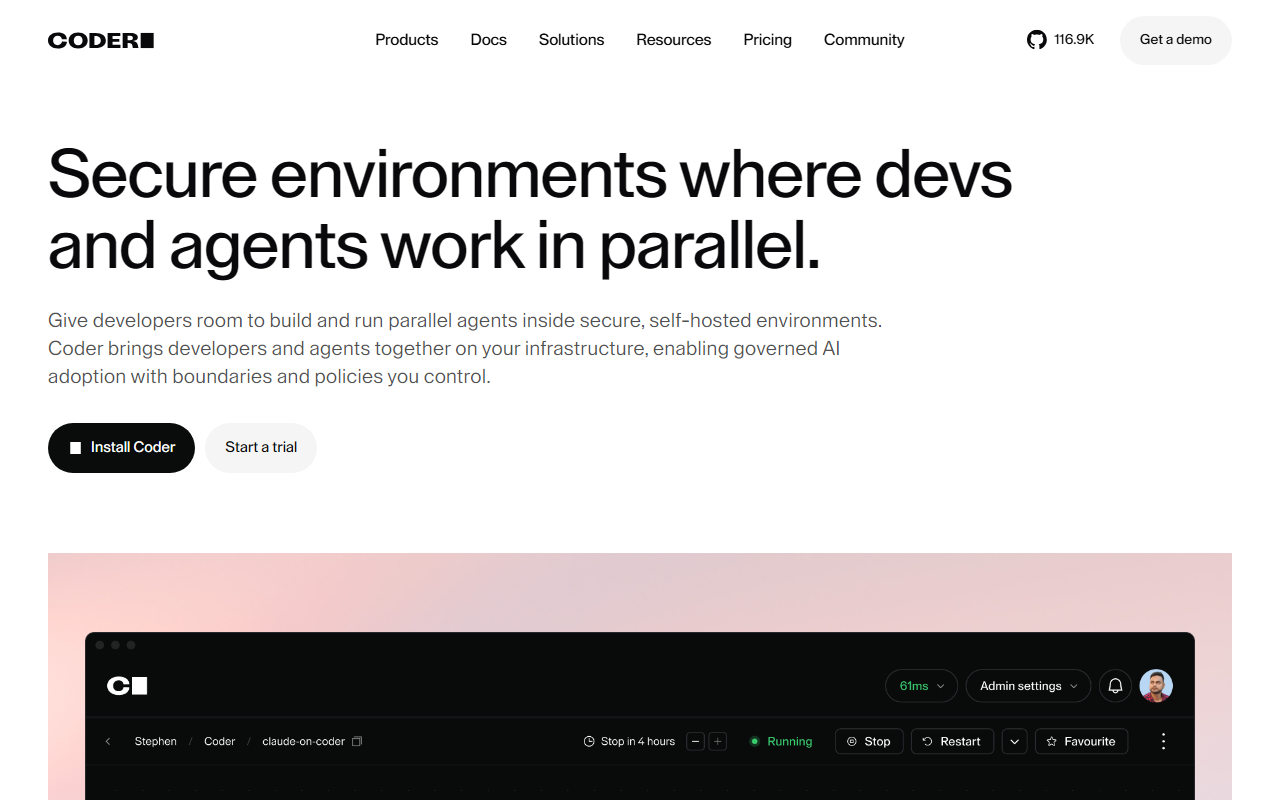
Upon visiting Coder's website, I immediately notice a clean, enterprise-focused layout. The homepage clearly positions the platform as an "Enterprise AI Development Infrastructure & Governance" tool. This isn't just another cloud IDE — it's a self-hosted solution for provisioning consistent, secure development environments on your own infrastructure. The dashboard showcases two core products: Workspaces and AI Governance.
Workspaces allow developers and AI coding agents to spin up isolated environments defined as code using Terraform. During a quick scan of the integrations page, I see support for VS Code, JetBrains, Cursor, Windsurf, and Dev Containers — covering both traditional and AI-native editors. The platform is built for scale, with case studies from the U.S. Department of Defense, Dropbox, and Palantir. One standout claim: J.B. Hunt reduced developer VDI costs by 90% after switching to Coder.
What sets Coder apart is its focus on governance. Rather than just providing remote dev environments, it offers a centralized gateway to observe and control LLM tool usage. This is critical for regulated industries like finance, government, and automotive, where data leakage is a major concern.
Digging Deeper: AI Governance and Enterprise Security
The AI Governance feature is the real differentiator. It acts as a proxy between developers and external LLM services, allowing IT teams to set policies, audit prompts and responses, and restrict which models or agents can access sensitive codebases. During my exploration, I noted that Coder is designed to work in air-gapped environments — a must for defense and intelligence agencies. The platform runs on your infrastructure, whether cloud or on-premises, and supports all classification levels.
Technical details: environments are provisioned via Terraform templates, ensuring repeatability. You can define any infrastructure — from VMs to Kubernetes clusters — and attach GPUs for ML workloads. The platform claims to support "any IDE, tool, language, or OS." I observed mentions of integration with Backstage for developer portals, which adds to its enterprise readiness. The changelog and GitHub repository indicate active open-source development, though the premium features likely require a license.
For security-conscious teams, Coder offers granular access controls and compute optimization. The messaging around "parallel agents" suggests support for running multiple AI coding assistants (like Copilot or Cursor) within siloed environments, giving admins full visibility into agent behavior.
Pricing, Alternatives, and Target Audience
Pricing is not publicly listed on the website. Coder appears to follow a contact-sales model, with prominent "Get a demo" and "Start a trial" calls to action. This is typical for enterprise infrastructure software. For budget transparency, you'll need to reach out directly.
Alternatives include GitHub Codespaces and Gitpod, which offer cloud-based dev environments but lack the same level of self-hosted AI governance. For pure AI agent management, tools like LangSmith or Weights & Biases provide observability but not full environment provisioning. Coder occupies a unique niche: it combines infrastructure-as-code with AI oversight.
This tool is best suited for large enterprises in regulated sectors — banking, defense, healthcare — that need to maintain compliance (GDPR, DORA) while empowering developers with fast, consistent environments and AI tools. Solo developers or small startups will find the overhead and cost prohibitive.
Strengths, Limitations, and Final Verdict
Strengths: Coder delivers on its promise of secure, self-hosted dev environments with excellent governance features. The Terraform integration ensures reproducibility, and the ability to run on air-gapped infrastructure is rare and valuable. The case studies provide concrete evidence of cost savings and speed improvements.
Limitations: The lack of transparent pricing makes evaluation difficult for smaller teams. The platform's complexity — requiring Terraform expertise to create templates — may intimidate less technical organizations. Additionally, the focus on enterprise features means it's overkill for individual developers or small projects.
Overall, I recommend Coder to any enterprise that needs to combine fast developer onboarding with strict AI governance and compliance. If you're a large organization already using Terraform and managing multiple AI coding tools, this is a compelling choice. For others, consider lighter alternatives. Visit Coder at https://coder.com/ to explore it yourself.













Comments