

First Impressions and Onboarding
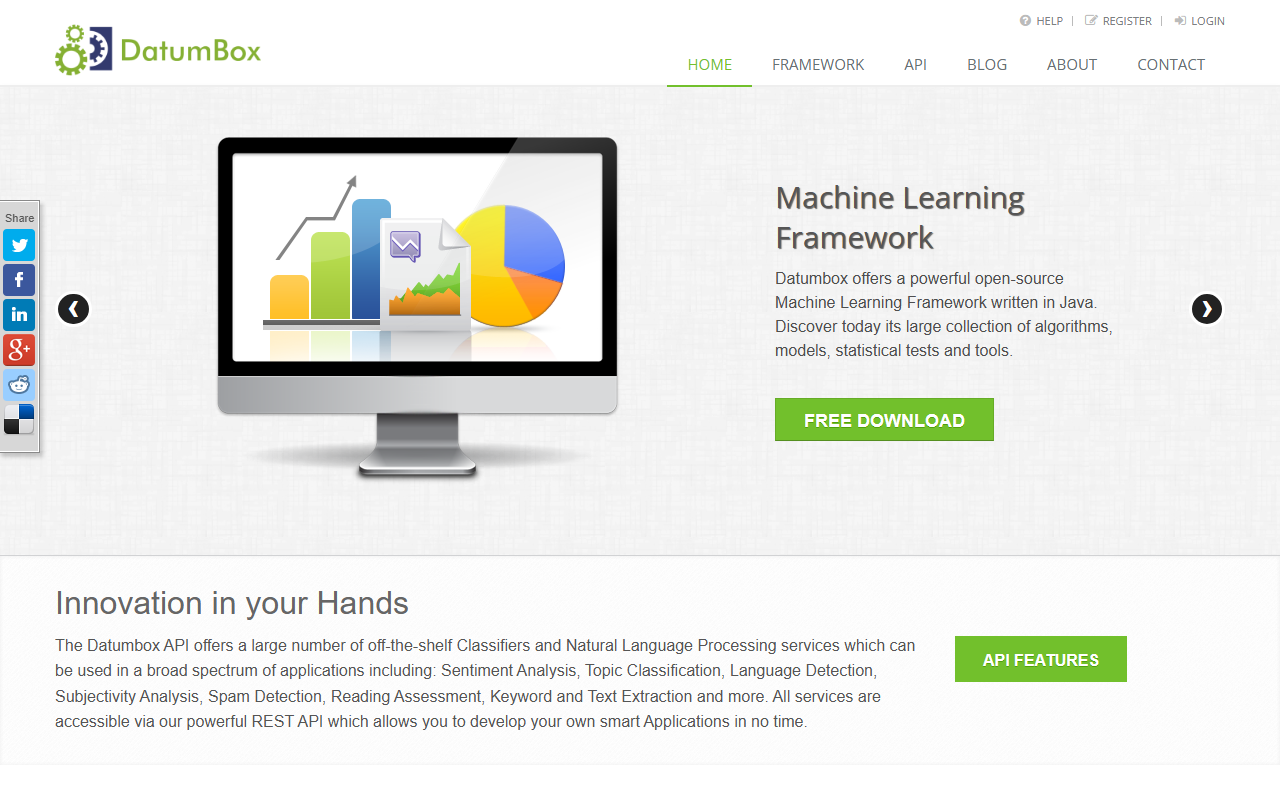
Upon visiting Datumbox's website, I was greeted by a clean, no-nonsense landing page that immediately emphasizes two core offerings: an open-source Machine Learning Framework written in Java, and a REST-based text analysis API. The homepage balances brevity with clarity, and within seconds I understood that this platform aims to serve developers who want off-the-shelf NLP classifiers without training their own models. The call-to-action buttons—"Free Download" for the framework and "Get a Free API Key" for the API—are prominent. I registered for a free API key, which was a quick email-only process. The dashboard, once logged in, is minimal: it shows your API key usage, a link to documentation, and little else. There's no interactive sandbox, so testing the free tier required me to manually craft a curl request. I sent a sample text to the sentiment analysis endpoint, and it returned a JSON response with a classifier label (e.g., "positive" or "negative") and a confidence score. The response was fast—under 200ms—and the structure was as simple as advertised.
Core Technology and Capabilities
Datumbox’s API exposes a wide range of NLP services: sentiment analysis, topic classification, language detection, subjectivity analysis, spam detection, keyword extraction, and reading assessment. Under the hood, it relies on the open-source Datumbox Machine Learning Framework (Java), which includes algorithms like Naive Bayes, SVM, and clustering methods. This framework is separate from the API; you can download it and train custom models on your own data. The API itself, however, provides pre-trained models that are ready to use. The documentation is concise—about a dozen endpoints—with code samples in Python, PHP, Ruby, and Java. During my test, the topic classifier correctly identified a news snippet about technology as "Technology & Computing." The API uses REST and JSON, making integration straightforward. Notably, the platform does not appear to offer any model customization or retraining for the cloud API; it's a fixed set of classifiers. That's a clear design choice: simplicity over flexibility. For developers needing a quick, high-level text analysis tool without heavy infrastructure, Datumbox delivers.
Pricing, Market Position, and Limitations
Datumbox offers a free tier that provides 1,000 API calls per day—generous for experimentation. Beyond that, pricing is not publicly listed on the website. You must contact sales for paid plans. This lack of transparent pricing is a friction point for developers evaluating cost before committing. In terms of market position, Datumbox competes with services like Google Cloud Natural Language API, AWS Comprehend, and MonkeyLearn. Unlike those giants, Datumbox focuses solely on text analysis with a developer-first, no-frills approach. It does not offer entity analysis or document-level classification beyond its fixed set of categories. The open-source framework is a differentiator—it lets you run Datumbox algorithms locally, which is appealing for privacy-sensitive projects. However, the library's documentation is sparse; the GitHub repository has limited activity, with the last commit in 2020. This suggests the framework is stable but not actively evolved. The user base appears modest—no logos or testimonials on the site. Datumbox is best suited for indie developers, small businesses, or educators who need a simple, reliable NLP API without vendor lock-in. Larger enterprises needing scale, custom models, or advanced features should look elsewhere.
Strengths, Weaknesses, and Final Verdict
Strengths: Datumbox’s simplicity is its greatest asset. The free tier is generous, the API is fast and well-documented, and the open-source framework provides transparency and offline capability. The service requires no machine learning expertise—just a HTTP call. It's also refreshing to see a tool that doesn't push a complex dashboard or demand a credit card upfront.
Weaknesses: The lack of public pricing for paid tiers is a notable gap. The fixed set of classifier categories (e.g., only 10 topic labels) may not fit niche verticals. There's no support for custom model training via the API, and the documentation, while clear, could include more real-world use cases and error-handling examples. The framework's Java-only nature limits its appeal among Python-first developers.
Overall, Datumbox is a niche but effective tool for straightforward text classification tasks. I recommend it for hackathons, prototypes, or small projects where a free, no-nonsense NLP endpoint suffices. If you need production-grade flexibility or scale, consider alternatives. Visit Datumbox at https://datumbox.com/ to explore it yourself.













Comments