

First Impressions and Architecture
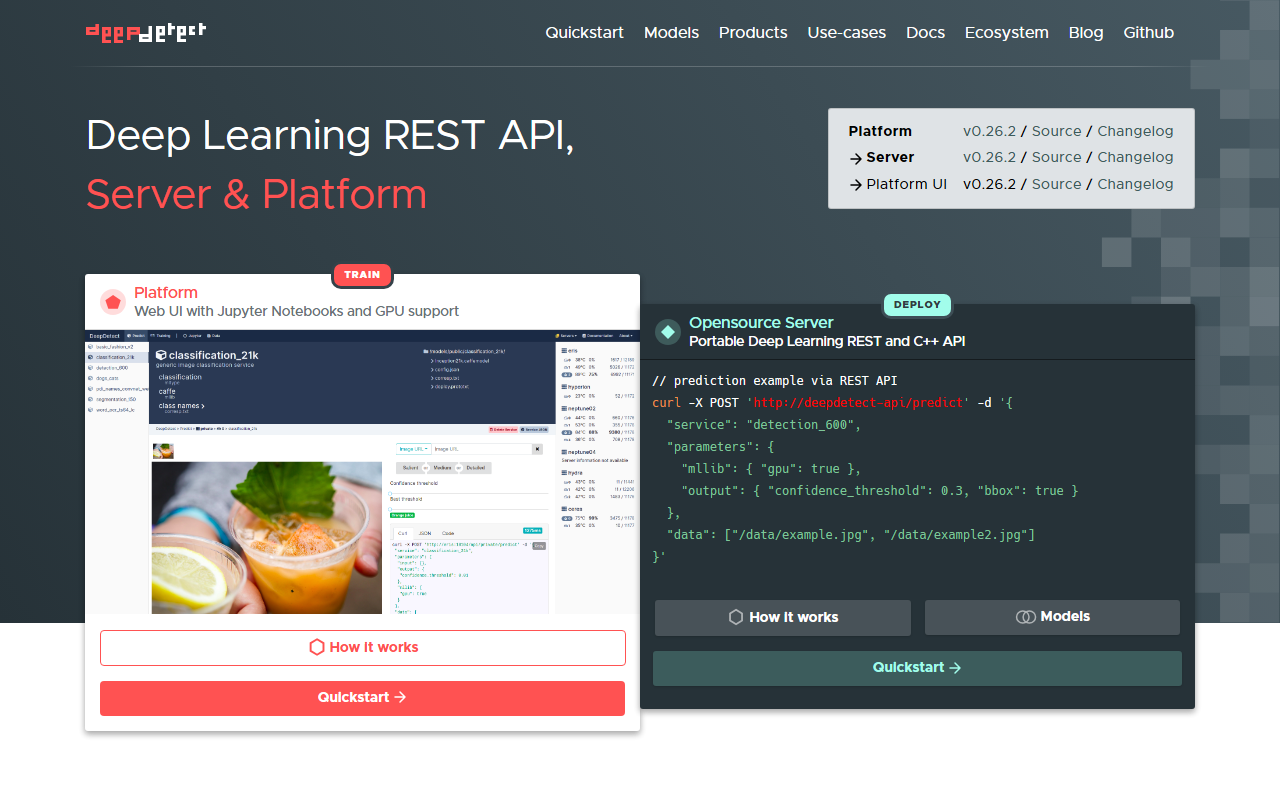
Upon visiting DeepDetect at deepdetect.com, I was greeted by a clean, developer-focused landing page that immediately showcases three main components: the Server (v0.28.0), the Platform UI (v0.26.2), and the core Platform itself. The site makes it clear that DeepDetect is not a single product but an ecosystem—an open-source deep learning REST API, a C++ server, and a web-based platform for training and deployment. This is a refreshing departure from many black-box AI services.
I started by exploring the Server documentation. The provided curl example—a POST request to /predict with parameters for GPU usage and confidence threshold—gives a solid taste of the workflow. The server is written in pure C++ and claims to support cloud, desktop, and embedded devices from a single codebase. This is a significant technical differentiator. The Platform UI, in contrast, offers a web interface with Jupyter Notebook integration and GPU support, aimed at higher-level model management.
The onboarding flow is straightforward for developers: you can either download the server source or use the Docker images. The Quickstart guides are minimal but functional. There is no signup or API key required for the open-source server; you self-host everything. This lowers the barrier for users who want full control over their data and infrastructure.
Capabilities and Use Cases
DeepDetect supports a wide range of AI tasks: image tagging, object detection, segmentation, OCR, audio, video, text classification, and even CSV for tabular and time-series data. The site proudly lists 25+ pre-trained models and neural network templates for GPUs, CPUs, and embedded devices. I tested the server locally with a few sample images from their GitHub repo. The response time was impressive—sub-second for object detection on a mid-range GPU—thanks to the optimized C++ backend.
What sets DeepDetect apart from cloud alternatives is its emphasis on “frugal models” and small-data training. A blog post from August 2021 discusses strategies for deep models with limited data, indicating that the platform is built for real-world scenarios where labeled data is scarce. The platform UI includes a web-based training interface that lets you upload data, configure hyperparameters, and monitor experiments without writing code. This bridges the gap between a REST API and a full MLOps platform.
For deployment, the REST API can serve multiple models simultaneously (real-time multiple model inference is a highlighted feature from a January 2022 post). The C++ server also exposes a native C++ API for applications requiring ultra-low latency. This dual interface—REST and native C++—makes it suitable for both microservices architectures and embedded systems.
Pricing, Open Source Ecosystem, and Competitors
Pricing is not publicly listed on the website. Since both the Server and Platform UI are open source (hosted on GitHub with changelogs and source links), you can use them for free. There is no mention of a paid cloud tier or enterprise license; the project appears to be community-driven. This is a strength for budget-conscious teams but a limitation if you need managed hosting or dedicated support. The site invites users to join a Gitter chat or subscribe to a newsletter for updates—not a typical commercial sales funnel.
Among alternatives, TensorFlow Serving and TorchServe are the most direct competitors. Unlike TensorFlow Serving, which is tightly coupled to the TensorFlow ecosystem, DeepDetect offers a model-agnostic approach with built-in support for various architectures and a unified REST API. It also distinguishes itself with the Platform UI and Jupyter integration. On the other hand, cloud services like AWS Rekognition or Google Cloud Vision provide simpler APIs but lock you into their infrastructure and pricing models. DeepDetect is best suited for teams that want to avoid vendor lock-in and need to deploy on edge devices or air-gapped environments.
The project’s “Great teams use DeepDetect around the world” claim is backed by a small but active community. The latest blog posts are from 2022 and 2021, which suggests the pace of new features may have slowed. However, the core functionality is mature and well-documented.
Final Verdict and Recommendations
DeepDetect is a powerful open-source framework for deep learning inference and training, especially strong in its performance and flexibility. It genuinely solves the problem of deploying AI across diverse hardware with minimal overhead. The C++ server is a standout feature for latency-sensitive applications.
However, it has limitations. The documentation, while adequate, lacks the polish of commercial alternatives. The web UI is functional but not as polished as offerings from SageMaker or Vertex AI. New users may find the initial setup (e.g., installing dependencies, configuring GPU support) challenging if they lack DevOps experience. Also, the absence of a managed cloud option means you must handle scaling and reliability yourself.
I recommend DeepDetect for data scientists and ML engineers who want full control over their stack, prefer open-source tools, and need to deploy models on edge devices or inside complex C++ pipelines. It is less suitable for teams that prioritize rapid prototyping with minimal infrastructure management. If you’re comfortable with Docker and REST APIs, give it a try—the free open-source license is a compelling reason.
Visit DeepDetect at https://deepdetect.com/ to explore it yourself.










Comments