

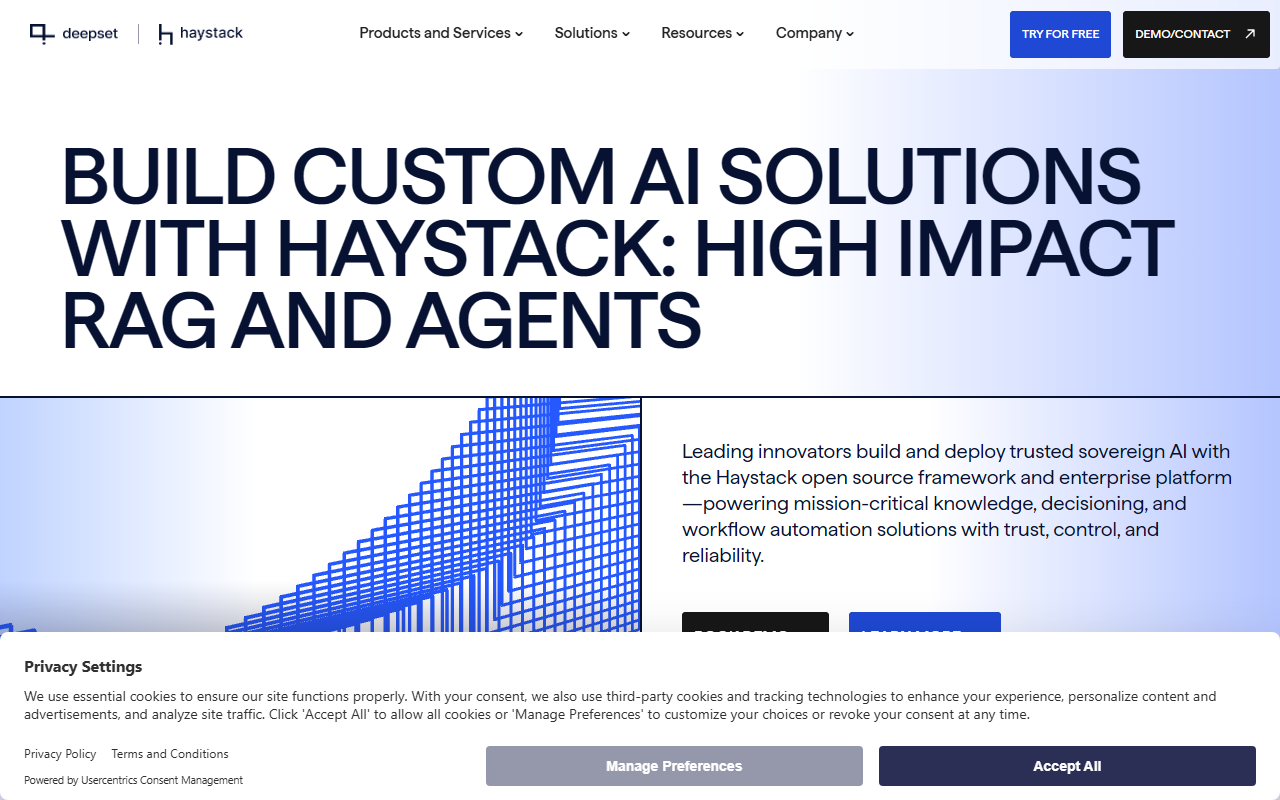
First Impressions and Onboarding
Upon visiting deepset.ai, the landing page immediately communicates a strong emphasis on sovereignty and control. The tagline “Sovereign AI Starts with Haystack” sets the tone: this is a platform built for organizations that cannot afford vendor lock-in or data leakage. The navigation is clean, with clear calls to action for a free trial and a demo request.
When testing the free tier—accessible via a sign-up form—I found that the onboarding for Haystack’s open-source framework is primarily documentation-driven. Deepset provides extensive tutorials and a quickstart guide that walks you through building your first retrieval-augmented generation (RAG) pipeline. The dashboard for the Enterprise Platform is not available without a demo, but the open-source repository on GitHub is well-maintained, with many example pipelines for agents, text-to-SQL, and intelligent document processing (IDP).
Interestingly, the site prominently displays certifications: SOC 2 Type II, ISO 27001, GDPR, HIPAA, and CSA Star Level 1. These badges reassure compliance-focused buyers immediately.
Core Technology and Capabilities
Deepset’s core offering is Haystack, an open-source Python framework that lets you compose modular AI pipelines. Unlike other frameworks that abstract away model choices, Haystack gives you full control: you can swap between any LLM (OpenAI, Anthropic, local models via Hugging Face), any vector database (Pinecone, Weaviate, Qdrant), and any infrastructure (cloud, VPC, on-prem, air-gapped). The technology is model-agnostic and component-based.
During my exploration of the documentation, I observed that Haystack treats retrieval as a first-class discipline. The pipeline architecture includes dedicated nodes for document stores, retrievers, readers, and generators. For example, you can chain an embedding retriever with a re-ranking step and then pass the context to an LLM for answer generation. This modularity is especially valuable for building custom agents that require deterministic orchestration alongside LLM reasoning.
Deepset highlights five primary use cases: custom AI agents, RAG, enterprise search, IDP, and text-to-SQL. Each has dedicated reference architectures. For agents, Haystack supports multi-step workflows with tool calls, guardrails, and human-in-the-loop approvals. For RAG, they emphasize hybrid retrieval and evaluation tooling to reduce hallucinations. The framework also supports multimodal inputs (text, tables, images, scanned documents) through task-specific models integrated into pipelines.
Enterprise Features and Market Position
Deepset offers three tiers beyond the open-source Haystack: Enterprise Starter, Enterprise Platform, and Expert AI Services. Pricing is not publicly listed on the website; you must book a demo for a quote. The Enterprise Starter adds consulting, support, and deployment guidance. The Enterprise Platform provides a visual pipeline builder, governance tooling, and monitoring for production deployment. Expert Services gives you access to deepset’s AI engineers for custom implementation.
Compared to alternatives like LangChain or LlamaIndex, deepset differentiates itself through its strong enterprise governance focus. LangChain is more popular for rapid prototyping with many integrations, but deepset offers a more controlled environment with certified compliance. LlamaIndex excels at data indexing and retrieval, while Haystack provides a broader lifecycle management—from development to monitoring to compliance.
The platform is trusted by global enterprise, public sector, and defense organizations. A case study from Bosch showcases a 5x ROI on AI agents, sub-second response times, and over 50% reduction in total cost of ownership. These statistics, while vendor-provided, suggest real-world production adoption.
Strengths, Limitations, and Verdict
Strengths: The biggest strength is true sovereignty. You can run Haystack in an air-gapped environment, choose your own models and infrastructure, and remain compliant with strict regulations (HIPAA, GDPR, etc.). The modular pipeline design is highly extensible. The framework supports a wide range of use cases from simple search to complex agentic workflows.
Limitations: For developers new to AI frameworks, the learning curve is steep. The open-source version requires comfort with Python and pipeline orchestration. The enterprise pricing is opaque, which may frustrate small teams or individual developers. Additionally, the community size is smaller than LangChain’s, meaning fewer third-party tutorials and plugins.
Verdict: Deepset’s Haystack is best suited for enterprises and public sector organizations that prioritize data control, security, and compliance over speed of development. If you need a flexible, auditable foundation for production AI agents and RAG, and you have the engineering resources to handle modular architecture, deepset is an excellent choice. For quick prototypes or smaller projects, consider starting with LangChain, but keep Haystack in mind when you outgrow that freedom.
Visit deepset at https://deepset.ai/ to explore it yourself.










Comments