

A First Look at Defined.ai
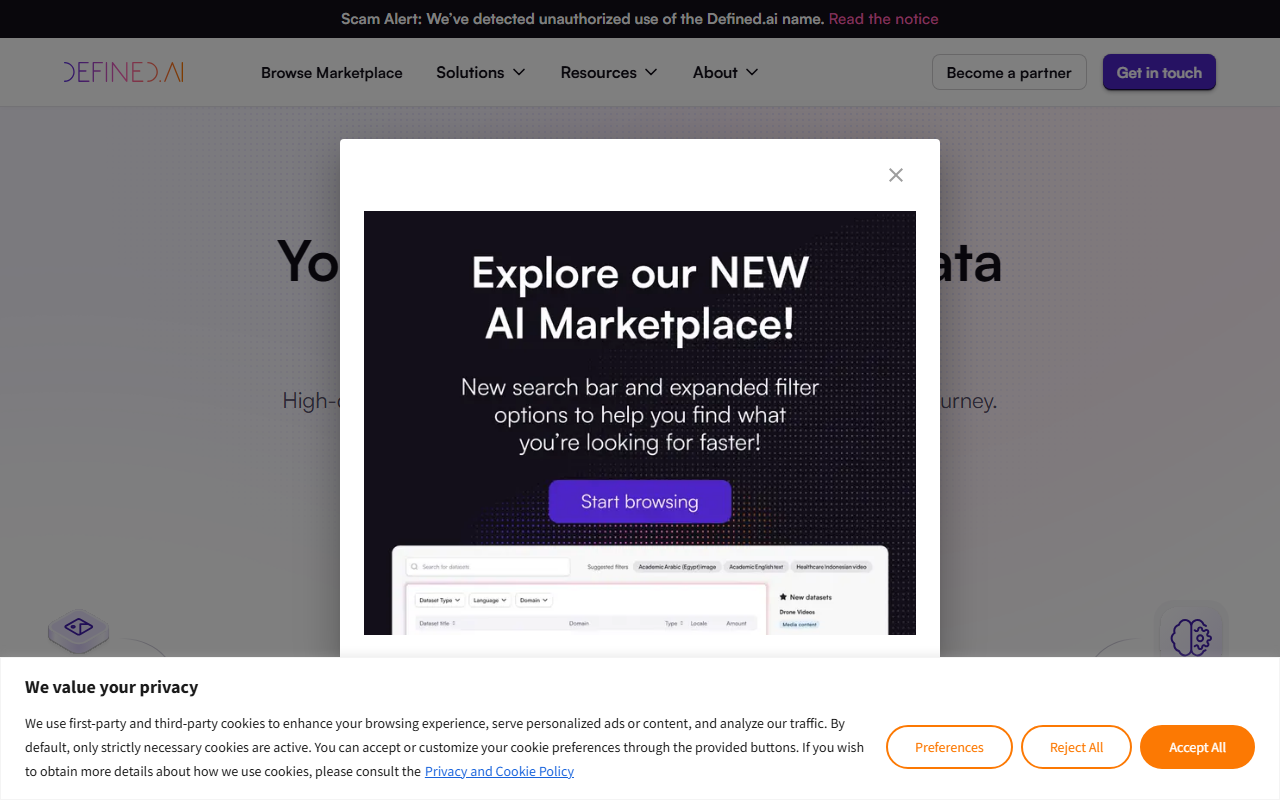
Upon visiting Defined.ai, I encountered a prominent scam alert warning about unauthorized use of their name—a clear sign they take brand protection seriously. The dashboard presents a clean, enterprise-focused interface with quick links to browse the data marketplace, view solutions, and access resources. The homepage immediately emphasizes ethical AI and compliance, listing ISO 27001, 27701, and 42001 accreditations alongside GDPR and HIPAA compliance. This focus on trust and security sets the tone for the platform’s value proposition.
Defined.ai positions itself as an end-to-end AI training data partner, offering not just datasets but also annotation, collection, machine translation, and model evaluation services. The platform claims to have the world’s largest AI data marketplace, with a crowd of 1.6 million global experts across 150+ countries and 500+ languages. For anyone who has tried to source diverse, high-quality training data, that scale is immediately compelling.
Exploring the Data Marketplace and Services
When testing the free tier—though there is no publicly listed free plan—I browsed the marketplace using advanced filters for domain, language, and data type. I found ready-to-use datasets like English Doctor-Patient Conversations, Arabic Call Center recordings, and Medical Imaging surgical images. Each dataset includes metadata such as locale and use case, making it easy to narrow down options. The ability to request free samples and quotes is a practical touch, though it means no instant access.
The platform’s core strength is its end-to-end approach. Beyond off-the-shelf datasets, Defined.ai offers custom data collection and annotation with “model-in-the-loop” expert verification. This is crucial for enterprise teams that need precise labeling for niche domains like healthcare or autonomous driving. I observed that the annotation pipeline supports text, audio, image, and video, with options for customization of file format, sample rate, and bit depth. For machine translation projects, their multilingual crowd adds significant value.
Defined.ai also provides data and model evaluation services, including bias detection and fairness testing. This aligns with their ethical AI manifesto, which I read on the site—it commits to fair working conditions and transparent sourcing. Compared to competitors like Scale AI or Appen, Defined.ai differentiates itself by combining a public marketplace with a strong ethical and compliance framework, making it a safer choice for regulated industries.
Pricing and Technical Details
Pricing is not publicly listed on the website. All interactions appear to go through a sales or partnership team—the site repeatedly prompts “Get in touch” or “Become a partner.” This suggests a custom enterprise pricing model, which is typical for end-to-end data services. For small teams or individual developers, the lack of transparent pricing and a self-service checkout could be a barrier. However, for enterprise-scale projects, the ability to negotiate volume discounts and get dedicated support is likely worthwhile.
Technically, Defined.ai offers API delivery for datasets, which speeds up integration. The platform is built for scale and speed, with secure file transfer options. Their crowd management system (1.6M contributors) allows for rapid collection across geographies. The site mentions support for multimodal data, which is increasingly important for foundation models. I did not see evidence of a developer sandbox or trial datasets without contact, which is a limitation for quick experimentation.
Strengths, Limitations, and Final Verdict
The genuine strengths of Defined.ai are its ethical sourcing, compliance certifications, and massive global crowd. For enterprises in healthcare, finance, or automotive that must meet GDPR or HIPAA, this platform provides peace of mind. The end-to-end services reduce the need to juggle multiple vendors. The marketplace of ready-to-use datasets is extensive and covers niche domains like medical imaging or Arabic call center audio.
However, there are real limitations. The lack of public pricing and self-service access makes it difficult for startups or smaller AI teams to evaluate the platform without a sales conversation. The scam alert on the homepage, while a protective measure, might cause initial confusion. Also, while the crowd is large, quality control depends on their vetting process, which is not transparent to external users. The platform is clearly built for enterprise-scale projects, not for experimentation—someone looking for a quick dataset to test a model might find the process too heavy.
Overall, Defined.ai is best suited for enterprises that need compliant, diverse, and scalable training data for custom AI models. It is less ideal for individual developers or small teams on tight budgets. If you are building a production model in a regulated industry and require end-to-end support, Defined.ai is a strong contender. Visit Defined.ai at https://defined.ai/ to explore it yourself.










Comments