

First Impressions and Onboarding
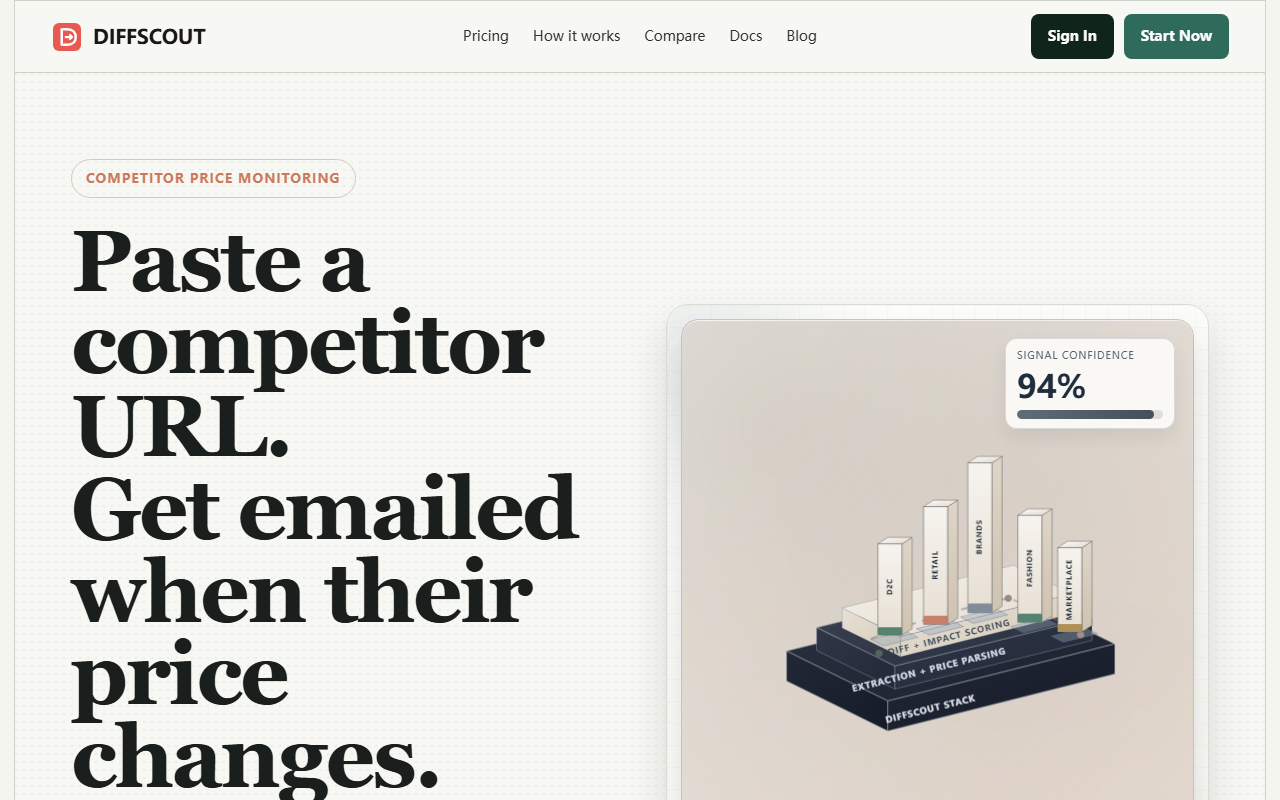
Upon visiting DiffScout, I was struck by how stripped-down the landing page is. No product catalogs, no SKU matching, no developer setup—just a single field to paste a competitor URL. I entered the URL of a Shopify clothing store that I know fluctuates prices. Within 30 seconds, DiffScout displayed an example alert: "Nike Air Max 270: $130 → $110." The dashboard shows a clean "Missions" view where I can add URLs and set check frequency (daily, weekly, or hourly on paid plans). The free tier includes 1 mission and 5 checks, which is enough to evaluate the tool on a single product. I tested it on an Amazon product page, and the AI quickly parsed the price without any manual matching. The onboarding flow is virtually nonexistent—after signing up with an email, I was taken straight to the dashboard. That simplicity is the entire value proposition.
Core Features and Technology
DiffScout uses a combination of AI extraction and what it calls "AI vision" to read prices from bot-protected and JavaScript-rendered pages. Unlike general-purpose change detectors such as Visualping, which only tells you something changed, DiffScout extracts the specific price values and archives a screenshot with each check. I observed this when monitoring a brand.com PDP; the alert email contained the old price ($89), the new price ($74), and a 16% drop indicator. The tool also supports custom rules—you can set thresholds (e.g., ignore changes under 3%) to filter out cosmetic edits or minor rounding. For D2C teams, this means no more Monday morning tab checks; alerts land in your inbox within 60 minutes of a competitor's price change. The technology behind it is clearly focused on e-commerce price intelligence, not generic web monitoring. Integrations are minimal at launch—email alerts work immediately, and webhooks (Slack, Zapier) are listed as "coming soon" on the Business plan.
Pricing and Competitor Comparison
Pricing is transparent and straightforward. The Free tier includes 1 mission and 5 checks with email alerts. Starter ($29/mo) gives 4 missions and 120 checks per month with daily/weekly checks. Pro ($49/mo) offers 50 missions and 200 checks, while Business ($99/mo) allows unlimited missions and 450 checks per month, plus hourly checks and upcoming webhooks. Compared to Prisync (which starts at $40/mo and requires uploading a product catalog and matching SKUs), DiffScout is simpler and cheaper for small teams that only monitor a handful of competitor URLs. Against Visualping (free for basic checks but lacks price parsing), DiffScout adds meaningful context. For large enterprises needing to monitor thousands of SKUs, Prisync or Wiser (priced higher) are more appropriate. DiffScout explicitly targets D2C brands, fashion retailers, and marketplace sellers—anyone who wants competitor price intelligence without heavy operational overhead.
Strengths, Limitations, and Recommendation
Strengths: Setup takes less than 30 minutes. No product catalog or developer required. Works on Shopify, Amazon, brand.com, and marketplace listings. AI extraction handles bot-protected pages and JavaScript-heavy sites. Alerts include old and new price, percent change, and a screenshot—actionable, not just a notification. The free tier lets you test with zero risk.
Limitations: The free tier is very limited (only 5 checks). The Pro and Business tiers may feel restrictive if you need more than 200 or 450 checks per month—no pay-as-you-go option. Webhook integration is still in development, so workflows beyond email are not yet available. For enterprise-scale monitoring (thousands of URLs), DiffScout is not designed; you'd need Prisync or a custom scraping solution. Additionally, while the AI extraction is impressive, I noticed a slight lag on slower-loading pages during my test—the screenshot was sometimes stale by a minute.
Recommendation: If you run a small to mid-sized D2C brand, a single Shopify store, or a marketplace shop and want to track competitor prices without hiring a developer or maintaining scrapers, try DiffScout on its free tier. It solves the exact problem of "Monday morning tab checking" and delivers email alerts that let you respond same-day. For larger operations with hundreds of SKUs, consider Prisync or a dedicated API like Price2Spy. But for speed and simplicity, DiffScout is a clear win.
Visit DiffScout at https://diffscout.com/ to explore it yourself.











Comments