

First Impressions and Onboarding Flow
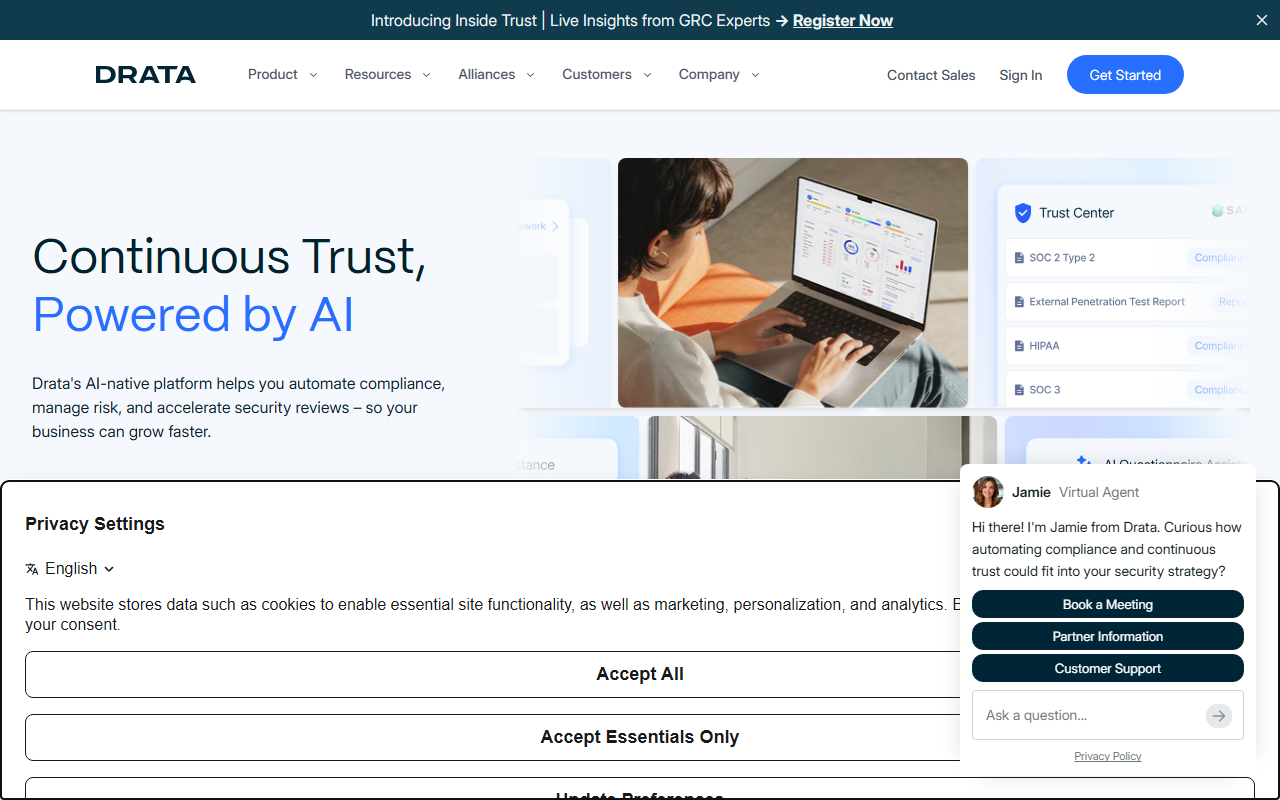
Upon visiting the Drata website, I was immediately struck by the space-themed branding — "Command the Mission," "Initiate Launch," "Open the Airlock." It is a bold metaphor for security operations. The homepage clearly lists five core modules: Enterprise GRC, Compliance Automation, Trust Center, Questionnaire Automation, and Third-Party Risk. The design is clean and promises "Agentic Trust Management." There is no free tier; instead, a "Get Started" button leads to a demo request. This suggests Drata targets serious buyers, not casual users. I explored the "Why Drata" section, which highlights three pillars: Continuous Real-Time Trust, Enterprise-Grade Flexibility, and Agentic AI Productivity. The site also breaks down use cases for Startup, Growth, and Enterprise stages. This segmentation indicates thoughtful product design. Without direct access to the dashboard, I relied on published customer stories and statistics. For example, Drata claims an average enterprise saves 7,980 hours annually on audit preparation and 200+ hours with AI-powered questionnaire automation. These figures, while impressive, are vendor-provided and should be verified independently.
Core Features and AI Capabilities
Drata’s AI agents are the headline feature. The platform automates compliance by mapping controls, collecting evidence, and monitoring continuously across multiple frameworks like SOC 2, ISO 27001, ISO 42001, GDPR, HIPAA, and PCI DSS. The "Compliance Autopilot" claims to reduce SOC 2 audit duration by 75%, cross-mapping controls in two hours. The Trust Center uses AI to generate and manage customer assurance documentation, reducing back-and-forth. I observed a specific claim: 10x faster turnaround on trust documentation. The questionnaire automation module is particularly compelling. Drata AI learns from a Knowledge Base to draft accurate responses, saving an estimated 375 hours per year. Third-party risk management is also agentic: AI assesses vendors, collects documents from Trust Centers, and performs follow-ups automatically. The platform integrates with hundreds of tools, though the exact list was not detailed on the homepage. The tech stack appears to use proprietary AI models; no specific model names are mentioned. Unlike competitors such as Vanta, which also automates compliance, Drata places a heavier emphasis on agentic autonomy across multiple domains beyond evidence collection.
Pricing and Market Positioning
Drata does not publicly list pricing on its website. The "Get Started" button leads to a request for a demo, suggesting a custom quote model typical of enterprise SaaS. This lack of transparency can be a hurdle for smaller teams evaluating the tool. Drata positions itself as a full-fledged trust management platform, not just a compliance checker. With 8,000+ global customers and a 4.8/5.0 G2 rating, it has strong market credibility. The company likely targets mid-market and enterprise organizations that manage multiple frameworks and need third-party risk assessments. For startups, the platform may be overengineered and expensive, though Drata does have a "Startup" segment suggesting a tailored offering — likely a scaled-down version or pricing tier. Alternatives include Vanta, Secureframe, and OneTrust. Vanta is more straightforward for SOC 2, while Drata aims to encompass GRC, trust center, and vendor risk. Drata’s strength lies in its AI-driven orchestration across all these areas.
Strengths, Limitations, and Verdict
Drata’s strengths are clear: comprehensive automation, real-time monitoring, and AI agents that reduce manual work. The platform is built to scale and adapt to multiple regulatory frameworks. The Trust Center and questionnaire automation are standout features that help security teams respond faster and reduce friction with sales. However, limitations exist. The pricing is opaque, which may frustrate budget-conscious buyers. The AI claims, while promising, are unverified; users should test how well the AI adapts to their specific context. Also, the learning curve for such a broad platform could be significant for smaller teams without dedicated compliance staff. In conclusion, Drata is best suited for enterprises and growth-stage companies that need an integrated trust and compliance solution with advanced AI capabilities. Startups looking for a simple SOC 2 path might find lighter alternatives more accessible. If you value automation across the entire trust lifecycle and have the budget for a premium tool, Drata is worth a demo. Visit Drata at https://drata.com/ to explore it yourself.










Comments