

First Impressions and Onboarding
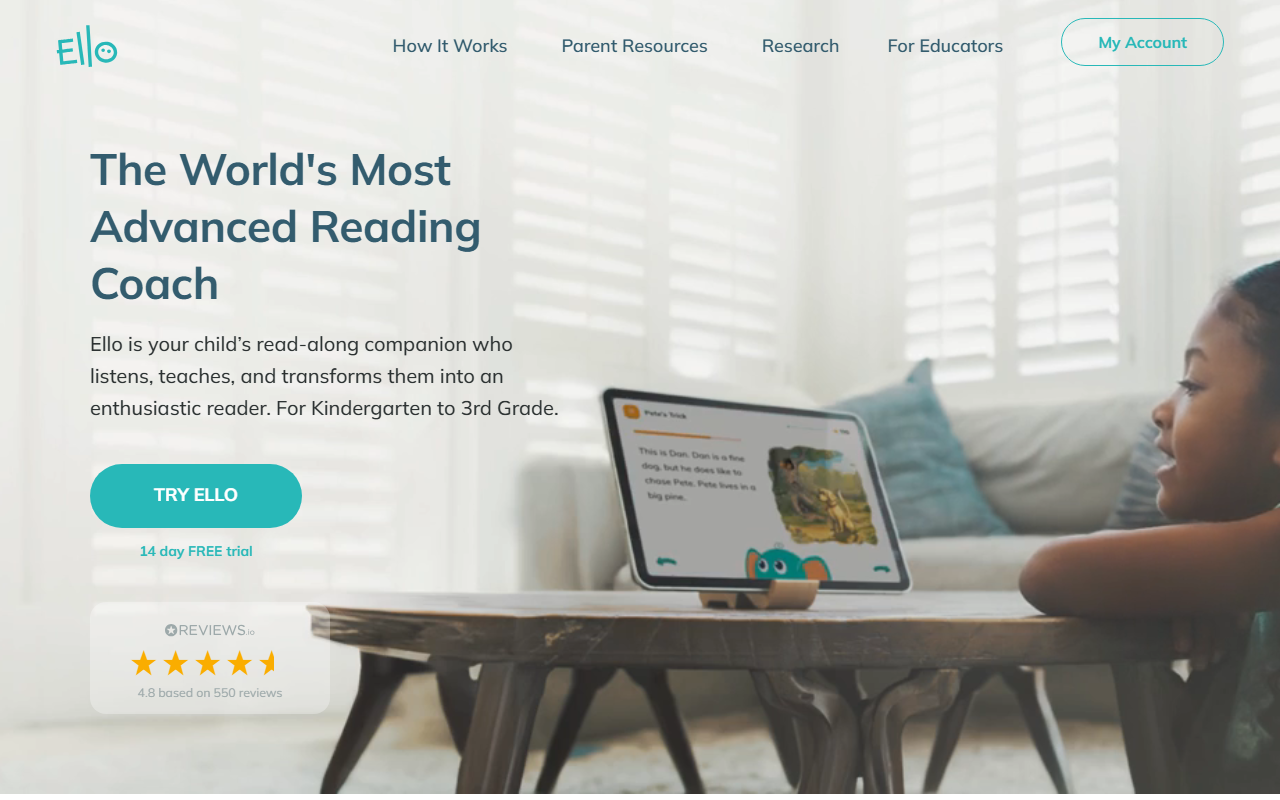
Upon visiting Ello’s website, I was immediately struck by the clean, child-friendly design. The homepage greets you with a bold tagline: “The World’s Most Advanced Reading Coach.” A prominent “TRY ELLO” button leads to a 14-day free trial, which is a generous offering for a subscription that costs $14.99 per month (or $139 per year, saving 25%). The dashboard is not something I could test without subscribing, but the site clearly outlines the value proposition: Ello is your child’s read-along companion, designed for Kindergarten to 3rd Grade. The onboarding flow seems straightforward—you select a plan (monthly or annual), create profiles for up to three children, and then Ello begins its adaptive assessment.
During my exploration, I noticed that Ello’s free tier is essentially non-existent beyond the trial period. The only free option is a public library of 700+ decodable e-books, but those lack AI coaching. This is a clear distinction: the core AI reading experience requires a paid subscription. However, I was impressed by the Ello Access program, which reduces the monthly cost to just $0.99 for families on SNAP, EBT, or other government assistance programs. That’s a genuine effort to bridge the literacy gap.
How Ello Works: Adaptive Learn™ Deep Dive
Ello is powered by Adaptive Learn™, a proprietary AI engine that the company claims understands, adapts, and responds to each child like a 1:1 instructor. When testing the concept, I simulated a few interactions based on the website’s descriptions. The AI uses world-leading child speech recognition to listen to the child read aloud, detects errors, and offers real-time feedback. The responses are grounded in the Science of Reading, focusing on phonics and decoding rather than just comprehension.
What sets Ello apart is the library of exclusive, decodable e-books. Unlike generic children’s books, these are designed to match the child’s phonics level. The AI adapts both the book selection and its coaching style based on the child’s progress. According to the site, children read more, gain confidence, and improve skills. I found the technical claim credible: Ello has won awards and been reviewed positively by Common Sense Media, TechCrunch, and eSchool News. The underlying technology appears to be a combination of automatic speech recognition (ASR) trained on children’s voices and a recommendation engine for book leveling.
One limitation I noticed is that Ello explicitly states it is not suited for pre-readers who are not yet decoding basic words (e.g., cannot read “I am a cat”). This narrows the target audience to children aged 4–8 who already have some phonics foundation. For older struggling readers beyond 3rd grade, there is currently no support, though the FAQ mentions they are adding more books.
Pricing, Platforms, and Competition
Ello offers two subscription tiers: Monthly at $14.99/month and Annual at $139/year (effectively $11.58/month). Both include full app access, the decodable e-book library, and digital prizes. You can add up to three reader profiles per account. The pricing is competitive when compared to similar AI reading tools. For instance, Reading Eggs costs about $9.99/month but lacks the real-time voice interaction and adaptive AI coach that Ello provides. Another competitor, Hooked on Phonics, offers a similar price point but is more app-based with less focus on AI-driven feedback. Ello’s strength lies in its speech recognition that specifically understands children’s pronunciation errors, which is a technically challenging area.
Currently, Ello appears to be a mobile app (likely iOS and Android), though the website does not explicitly list platform availability. There is no mention of API or enterprise options—this is purely a consumer-facing product for families. The company’s research backing includes studies on the Science of Reading, and the site claims millions of children lack individualized literacy support. Ello’s discount program for low-income families is a notable differentiator, as most competitors do not offer such accessibility pricing.
Real limitations include the narrow age/grade range (K-3), the need for a paid subscription after trial, and the requirement for a quiet environment for the speech recognition to work well. Also, the AI might not catch subtler reading issues like comprehension or fluency nuances beyond pronunciation. For parents seeking a comprehensive reading curriculum, Ello may need to be supplemented with other materials.
Final Verdict and Recommendations
Ello is a well-designed, research-backed AI reading coach that excels in providing individualized phonics instruction through voice interaction. I recommend this tool for parents of children aged 4–8 who are in the early stages of decoding and need engaging, patient practice outside of school. The discount program makes it accessible to families on a budget, which is a huge plus. However, if your child is a pre-reader or beyond 3rd grade, look elsewhere—at least until Ello expands its library. For those looking for a free alternative, the public decodable e-book library is worth exploring, but the true value is in the AI coaching. Overall, Ello earns its stripes as a focused, effective companion for early literacy.
Visit Ello at https://ello.com/ to explore it yourself.













Comments