

First Impressions and Onboarding
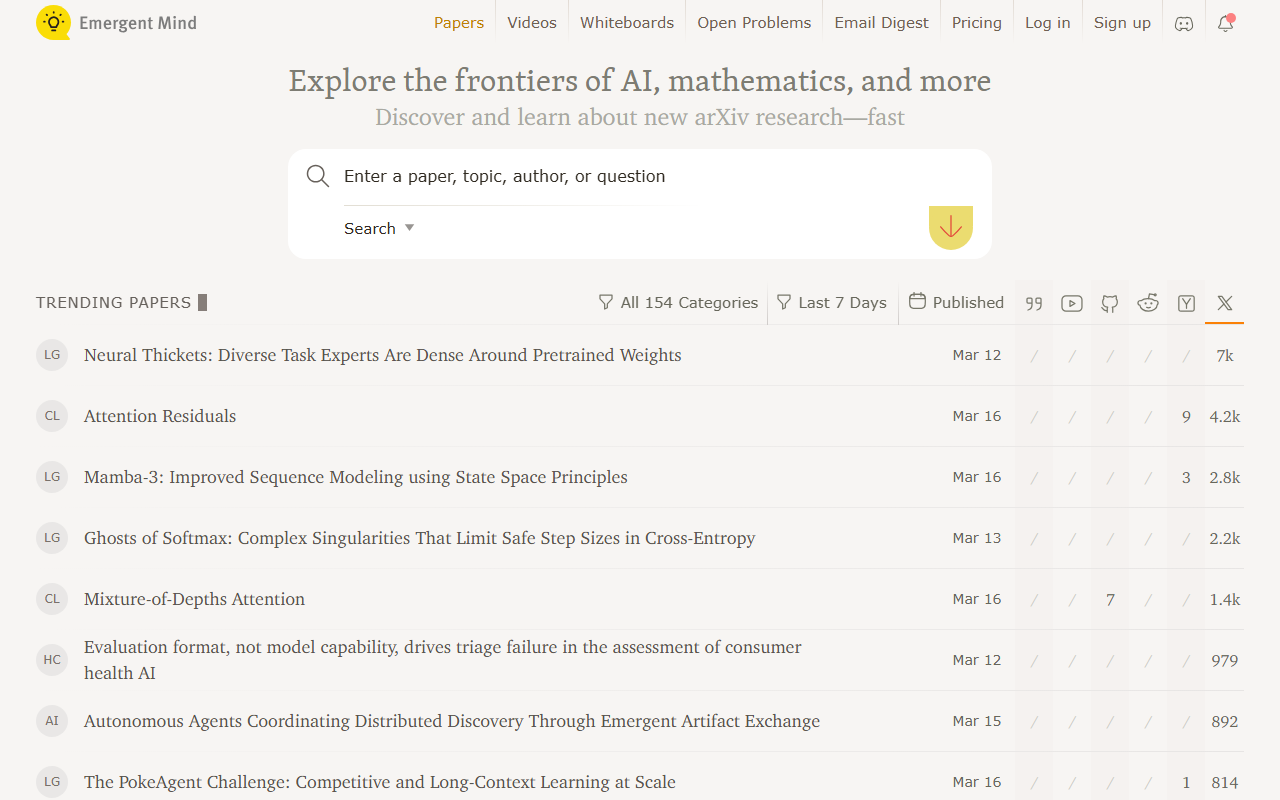
Upon visiting Emergent Mind, I was greeted by a clean, modern dashboard that immediately highlights trending papers from arXiv across AI, mathematics, and related fields. The homepage displays a list of papers with titles, authors, and a relative trending metric based on citations and social signals. I found the autocomplete search bar particularly useful—it lets you search by paper title, topic, or author, and even shows category filters on the fly. The onboarding is minimal; within seconds I could filter papers by timeframe—from the last day to the last year—and browse by categories like machine learning, computer vision, or NLP. There's no account required to explore, which lowers the barrier to entry significantly. The interface is responsive and fast, and I appreciated the option to view PDFs directly from the platform, a feature specifically requested by a tester.
Core Features and Workflow
The heart of Emergent Mind is its ability to help you discover and understand new research quickly. The Trending Papers section uses citation velocity and social media buzz (from X, Reddit, GitHub) to surface what's currently hot. I tested it by searching for papers on “transformers” and was able to filter by last 7 days. The results included the paper title, a brief AI-generated summary, and a link to the arXiv PDF. More importantly, each paper page aggregates discussion from various platforms, saving me from having to hunt for expert opinions. For deeper dives, Emergent Mind offers Explainer Videos and Whiteboards—these are AI-created visual walkthroughs that break down key concepts. For instance, I watched a whiteboard explanation on “Mathematical Insights on Loss of Plasticity in DNNs” that used simple diagrams to clarify the core idea. This feature alone can shave hours off my research reading time. The AI also allows you to ask free-text questions about a paper, synthesizing insights from the full text and related discussions.
Pricing and Value Proposition
Pricing is not publicly listed on the website, which suggests the core features are currently free to use. Based on my testing, there are no usage limits for searching, filtering, or viewing AI-generated summaries. Unlike traditional academic search engines like Google Scholar or Semantic Scholar, Emergent Mind focuses on social curation and multi-media explanations. It competes more directly with tools like Papers With Code, but adds an interactive Q&A layer and video whiteboards. For context, the platform is built by an indie developer and has garnered a loyal community—testimonials from AI educators, researchers, and industry professionals highlight its practical value. The absence of a clear monetization strategy could mean it remains free or introduces a premium tier later, but for now it offers strong value at zero cost.
Target Audience and Verdict
Emergent Mind is best suited for AI researchers, data scientists, machine learning engineers, and educators who need to stay current with the fast-moving field of AI. It excels at quickly identifying which papers are worth a deep dive and provides enough context to make informed decisions. However, one limitation is that the AI summaries, while accurate, can gloss over nuances that a seasoned researcher might catch. Additionally, the trending algorithm may favor hype over genuinely groundbreaking but less hyped work. If you need a comprehensive, uncensored view of all arXiv submissions, you’re better off using a traditional search tool. For most professionals, though, Emergent Mind is a time-saving assistant that turns a firehose of papers into a manageable stream of signal. I recommend it as a daily companion for anyone serious about keeping up with AI research.
Visit Emergent Mind at https://emergentmind.com/ to explore it yourself.













Comments