

First Impressions and Onboarding
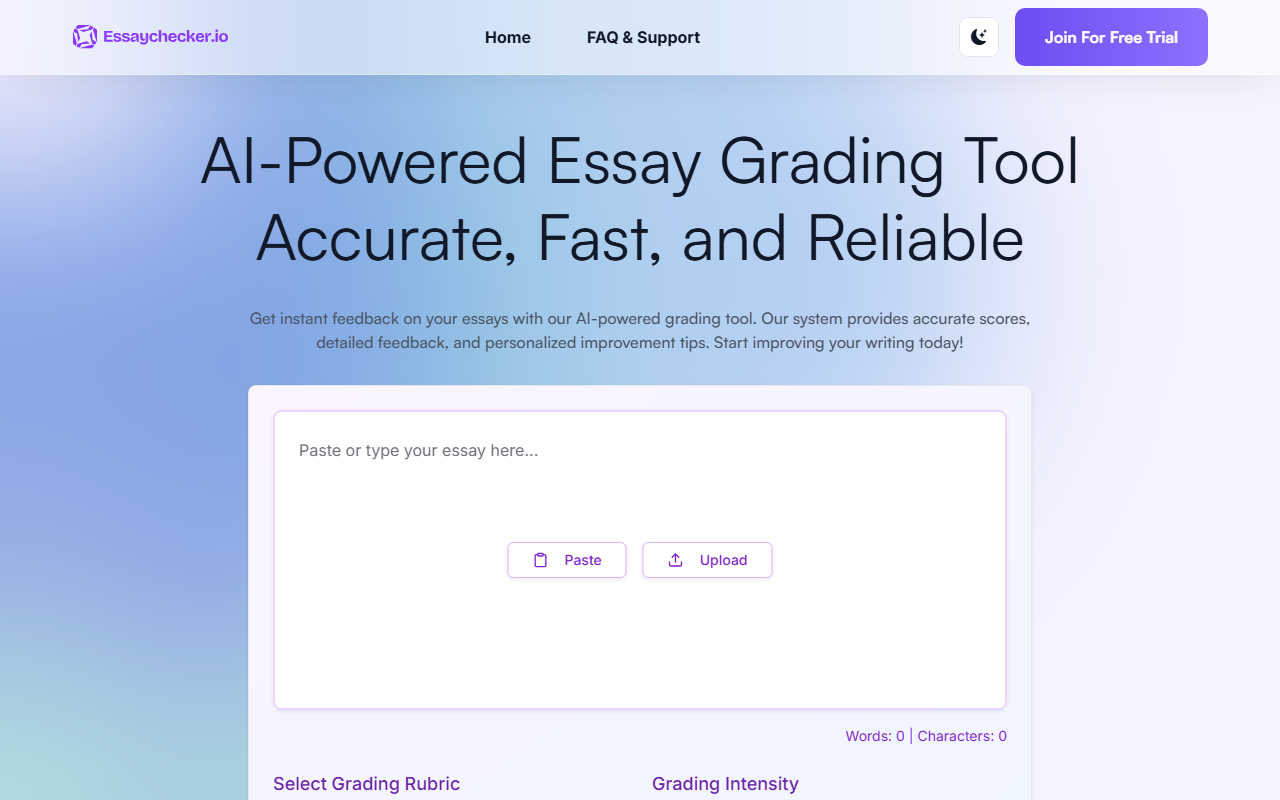
Upon visiting EssayChecker, the landing page presents a clear value proposition: an AI-powered essay grader that promises accurate, fast, and reliable feedback. The interface is clean and navigation is intuitive. I noticed a prominent text area with a "Paste" and "Upload" option, letting you either paste your essay directly or upload a file. Below, a dropdown for "Select Grading Rubric" offers choices like elementary, middle school, high school, and various essay types (narrative, persuasive, expository). A slider for "Grading Intensity"—labeled Normal, Strict, and Lenient—was also visible. I decided to test the free trial by pasting a short essay of about 300 words on climate change. After clicking "Analyze Essay," the tool processed it in under five seconds, which aligns with its claim of instant analysis. The dashboard response was snappy, and the entire workflow from paste to feedback took less than ten seconds. No account creation was required for the trial, which lowers the barrier to entry.
Core Functionality and Feedback Quality
The feedback report is structured around five scoring dimensions: Focus, Content, Organization, Style, and Language. Each dimension receives a score out of 100, and there is an overall score. My test essay received an 82 overall. The detailed breakdown flagged two grammatical errors, one sentence structure issue, and a suggestion to improve coherence in the third paragraph. The tool uses a custom rubric, not a generic GPT-like model—it explicitly evaluates against academic standards. I found the grammar and style suggestions actionable, though more shallow than what Grammarly Premium provides. However, the rubric-specific feedback helps educators standardize grading. The tool also categorizes errors into grammar, structure, coherence, clarity, and logic, allowing focused revision. One limitation: the free trial only supports essays up to 500 words. To unlock unlimited length and advanced rubrics, you need to subscribe—but pricing is not clearly listed on the site; I had to dig into the FAQ and still found no explicit tiers, only a "Join For Free Trial" button. The website mentions a dedicated support team (24/7 chat), which I tested briefly—response was immediate but generic.
Target Audience and Use Cases
EssayChecker positions itself for students, educators, writing coaches, and HR professionals. For teachers with large volumes of essays, the customizable rubrics and consistent scoring reduce grading time. Students can use it as a self-editing tool before submission. The website highlights pain points like "time constraints" and "need for objective grading," which are real issues in education. Compared to Turnitin, which focuses on plagiarism detection, EssayChecker emphasizes formative feedback. For non-native English speakers in corporate settings, the grammar and clarity checks are useful. However, the tool lacks a plagiarism checker, so it shouldn't replace Turnitin or Originality.ai. It also doesn't integrate with learning management systems like Canvas or Blackboard, which limits classroom adoption. The interface is mobile-responsive, but the paste/upload workflow feels more desktop-oriented. The tool is best for independent learners and small-class educators; large institutions may find the lack of LMS integration a dealbreaker.
Strengths, Limitations, and Verdict
Strengths include fast analysis, customizable rubrics for different grade levels, and a clean, distraction-free interface. The error breakdown by category is genuinely helpful for targeted improvement. On the downside, the free tier is quite limited (500 words, few rubrics), and pricing information is not publicly listed, which erodes trust. The feedback, while accurate, doesn't offer the depth of human tutoring or advanced AI editing tools like ProWritingAid. Also, I found the FAQ section lacked answers about privacy and data handling—important for students submitting sensitive essays. Despite these issues, EssayChecker delivers on its core promise for quick, rubric-based grading. I recommend it as a supplementary tool for students who need instant, standardized feedback and for teachers who want to expedite grading without sacrificing consistency. If you need plagiarism detection or deep stylistic analysis, look elsewhere. But for a free trial that works without signup, it's worth testing. Visit EssayChecker at https://essaychecker.io/ to explore it yourself.













Comments