

First Impressions and Onboarding
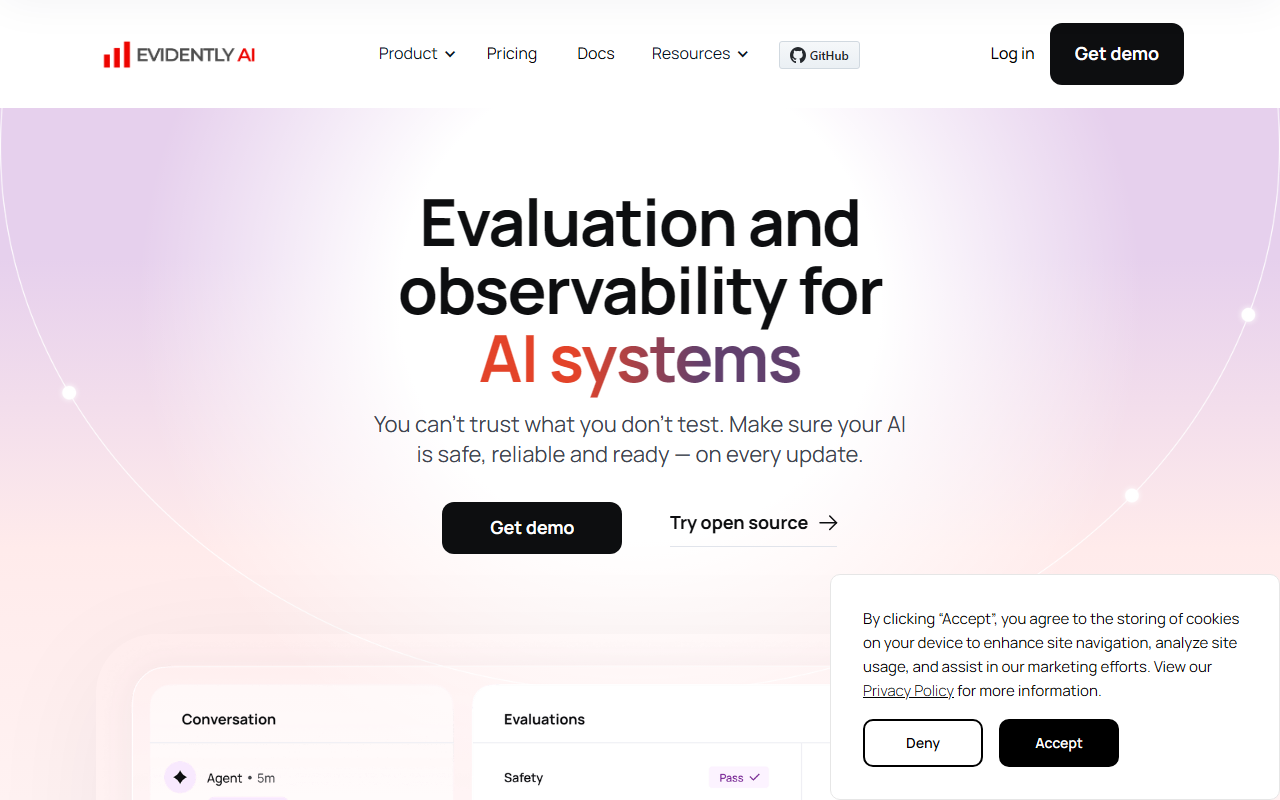
Upon visiting Evidently AI's website, I was immediately struck by the clarity of its value proposition: "You can't trust what you don't test." The landing page wastes no time addressing the core challenge of non-deterministic AI failures—hallucinations, edge cases, PII leaks, jailbreaks, and cascading errors. The dashboard, accessible after signing up for a demo, presents a clean interface with a left-hand navigation bar linking to evaluations, dashboards, and synthetic data generation tools. Onboarding for the open-source version is straightforward: you install the Python package and run a few lines of code to generate your first evaluation report. I tested this by cloning a sample RAG pipeline from their GitHub repository, and within minutes I had a visual report highlighting retrieval accuracy and hallucination scores. The open-source tool runs locally, while the platform version adds collaboration features, continuous monitoring, and managed infrastructure.
Core Capabilities and Technology
Evidently AI is built around two complementary offerings: an open-source Python library (with over 7,000 GitHub stars and 35 million downloads) and a cloud platform. The library provides 100+ pre-built metrics for evaluating LLM outputs, including accuracy, safety, relevancy, toxicity, PII detection, and custom conditions using any prompt or model. The platform extends this with automated evaluation pipelines, synthetic data generation for adversarial testing, and live dashboards for continuous monitoring. What impressed me most was the LLM-as-a-Judge capability, which lets you leverage LLMs themselves to evaluate outputs—a technique the platform documents thoroughly in a free guide. For RAG evaluation, you can test context relevance, faithfulness, and retrieval precision. For AI agents, the tool can validate multi-step reasoning and tool usage. The platform also supports custom evaluations via Python, making it flexible for non-standard use cases.
Market Position and Limitations
Evidently occupies a unique niche between open-source flexibility and enterprise-grade observability. Compared to competitors like LangSmith (which focuses more on tracing) and Arize AI (stronger on production monitoring), Evidently emphasizes verification before deployment while still offering production drift detection. A standout strength is its active community (3,000+ members) and the backing of well-known users like DeepL and Wise. However, there are limitations. The platform's pricing is not publicly listed on the website; you must request a demo to get a quote—a common but sometimes frustrating hurdle for small teams. Additionally, the open-source library, while powerful, requires Python expertise, which can be a barrier for non-engineer stakeholders who want a no-code evaluation dashboard. The platform version addresses this but introduces a dependency on their cloud infrastructure.
Final Verdict
Evidently AI is an excellent choice for ML engineers and data scientists who need rigorous, customizable AI evaluation. It excels for teams working on RAG, agents, or adversarial testing who value open-source transparency and want to avoid vendor lock-in. If you need a quick, all-in-one SaaS solution for production monitoring with a clear price tag, you might prefer Arize or WhyLabs. But for deep testing and validation—especially if you want to see exactly how your AI breaks upfront—Evidently's combination of open-source library and optional platform is hard to beat. I recommend starting with the open-source version, then scaling to the platform when you need team collaboration and continuous monitoring. Visit Evidently AI at https://evidentlyai.com/ to explore it yourself.










Comments