

First Impressions and the Missing Demo
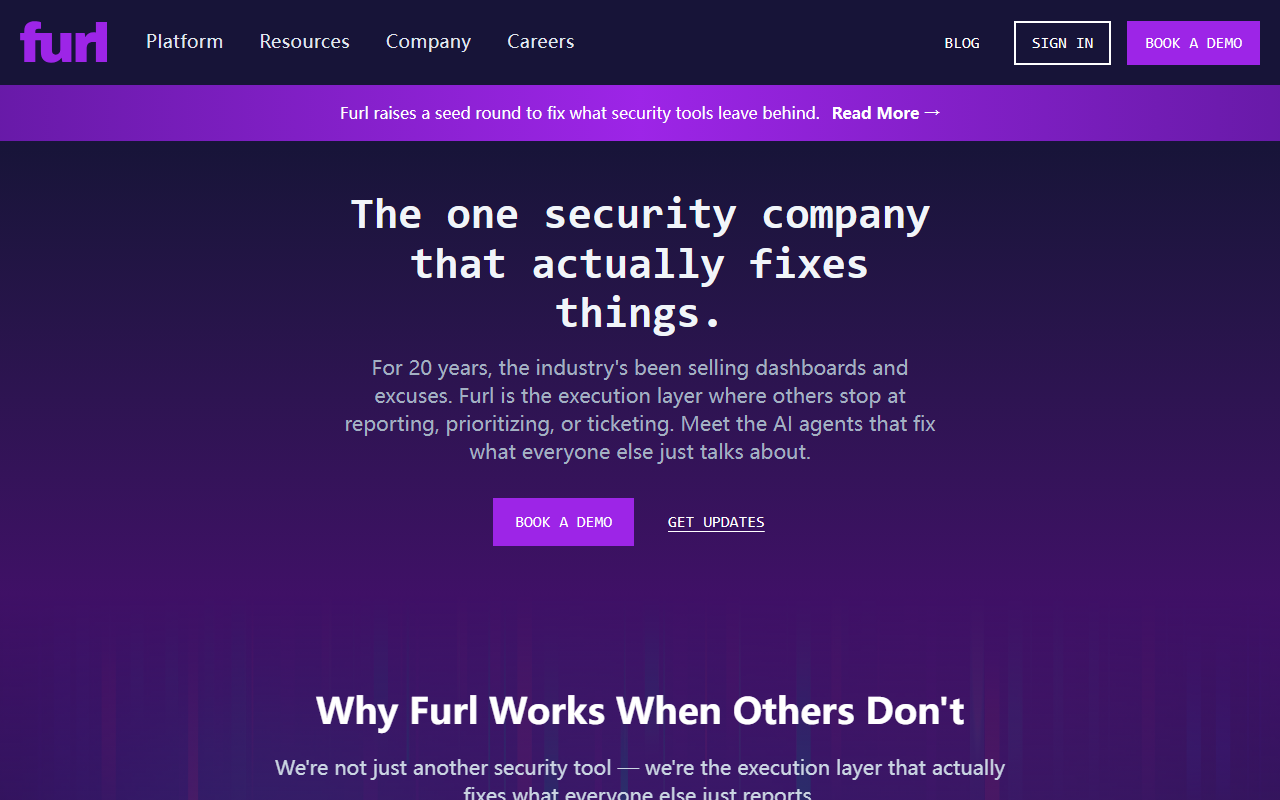
Upon visiting furl.ai, I was greeted by a clean, modern landing page that immediately pitches Furl as a solution for the vulnerabilities that “your patch manager can’t touch.” The hero section uses the tagline “Continuous Remediation” and promises an “infinite fix to your never ending backlog.” Below that, a prominent “Book a demo” button appears repeatedly — a strong hint that this is an enterprise-grade tool that isn’t publicly self-servable. The background imagery and logos of other tools (Qualys, Tenable, Rapid7) suggest deep integration with existing security stacks. I wasn’t able to sign up or test any functionality directly; the only call to action is scheduling a conversation. That’s a limitation for a reviewer like me, but typical for high‑end security platforms.
How Furl Works: Analytical Autonomy with Guardrails
Furl describes itself as a continuous remediation platform that acts agentically. It plugs into your existing scanners and patch tools, pulls context from your environment, and generates fixes built for your specific stack. The website breaks the process into three phases:
- Context — Before touching anything, Furl maps your environment: what’s running, who owns it, what depends on it, and how business‑critical it is. This mapping makes autonomous execution safe.
- Execution — Furl generates a fix built for your exact environment — not a generic patch, but a script tailored to your software versions and dependencies. It deploys, validates, and rolls back if anything fails.
- Guardrails — You set a confidence threshold. Furl won’t touch production without your approval. If validation fails after deployment, it rolls back automatically. You stay in control while Furl handles the volume.
This is a refreshingly pragmatic approach compared to many “automatic fix” tools that either lack context or skip validation. The emphasis on rollback and approval is crucial for security teams that have been burned by botched patches.
Market Positioning and Pricing Holes
Furl sits in a niche that traditional patch management tools (like Microsoft SCCM or Ivanti) don’t address: the half of the vulnerability backlog that has no vendor patch — configuration drift, hardening gaps, end‑of‑life software, etc. Competitors include Qualys Patch Management and Tenable Patch, but those are more focused on patching known CVEs with official fixes. Furl goes after the “unpatchable” issues. The integrations page lists Qualys, Tenable, and Rapid7, which are the dominant scanners for security teams, so Furl is clearly positioning itself as a complementary layer. Pricing is not publicly listed on the website. The only option is to book a demo, which strongly suggests custom enterprise pricing. That’s a barrier for smaller teams, but typical for this category. The site mentions “used by security and IT teams fixing real backlogs at” (with logos that likely include familiar companies, but the page doesn’t load them in my session). Without transparent pricing or a self‑serve option, Furl is best suited for mid‑market to large enterprises with mature security operations that already have a scanner in place.
Strengths, Limitations, and Final Verdict
Strengths: Furl addresses a real pain point — the messy, context‑dependent vulnerabilities that consume hours of manual work. Its guardrail system (confidence thresholds, approval gates, automatic rollback) demonstrates an understanding of production risk. Deep integration with major scanners means no rip‑and‑replace.
Limitations: The lack of public pricing and the mandatory demo process make it difficult to evaluate suitability without a sales interaction. The website is still somewhat light on technical detail (no API docs, no model architecture, no case studies with real numbers). Also, because it requires existing scanner infrastructure, teams without Qualys, Tenable, or Rapid7 may not benefit.
Who should try it: Security teams drowning in backlog of misconfigured endpoints, legacy systems, and hardening gaps — especially those already using one of the supported scanners. Who should look elsewhere: Small shops without a scanner in place, or teams that need a simple patching solution for known CVEs. Furl is a powerful, niche tool that fills the gap between detection and truly automated remediation. Visit Furl at https://furl.ai/ to explore it yourself.













Comments