

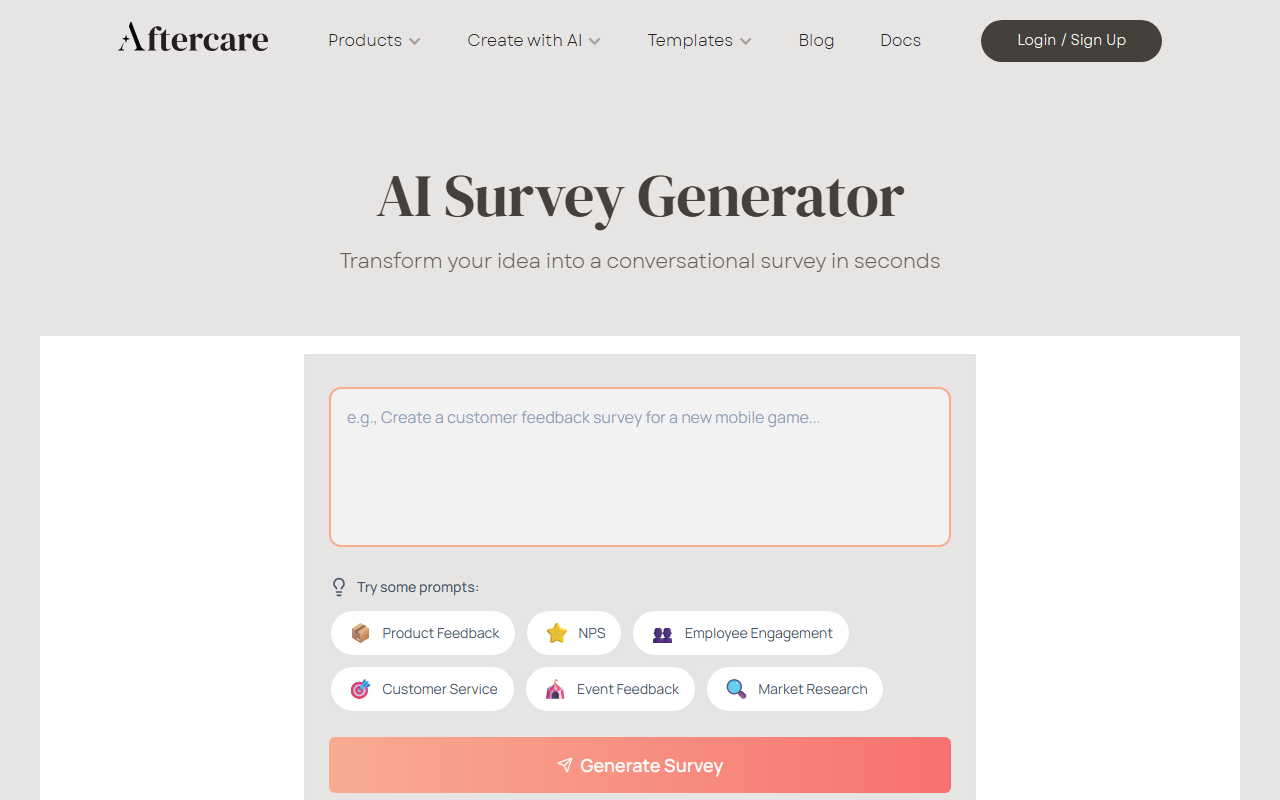
First Impressions and Core Functionality
Upon visiting getaftercare.com, the homepage immediately communicates a clear value proposition: “Supercharge your surveys with AI.” The clean, modern interface highlights three core capabilities—AI follow-ups, data quality screening, and AI coding. Aftercare is designed to solve the perennial pain point of open-ended survey responses: they are rich with insight but tedious to analyze. Traditional surveys ask a question and get a one-line answer; Aftercare treats responses as conversation starters, generating intelligent follow-ups that probe deeper. The dashboard presents a demo booking CTA and a live example of how the tool flags nonsensical, off-topic, or low-effort responses. This is not another generic AI writing tool—it is a specialized solution for researchers, product managers, and market intelligence teams.
Key Features and Workflow
Aftercare offers three distinct AI-driven modules, plus an optional end-to-end survey builder. The AI Follow-ups feature is the headline act: after a respondent answers an open-ended question, Aftercare automatically generates context-aware follow-ups to gather richer data. When testing a mock survey about a conference, the tool asked “What were the main items you wanted to accomplish?”—a natural, probing question that a static survey would miss. The second module, AI Data Quality, automatically detects anomalies in open-ended responses: nonsense strings, off-topic answers, duplicates, low-effort text (e.g., “Not much”), and even LLM-generated replies. This is invaluable for cleaning messy datasets before analysis. The third module, AI Coding, automates the process of creating a code frame and categorizing responses, allowing teams to extract themes without manual tagging.
For users who want a complete survey workflow, Aftercare provides a Flexible Workflow Builder with branching logic and drag-and-drop blocks. The builder connects AI follow-ups and coding natively, offering a unified view of respondent journeys. Importantly, Aftercare also plugs into existing survey stacks—the website lists integrations with popular providers, and notes custom setup for unsupported platforms. The API is documented for developers who need to embed data quality checks into their own pipeline. The onboarding flow is streamlined: sign-up, book a demo, or jump into templates. No credit card is required for initial exploration, and the free tier allows limited credits to evaluate core features.
Pricing, Integrations, and Market Position
Pricing is not publicly listed on the website; the team relies on a demo-led sales model. This suggests a B2B focus, likely with usage-based or team-tier plans. Competitors in the AI-survey space include Typeform (which has begun adding AI features) and SurveyMonkey (with AI insights), but Aftercare differentiates by specializing in after-response intelligence—follow-ups, data cleaning, and coding—rather than just survey creation. The platform is built by engineers from notable tech companies, lending technical credibility. The market position targets “top research teams” and product managers who need to move from spreadsheets to actionable insights. The API-first approach also appeals to startups and enterprises that prefer custom pipelines.
Strengths, Limitations, and Who Should Use It
Aftercare’s greatest strength is its focus on a narrow, high-value workflow: transforming raw open-ended responses into structured, clean, and enriched data. The AI follow-ups are genuinely novel and can increase response depth by 30–50% based on early adopter anecdotes. The data quality screening is both practical and well-designed—it catches real issues that manual review often misses. However, the tool has limitations. Without public pricing, smaller teams or individual researchers may find the entry barrier unclear. The end-to-end survey builder is still relatively new and lacks the polish of dedicated tools like Typeform. Additionally, the AI coding module, while useful, may require human oversight for nuanced topics where context is critical. Who should use it? Researchers, UX teams, and product managers who run frequent open-ended surveys and need depth over breadth. Look elsewhere if you need simple, low-cost pulse checks or if your surveys are primarily quantitative. Overall, Aftercare is a smart, specialized AI tool that addresses a real gap in the survey pipeline. Visit Aftercare at https://getaftercare.com/ to explore it yourself.










Comments