

First Impressions and Onboarding
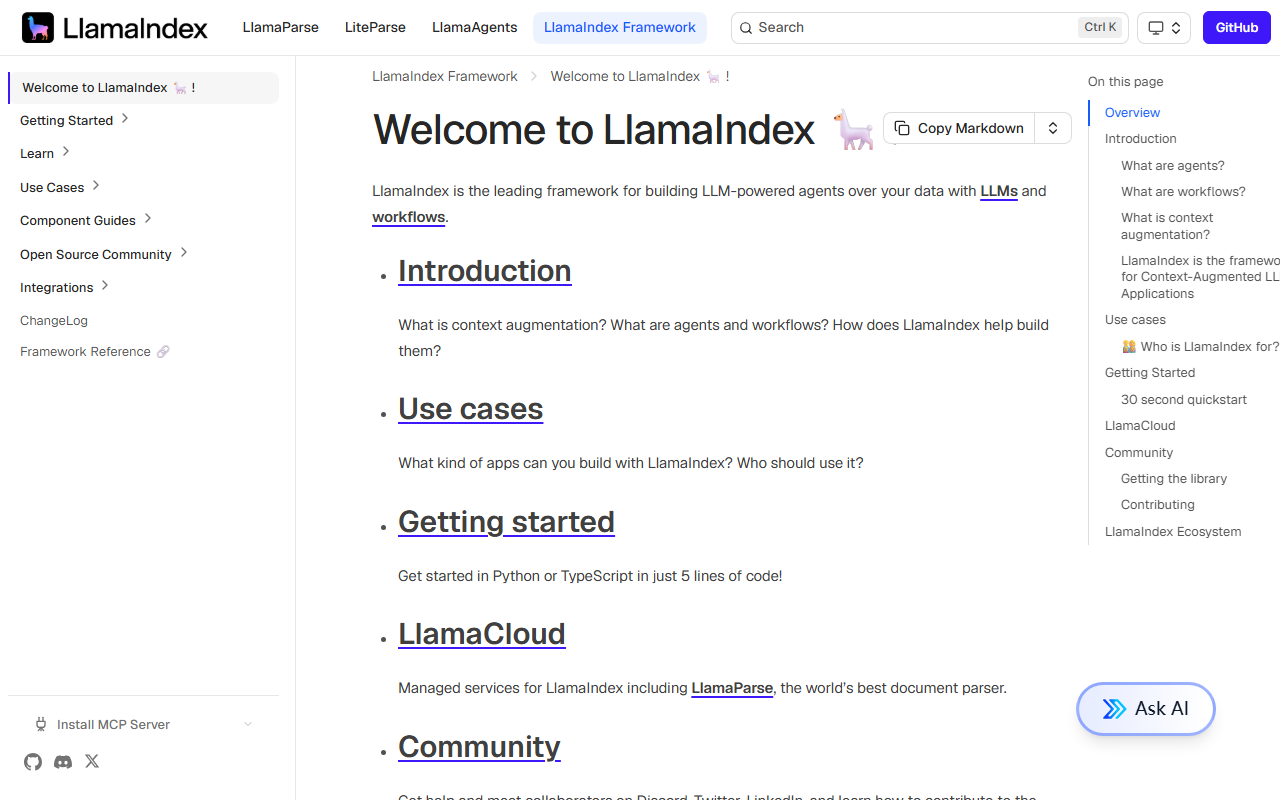
Upon visiting the LlamaIndex documentation site at https://gpt-index.readthedocs.io/, I was greeted by a clean, searchable documentation hub with a dark/light mode toggle. The landing page immediately frames the tool as the leading framework for building LLM-powered agents over your data. As someone who has tested many developer frameworks, I appreciated the quickstart section that promises a working setup in 30 seconds and famously 5 lines of code. I followed the Python quickstart: installed via pip install llama-index, set an OpenAI API key, placed a few documents in a data folder, and ran the snippet using VectorStoreIndex and SimpleDirectoryReader. It worked without friction. The example outputs a response to a user query, immediately demonstrating the core Retrieval-Augmented Generation (RAG) workflow. The documentation also offers a TypeScript variant and links to a managed cloud service called LlamaCloud.
Core Features and Technical Depth
LlamaIndex is not just another wrapper around LLMs—it is a comprehensive toolkit for context augmentation. The framework solves a fundamental problem: LLMs are trained on public data, but enterprise applications need to ground answers in private, proprietary datasets that live in PDFs, SQL databases, APIs, or slide decks. LlamaIndex provides data connectors to ingest from these sources, indexes (e.g., vector indices) to structure data for retrieval, and engines—query engines for question-answering and chat engines for conversational interfaces. I was particularly impressed by the agent and workflow abstractions. Agents are described as knowledge assistants that can use RAG pipelines as tools, while workflows are event-driven multi-step processes that combine agents, connectors, and reflection loops. This is more flexible than graph-based frameworks like LangGraph. The framework also includes observability integrations for evaluation and monitoring, which is critical for production deployments. Under the hood, LlamaIndex leverages the LLM of your choice (OpenAI, Anthropic, open-source models) and supports a modular architecture where you can customize retrievers, rerankers, and prompt templates.
Pricing and Market Positioning
Pricing is not publicly listed on the website; the core LlamaIndex framework is open source (MIT license) and free to use. The managed offering, LlamaCloud, includes LlamaParse (a document parser) and likely tiered pricing, but those details are behind a sign-up flow. This places LlamaIndex in a strong position against competitors like LangChain and Haystack. Unlike LangChain, which can feel bloated with abstractions, LlamaIndex emphasizes a clean separation between data ingestion, indexing, and execution. Its workflow event system offers a more intuitive way to build multi-agent applications compared to graph-based approaches. The tool is backed by a vibrant community on Discord and GitHub, with thousands of stars and active contributions. It includes connectors at LlamaHub, a library of readers and integrations. For beginners, the high-level API lets you get started quickly; for advanced users, the low-level API provides granular control. However, one limitation is that the documentation, while comprehensive, can be dense for newcomers who are not already familiar with RAG concepts. Additionally, production deployments require careful management of LLM costs and latency, as the framework itself does not provide inference.
Final Verdict
LlamaIndex is a top-tier framework for developers who need to build context-augmented LLM applications—especially RAG pipelines, chatbots, and autonomous agents. Its modular design, support for both Python and TypeScript, and event-driven workflow system make it a compelling choice over LangChain for complex, multi-step tasks. I recommend it for data scientists, backend engineers, and AI product builders who want a robust, open-source foundation without vendor lock-in. Beginners should start with the 5-line quickstart and then explore the use-case tutorials. More experienced users will appreciate the flexibility to swap out every component. If you need a framework that scales from prototype to production and handles messy enterprise data gracefully, LlamaIndex deserves a spot in your toolkit.
Visit LlamaIndex at https://gpt-index.readthedocs.io/ to explore it yourself.











Comments