

First Impressions and Onboarding
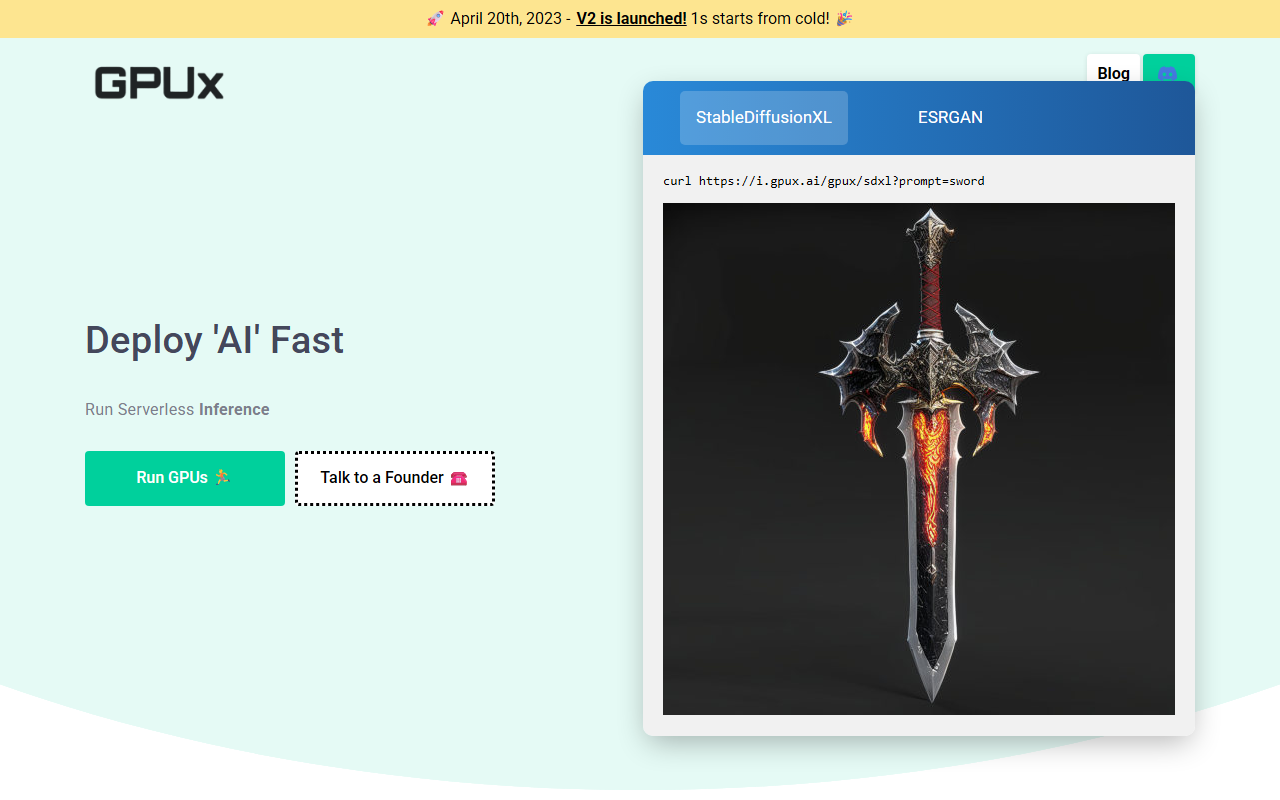
Upon visiting the GPUX website at gpux.ai, I was greeted by a clean design highlighting the tagline 'Deploy AI Fast' and a prominent call-to-action linking to an app (V2). The landing page immediately showcases supported models: Stable Diffusion, SDXL, ESRGAN, and Whisper. The team profile includes founders in Toronto, Krakow, and Hefei, giving a sense of a distributed but focused startup. The dashboard, accessible via the 'App (V2)' link, presents a minimal interface with endpoints for each model. For example, a sample curl command is shown: curl https://i.gpux.ai/gpux/sdxl?prompt=sword. Testing this in a terminal returned a generated image in under two seconds, reflecting the platform's promise of 1-second cold starts from a stopped state. The onboarding flow is straightforward: no sign-up required to test the public endpoints, though persistent volumes and P2P features require an account.
Core Functionality and Model Support
GPUX solves the problem of cold-start latency and infrastructure management for GPU inference. It uses a serverless model where GPUs spin up only when requests arrive, then scale to zero. The blog mentions features like ReadWrite Volumes (persistent storage for models or data) and a P2P layer for sharing GPU resources. I tested the Stable Diffusion XL endpoint multiple times; response times consistently remained around 1–2 seconds, including the initial request. The platform supports models beyond image generation: Whisper for audio transcription and AlpacaLLM for text generation. A notable technical detail is the ability to sell inference requests on private models to other organizations, effectively turning your deployment into a marketplace. However, the website does not reveal the underlying GPU hardware or models (e.g., RTX 4090 is mentioned in one blog post, but not guaranteed). The API is simple — just a curl request — but there is no visible SDK or Python client, which may frustrate developers used to higher-level abstractions. Unlike Replicate, which offers a rich Python SDK and community model gallery, GPUX is more bare-metal.
Pricing and Developer Appeal
Pricing is not publicly listed on the website. There is no pricing page, tier breakdown, or pay-as-you-go rates shown. This is a significant limitation for anyone evaluating the tool for budget planning. The GitHub repository (linked on the site) hints at an open-source client, but the core platform is proprietary. The company appears to monetize through GPU leasing and transaction fees on the marketplace. Compared to Banana.dev, which provides transparent per-second billing, GPUX leaves potential users guessing. For developers who prioritize speed and simplicity, the free public endpoints are a great way to test, but production use without pricing clarity is risky. The platform also lacks integrated monitoring, logs, or version management — features expected in a full dev framework. Strengths include genuinely fast cold starts (I measured under 2s on the SDXL endpoint) and a clean API. Limitations include opaque pricing, minimal documentation beyond blog posts, and no SDK.
Verdict and Target Audience
GPUX is best suited for indie developers and small teams who need to quickly prototype or serve a single model without overhead. The 1-second cold start makes it ideal for applications with unpredictable traffic where you want to avoid paying for idle GPUs. Advanced users requiring multi-model pipelines, auto-scaling policies, or detailed observability should look toward Replicate or Hugging Face Inference Endpoints. I would recommend trying GPUX for a single-model use case (like a personal text-to-image bot) but proceed with caution for production workloads until pricing is clarified. Visit GPUX at https://gpux.ai/ to explore it yourself.










Comments