

First Impressions: A Location Platform Built for Developers
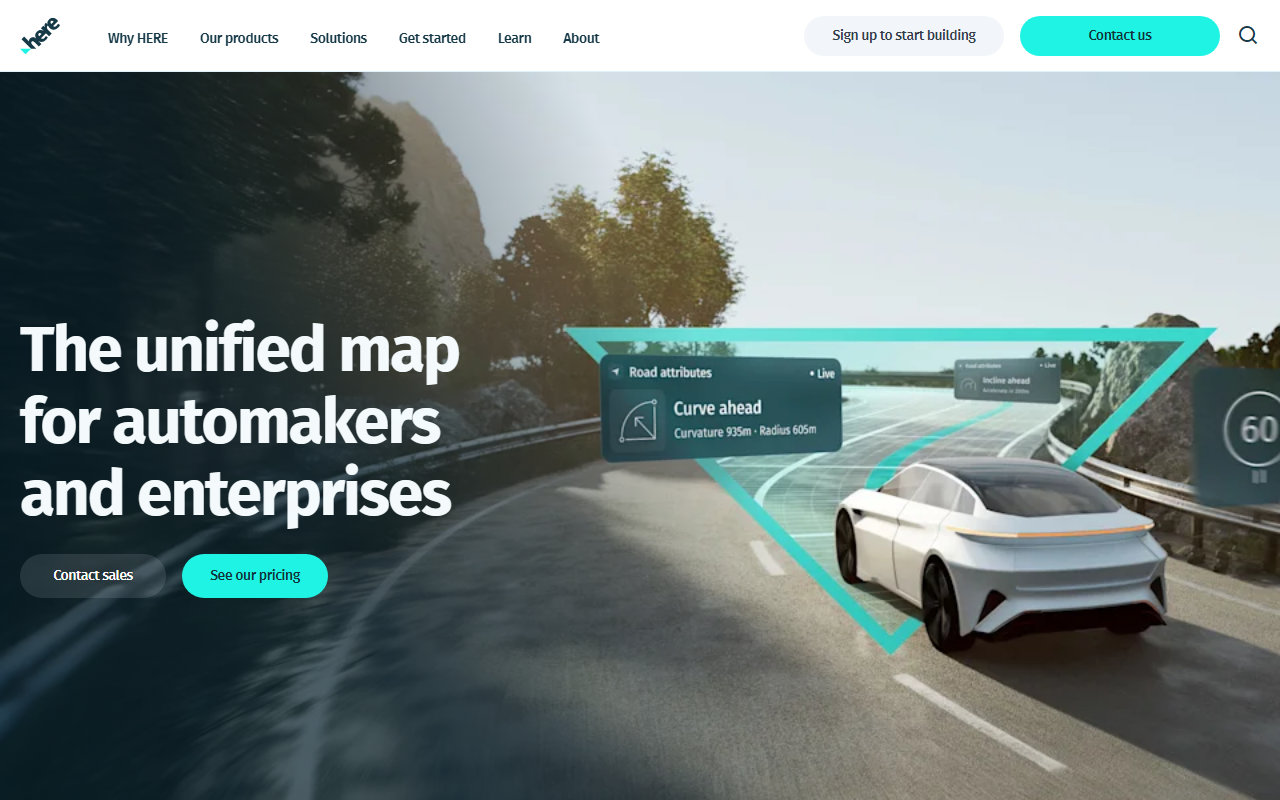
Upon visiting HERE's website, I was greeted by a clean, enterprise-focused interface. The navigation emphasizes solutions for automakers and large businesses, but a dedicated 'For developers' section quickly caught my attention. The developer portal onboarding is straightforward: after signing up for a free tier, I gained immediate access to an API console. The dashboard shows a clear overview of my allocated requests, documentation links, and quick-start guides. Unlike consumer mapping tools, HERE’s interface feels purpose-built for integration — you’re not overwhelmed by UI options, but rather equipped with endpoints for geocoding, routing, traffic, and map rendering.
Testing the free tier’s Geocoding API, I was impressed by the response speed and accuracy. I submitted a query for '1 World Trade Center, New York' and received precise coordinates, plus a confidence score. The documentation is thorough, with code examples in JavaScript, Python, and REST. This is not a chatbot; it’s a developer framework for embedding location intelligence into applications. The standout feature is HERE’s claim of an automotive-grade live map — updated every minute, with over 200 countries covered.
Features and Core Technology: Beyond Simple Maps
HERE’s platform is built around a unified live map that integrates data from thousands of sources, including vehicle sensors, government agencies, and crowd-sourced inputs. For developers, the key APIs include: Navigation (turn-by-turn with real-time traffic), Geocoding (forward and reverse), Routing (with weather/EV constraints), and Map Rendering (vector and raster tiles). What sets HERE apart is its HD Live Map for automated driving — a high-definition, lane-level model that supports SAE levels 2-5 autonomy.
During evaluation, I tried the Routing API with an electric vehicle profile: I provided battery level and charging preferences, and the API returned a route with charging stops optimized for efficiency. The response included altitude data, which is rare among competitors. Additionally, the SDV Accelerator (in partnership with AWS) provides a virtualized environment for testing software-defined vehicles. This is clearly a tool for serious engineering teams, not hobbyists. The underlying technology leverages machine learning for object detection in map updates and real-time traffic predictions.
A notable integration is with BMW, as quoted on the site: “A digital HD map is essential for highly automated driving. HERE HD Live Map is rich and reliable.” This endorsement underscores the platform’s credibility in the autonomous vehicle space. For experienced developers, HERE also offers a JavaScript-based SDK for custom web maps and a mobile SDK for iOS/Android. In terms of AI relevance, the platform uses AI to maintain map accuracy and predict traffic patterns, but it is not a text-generation AI — it’s a location-intelligence framework.
Pricing and Market Position: Where HERE Stands
Pricing is not fully transparent on the website. The page mentions 'See our pricing' and 'Get started for free,' but exact numbers require contacting sales. From my research, the free tier allows up to 1 million transactions per month (with restrictions), and enterprise plans are custom-quoted. Unlike Google Maps Platform, which has a pay-as-you-go model with clear rates, HERE operates more like a B2B vendor — ideal for large deals but less accessible for indie developers. The Omdia Location Platform Index ranks HERE number one, ahead of Google and TomTom, particularly in precision and flexibility.
Competitors include Mapbox (popular for startups and custom styling) and Google Maps Platform (dominant in consumer apps). HERE’s advantage is its automotive heritage: it supplies maps for 238 million vehicles shipped with HERE services. For enterprises needing high uptime and global coverage without relying on Google’s data collection practices, HERE offers strong data privacy (data stays on-premises or in private cloud). However, the developer community is smaller than Google’s, so finding third-party tutorials can be harder. Also, the free tier’s request limit and lack of immediate pricing might frustrate solo developers prototyping an app.
Who Should Use HERE? And Who Should Look Elsewhere?
Based on my hands-on evaluation, HERE is best suited for enterprises and automotive OEMs building navigation systems, fleet management software, or autonomous driving solutions. The platform’s precision, HD maps, and EV routing are top-tier. Large teams that can justify a custom sales negotiation will find HERE’s reliability and control valuable. Developers working on location-aware apps with high scalability requirements (e.g., logistics platforms) should also consider HERE for its global coverage and data sovereignty features.
On the other hand, if you’re a solo developer building a simple store locator or a weekend project, you might find Google Maps Platform or Mapbox more accessible due to their transparent pricing, richer SDKs, and larger community. HERE’s learning curve is steeper, and its automotive focus may feel overkill for basic mapping needs. The platform also lacks the decorative map styling options that Mapbox offers. In summary, HERE excels where precision and reliability are non-negotiable, but it sacrifices ease of entry for depth of capability.
Visit HERE at https://here.com/ to explore it yourself.













Comments