

First Impressions and Onboarding
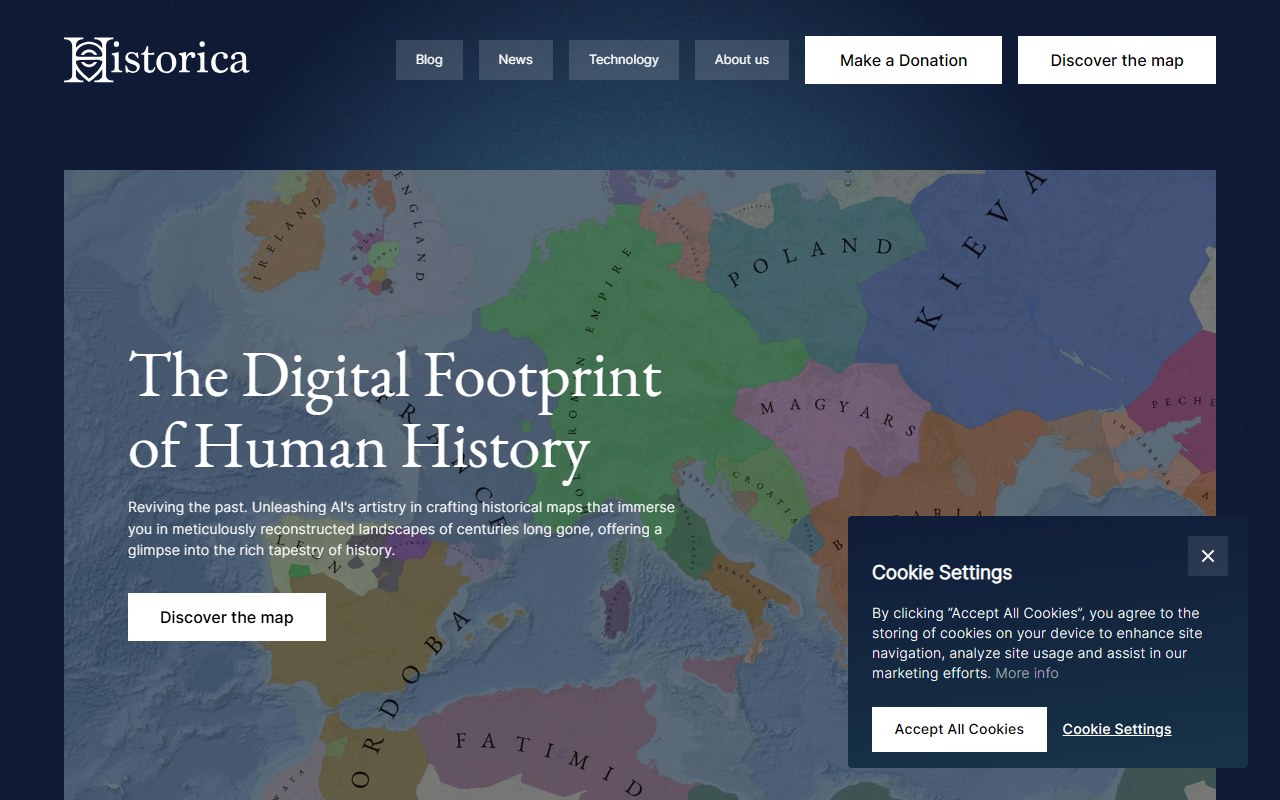
Upon visiting Historica.org, I was greeted by a clean, modern homepage that immediately emphasizes the project's mission: "The Digital Footprint of Human History." The hero section features a cryptic map visualization and a call-to-action labeled "Discover the map." Clicking it leads into what appears to be an interactive timeline spanning from year 1 to 2025, built with AI-driven data. The cookie preference popup appeared first, but after dismissing it, the site loaded quickly. The dashboard shows a world map with adjustable century sliders and clickable regions that reveal historical borders, cities, and events. I tested the free tier by browsing the map for 500 CE—the AI rendered a plausible reconstruction of European tribal territories, though some border lines were fuzzy. The onboarding is minimal; there is no tutorial, so I had to explore by trial. The experience feels more like a research prototype than a polished consumer product.
AI-Powered Historical Mapping: Capabilities and Technology
Historica’s core offering is an AI system that models historical processes and maps the evolution of state borders, as described in their blog. The technology appears to combine place name clustering, historical data, and AI verification—not just image generation. A blog post from April 2025 explains they moved away from generative image methods toward a logic-based model that gives historians more control. This is a notable technical differentiator. The map covers roughly 2,000 years with adjustable precision. I zoomed into 11th-century East Asia; the AI outlined the Song dynasty’s borders with reasonable accuracy for a model, though some disputed territories were ambiguous. The tool also includes a Map Builder, currently in closed beta for researchers, that allows custom mapping with editable borders and timelines. A recent news item notes the team presented this AI map at the University of Cambridge, lending academic credibility. However, the AI models or underlying architecture are not explicitly named on the site.
Pricing, Limitations, and Market Position
Pricing is not publicly listed on the website. The only financial element is a donation button with the note: "Your support enables us to pursue our mission of bringing the world’s history to life through technology and open access." This suggests Historica operates on a donation or grant-funded model, at least for now. There is no mention of a paid subscription or API access. A significant limitation is that the Map Builder is restricted to a closed beta for researchers—ordinary users cannot yet create custom maps. Additionally, the interface lacks mobile optimization; on my phone, the map was slow and hard to navigate. Compared to alternatives like the World History Encyclopedia (free, text-focused) or TimeMapper (open-source timeline tool), Historica focuses narrowly on AI-generated historical cartography. It stands out for its ambition but trails in usability and content breadth.
Who Should Use Historica?
Historica is best suited for history enthusiasts, educators, and researchers who want a visual, AI-assisted way to explore border changes over centuries. The tool is particularly compelling for those studying medieval or early modern territorial shifts. I would caution casual users that the experience is still rough around the edges—missing labels, occasional inaccuracies, and a steep learning curve. The closed beta Map Builder is promising but not yet widely available. If the team opens access and refines accuracy, Historica could become a go-to resource. For now, try it if you enjoy experimental historical tools and are willing to donate; otherwise, complement it with established reference sites. Visit Historica at https://historica.org/ to explore it yourself.










Comments